The deep ocean is a realm of secrets, where creatures of myth and mystery dwell in the crushing darkness. Sometimes, these secrets are not found in the depths themselves, but in the archives of human history, waiting for a curious eye to uncover them. A specimen collected from the stomach of a sperm whale during an Antarctic whaling expedition in the mid-1950s has recently revealed itself as more than just a curiosity. It is the sole representative of an entirely new family of squid, Mobydickidae, named after the legendary white whale. This discovery invites reflection on the hidden knowledge stored in museum collections and the enduring mysteries of the marine world. It is a moment where the past speaks to the present, revealing a lineage unknown to science for decades.
The specimen, now identified as Mobydickia poseidonii, was originally cataloged but never fully analyzed for its taxonomic significance. For nearly seventy years, it sat in a collection, a silent witness to the vastness of the ocean’s unexplored biodiversity. Silence holds stories. Time reveals truth.
Researchers using modern genetic and morphological techniques realized that this squid did not fit into any known family. Its unique features, including distinct arm structures and tissue composition, pointed to a separate evolutionary branch that had diverged millions of years ago. Difference defines identity. Evolution branches widely.
The name Mobydickidae pays homage to the sperm whale, the natural predator of deep-sea squids, and Herman Melville’s classic novel. It symbolizes the eternal struggle between hunter and hunted in the deep sea. Literature meets biology. Myth mirrors nature.
This finding highlights the importance of preserving biological specimens, even those that seem mundane at first glance. Museum collections serve as libraries of life, holding data that future technologies can unlock. Preservation enables discovery. Archives hold keys.
For marine biologists, the discovery of a new family is a rare and exciting event, reminding us that much of the ocean remains uncharted. It underscores the need for continued exploration and conservation of marine ecosystems. Ocean hides wonders. Exploration reveals them.
A squid specimen from a 1955 Antarctic whaling expedition has been identified as a new species and family, Mobydickia poseidonii. The discovery highlights the value of historical collections in understanding marine biodiversity. The hope is for further research into this unique lineage and its role in the deep-sea ecosystem.
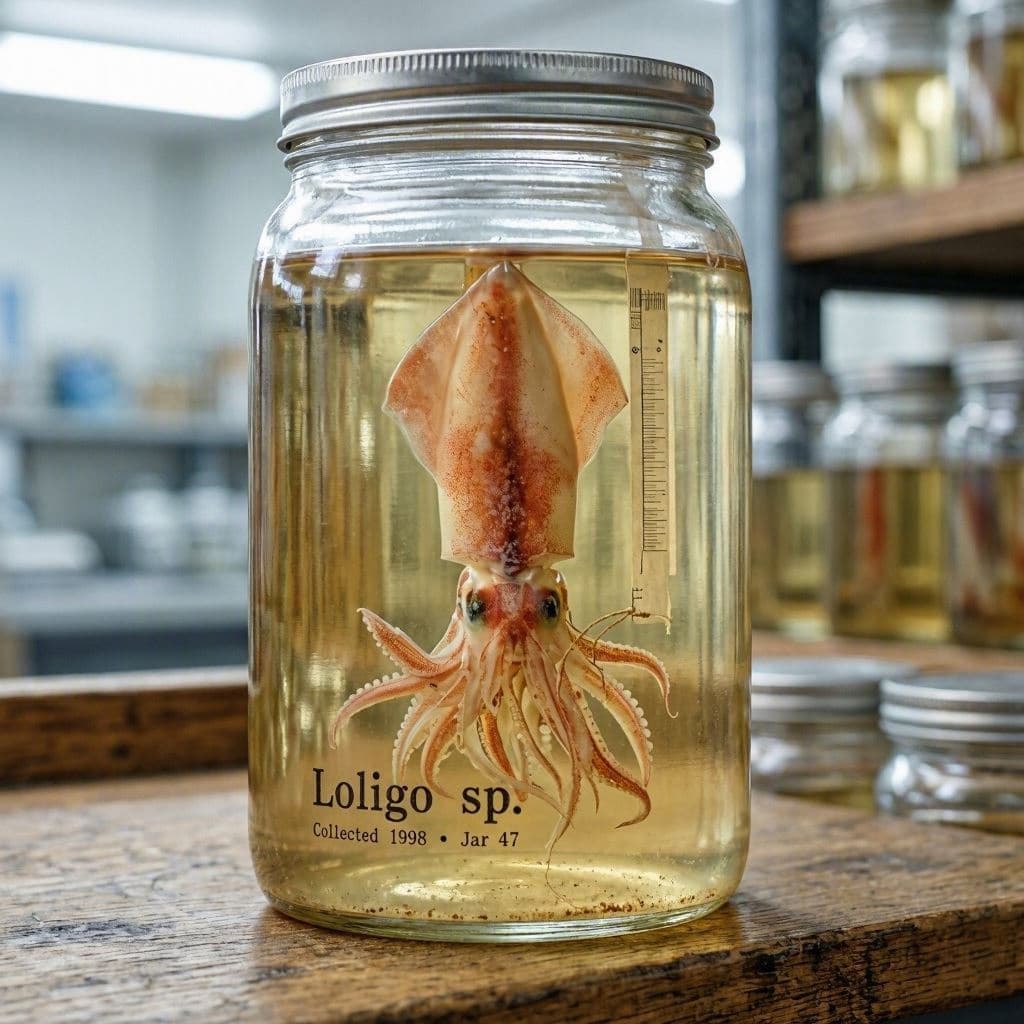
AI Image Disclaimer: The visual elements accompanying this report are AI-generated interpretations designed to reflect the scientific and marine context of the story.
Sources: MarineBio.org ScienceAlert The Conversation National Geographic
Published by Banx Network. This article is part of the Banx decentralized media programme, powered by the BXE token on the XRP Ledger.