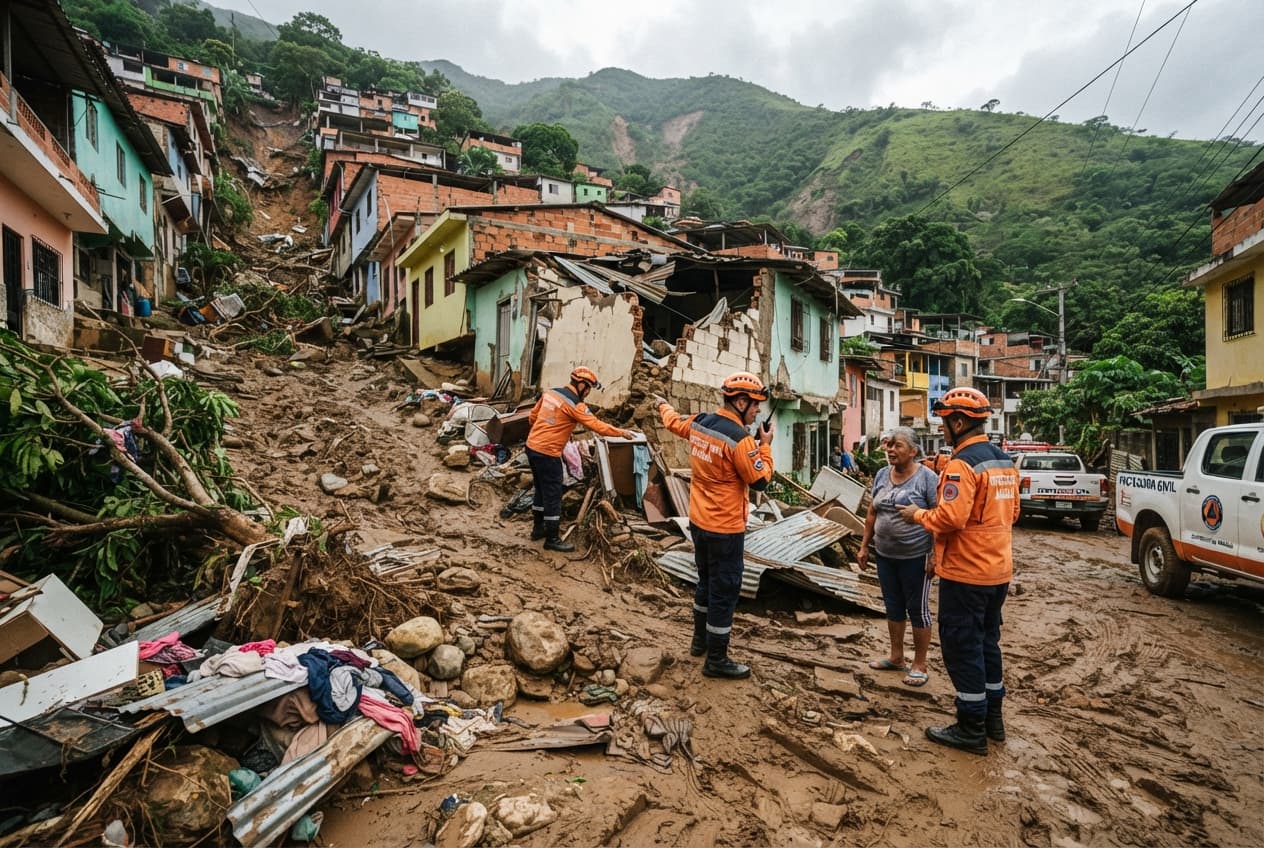
Maracay, Venezuela—Unchecked torrents of water rushed down the steep slopes of Henri Pittier National Park during the early morning hours, catching hillside communities completely off guard. Civil protection authorities confirmed that three residents lost their lives when mud-heavy flash floods battered several residential blocks in Aragua State. Persistent precipitation over preceding days saturated the mountain soils past their breaking point, turning dry ravines into violent rivers. Emergency units deployed before dawn, navigating blocked thoroughfares and fallen electrical lines to reach the stricken zone.
The sudden surge of water and debris tore foundations away from multiple modest homes, depositing heavy sediment across neighborhood streets. Residents woke to the deep roar of sliding earth moments before muddy torrents breached perimeter walls. First responders utilized manual shovels and ropes to extract trapped individuals from half-submerged structures. Relatives gathered near the police cordons, watching anxiously as rescue squads probed the dense muck with iron poles.
Regional civil protection directors noted that informal settlements constructed along natural drainage channels face extreme risks during seasonal weather extremes. Repeated municipal warnings regarding vulnerable slope conditions went unaddressed due to administrative delays and budget shortfalls. The absence of proper retaining walls and channel dredging left the entire residential sector exposed to catastrophic failure. Those systemic oversight failures directly exacerbated the scale of the disaster.
State disaster coordinator Commander Edgardo Silva addressed reporters near the forward command post. The sheer volume of water cascading from the mountain ridge overwhelmed local containment capacity within minutes, Silva stated. Every available rescue unit is currently deployed to search unstable debris fields and secure the perimeter. We cannot guarantee structural integrity for any buildings remaining inside the evacuation zone.
Medical field stations established near the incident perimeter treated several survivors for acute shock, lacerations, and hypothermia. Local clinics reported shortages of trauma provisions as injured individuals arrived from isolated mountain neighborhoods. Heavy cloud cover hindered military helicopter support, forcing rescue teams to rely on ground transport. Communication networks across the valley remained partially disabled, forcing personnel to utilize satellite radios.
Engineers began surveying the upper ridge line to determine whether additional slope stabilization measures are feasible before predicted nighttime rainfall begins. Heavy excavators pushed mud away from blocked roadway culverts to prevent secondary pooling behind the debris field. Families displaced by the disaster face indefinite shelter placement as municipal authorities evaluate safer relocation options. Search units maintain a continuous presence along the riverbanks as recovery efforts extend into the night.
Published by Banx Network. This article is part of the Banx decentralized media programme, powered by the BXE token on the XRP Ledger.