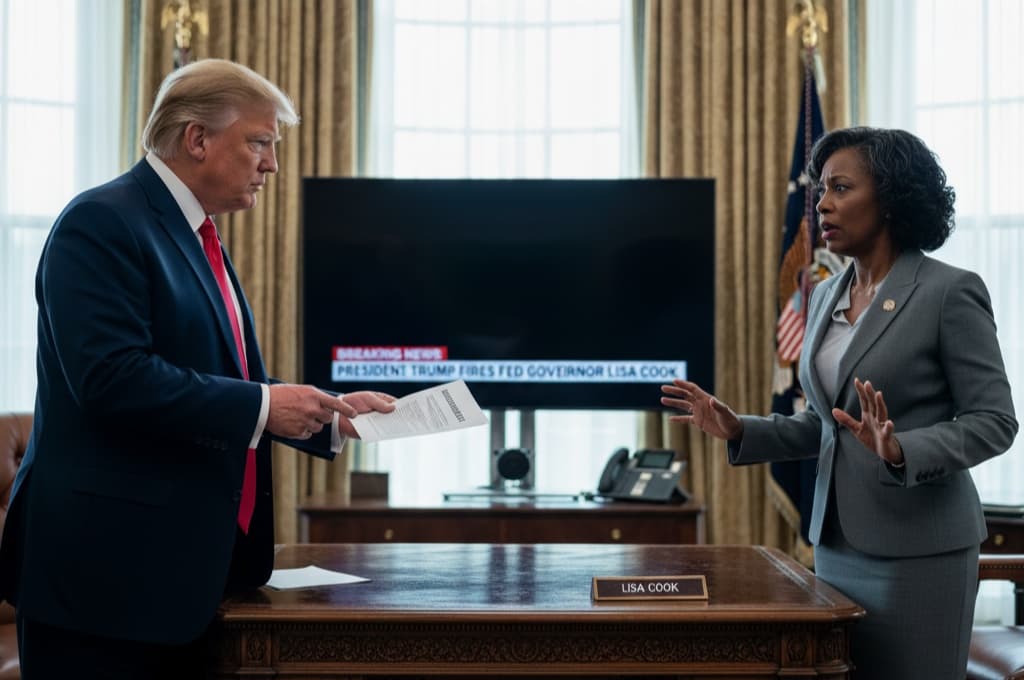
The legal clash between President Donald Trump and the Federal Reserve took another dramatic turn this week after the U.S. Court of Appeals for the D.C. Circuit upheld a lower court decision preventing Trump from removing Federal Reserve Governor Lisa D. Cook.
The ruling marks not only a legal setback for the White House but also a precedent-setting moment in the balance of power between the presidency and America’s most important financial institution. At its heart lies a fundamental question: how independent is the Federal Reserve, and to what extent can the president intervene in its governance?
The Case Against Cook
Trump had sought to remove Governor Cook, alleging that she engaged in mortgage fraud in 2021 by claiming two homes as primary residences. The allegations surfaced after Cook’s appointment by President Joe Biden in 2022, when she became the first Black woman to serve on the Federal Reserve’s Board of Governors. Cook has strongly denied any wrongdoing, calling the allegations politically motivated.
Critics note that the timing of the allegations and Trump’s aggressive move to oust Cook—without presenting her with formal charges or an opportunity to defend herself—raises red flags about the true motives behind the effort.
The Legal Framework
Unlike cabinet officials who serve at the pleasure of the president, Federal Reserve governors are shielded by statutory protections under the Federal Reserve Act. Governors are appointed for staggered 14-year terms and may only be removed “for cause.” That requirement, legal scholars argue, was designed to preserve the central bank’s independence from partisan politics.
The U.S. District Court judge who first issued a preliminary injunction against Trump emphasized that the alleged misconduct occurred before Cook’s appointment to the Fed. Because the law explicitly restricts removals to misconduct committed during service, the court found the White House’s attempt legally dubious. Appeals Court Ruling
In a 2-1 decision, the appeals court upheld the lower court’s ruling. Judges Bradley Garcia and Michelle Childs stressed that Cook had not been afforded due process—no formal notice of charges, no hearing, and no chance to respond. Such procedural failures, they wrote, “strike at the core of constitutional fairness.”
Judge Gregory Katsas, a Trump appointee, dissented. Katsas argued that the president holds broad constitutional authority to remove executive officers and that limiting this power risks undermining accountability. Still, the majority opinion carried the day, leaving Cook in her position—for now. Political Shockwaves
The ruling has ignited fierce political debate. Trump allies insist that the decision represents judicial overreach and strips the president of legitimate authority to ensure integrity in federal institutions. Supporters of Cook, however, argue that the court safeguarded a cornerstone of American democracy: the independence of the central bank.
Democrats quickly rallied around Cook, framing the case as an attack not only on her personally but on institutional safeguards. Progressive lawmakers noted that Trump’s move seemed designed less to enforce ethics and more to reshape the Fed into a political arm of the White House.
Republicans, meanwhile, remain divided. Some echo Trump’s frustrations, viewing Cook’s appointment under Biden as emblematic of political patronage. Others, including free-market conservatives, express discomfort at undermining the Fed’s independence, which they see as vital to investor confidence and economic stability.
Broader Implications for the Fed
Beyond the courtroom drama, the case reverberates through global financial markets. The Federal Reserve is widely seen as the most powerful central bank in the world. Its credibility depends on independence—on the belief that decisions about interest rates, liquidity, and monetary policy are insulated from partisan pressure.
If presidents could remove governors at will, investors fear that monetary policy could become a political tool, manipulated to secure electoral advantage rather than stabilize the economy. Such a shift could erode trust in U.S. markets, weaken the dollar, and trigger volatility in global capital flows.
The ruling, therefore, is about more than one governor. It is about whether the Fed remains the impartial referee of the economy—or becomes another player on the political field.
Historical Context
The battle echoes past clashes over central bank independence. Franklin Roosevelt famously expanded the Fed’s role during the Great Depression, sparking debates about executive overreach. Richard Nixon pressured then-Fed Chair Arthur Burns to keep rates low ahead of the 1972 election, a decision many historians blame for fueling runaway inflation in the 1970s.
More recently, Trump himself repeatedly attacked Fed Chair Jerome Powell during his first term, demanding lower interest rates to fuel growth. Powell resisted, defending the Fed’s autonomy. The Cook case, however, represents something new: an attempt to directly remove a sitting governor, something virtually unheard of in modern American history.What Comes Next?
The ruling does not close the matter entirely. Trump could appeal to the Supreme Court, where the balance of power tilts more favorably toward his appointees. Should the Court take up the case, it could redefine the boundaries of presidential authority over independent agencies.
For now, Cook remains on the Board, where she will continue to help shape monetary policy alongside Powell and other governors. Her presence ensures that the Biden administration’s imprint on the Fed endures, despite Trump’s efforts to reshape it.
Markets, meanwhile, are watching closely. Investors crave stability, and uncertainty about the Fed’s leadership only adds to existing anxieties over inflation, interest rates, and the global economy. Conclusion
The attempt to remove Lisa Cook is more than a personnel dispute. It is a proxy war over the future of the Federal Reserve and the balance of power in American governance. The appeals court ruling sends a clear message: independence matters, due process matters, and presidents—no matter how powerful—cannot simply bend institutions to their will. Whether this episode fades as a political skirmish or becomes a defining constitutional showdown will depend on the next steps from the White House and the courts. But one thing is certain: the fight over Lisa Cook has opened a new chapter in the long, contentious story of America’s central bank.
Published by Banx Network. This article is part of the Banx decentralized media programme, powered by the BXE token on the XRP Ledger.