
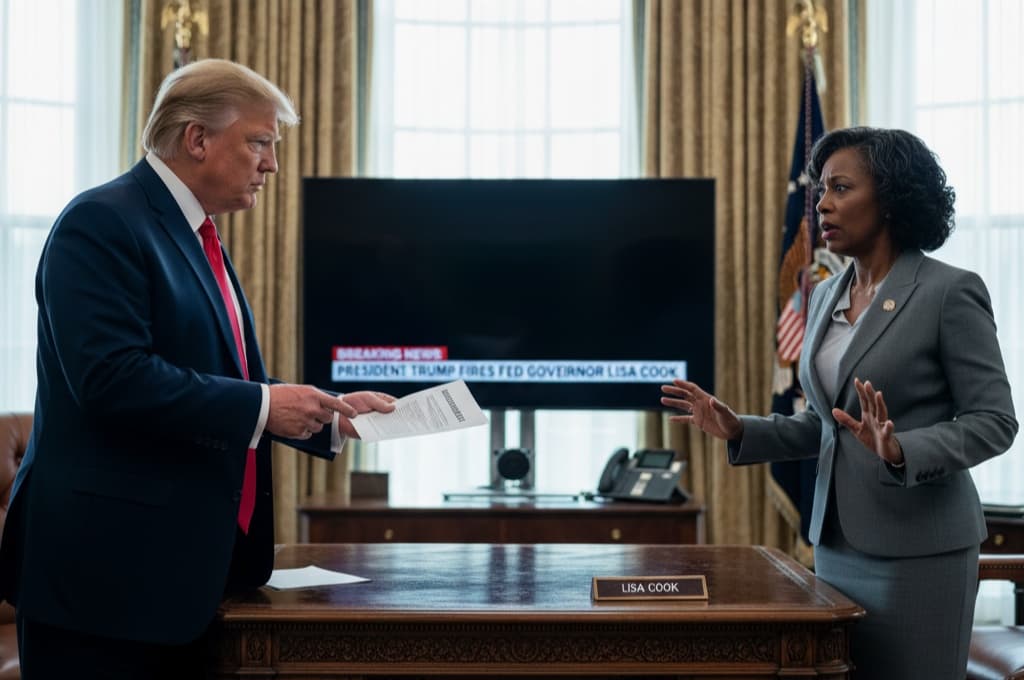
Key Highlights
- Appeals Court Decision:The D.C. Circuit Court upheld a ruling preventing Trump from removing Fed Governor Lisa Cook.
- Legal Precedent:The case raises questions about the independence of the Federal Reserve and presidential authority.
- Political Reactions:The ruling has sparked intense debate among lawmakers and political analysts.
The legal clash between President Donald Trump and the Federal Reserve took another dramatic turn this week after the U.S. Court of Appeals for the D.C. Circuit upheld a lower court decision preventing Trump from removing Federal Reserve Governor Lisa D. Cook. This ruling marks a significant legal setback for the White House and sets a precedent regarding the balance of power between the presidency and America’s most important financial institution. At its heart lies a fundamental question: how independent is the Federal Reserve, and to what extent can the president intervene in its governance?
Trump had sought to remove Governor Cook, alleging that she engaged in mortgage fraud in 2021 by claiming two homes as primary residences. These allegations surfaced after Cook’s appointment by President Joe Biden in 2022, when she became the first Black woman to serve on the Federal Reserve’s Board of Governors. Cook has strongly denied any wrongdoing, asserting that the allegations are politically motivated. Critics note that the timing of the allegations and Trump’s aggressive move to oust Cook—without presenting her with formal charges or an opportunity to defend herself—raises red flags about the true motives behind the effort.
Unlike cabinet officials who serve at the pleasure of the president, Federal Reserve governors are shielded by statutory protections under the Federal Reserve Act. Governors are appointed for staggered 14-year terms and may only be removed “for cause.” Legal scholars argue that this requirement was designed to preserve the central bank’s independence from partisan politics. The U.S. District Court judge who first issued a preliminary injunction against Trump emphasized that the alleged misconduct occurred before Cook’s appointment to the Fed. Because the law explicitly restricts removals to misconduct committed during service, the court found the White House’s attempt legally dubious.
In a 2-1 decision, the appeals court upheld the lower court’s ruling. Judges Bradley Garcia and Michelle Childs stressed that Cook had not been afforded due process—no formal notice of charges, no hearing, and no chance to respond. Such procedural failures, they wrote, “strike at the core of constitutional fairness.” Judge Gregory Katsas, a Trump appointee, dissented, arguing that the president holds broad constitutional authority to remove executive officers and that limiting this power risks undermining accountability. Still, the majority opinion prevailed, leaving Cook in her position—for now.
The ruling has ignited fierce political debate. Trump allies insist that the decision represents judicial overreach and strips the president of legitimate authority to ensure integrity in federal institutions. Supporters of Cook, however, argue that the court safeguarded a cornerstone of American democracy: the independence of the central bank. Democrats quickly rallied around Cook, framing the case as an attack not only on her personally but on institutional safeguards. Progressive lawmakers noted that Trump’s move seemed designed less to enforce ethics and more to reshape the Fed into a political arm of the White House.
Republicans remain divided. Some echo Trump’s frustrations, viewing Cook’s appointment under Biden as emblematic of political patronage. Others, including free-market conservatives, express discomfort at undermining the Fed’s independence, which they see as vital to investor confidence and economic stability. Beyond the courtroom drama, the case reverberates through global financial markets. The Federal Reserve is widely seen as the most powerful central bank in the world, and its credibility depends on independence—on the belief that decisions about interest rates, liquidity, and monetary policy are insulated from partisan pressure.
If presidents could remove governors at will, investors fear that monetary policy could become a political tool, manipulated to secure electoral advantage rather than stabilize the economy. Such a shift could erode trust in U.S. markets, weaken the dollar, and trigger volatility in global capital flows. The ruling, therefore, is about more than one governor. It is about whether the Fed remains the impartial referee of the economy—or becomes another player on the political field.
Historical Context
The battle echoes past clashes over the independence of the Federal Reserve, highlighting the ongoing tension between political influence and the need for a stable economic framework. As the legal proceedings continue, the implications of this case will likely resonate throughout the financial landscape and beyond, shaping the future of the Federal Reserve and its role in American governance.
Published by Banx Network. This article is part of the Banx decentralized media programme, powered by the BXE token on the XRP Ledger.



