Medellín, Colombia—A catastrophic landslide tore through a remote rural settlement in the Antioquia department early Sunday morning, leaving at least six residents dead, eight missing, and multiple homes buried beneath hundreds of tons of liquid mud and uprooted forestry. Emergency dispatchers received the first distress transmissions shortly before sunrise as unstable hillside soil gave way following forty-eight hours of uninterrupted, high-volume torrential downpours across the mountainous region. Emergency teams deployed to the site face severely degraded access routes and compounding earth movements that threaten to suspend ongoing recovery operations.
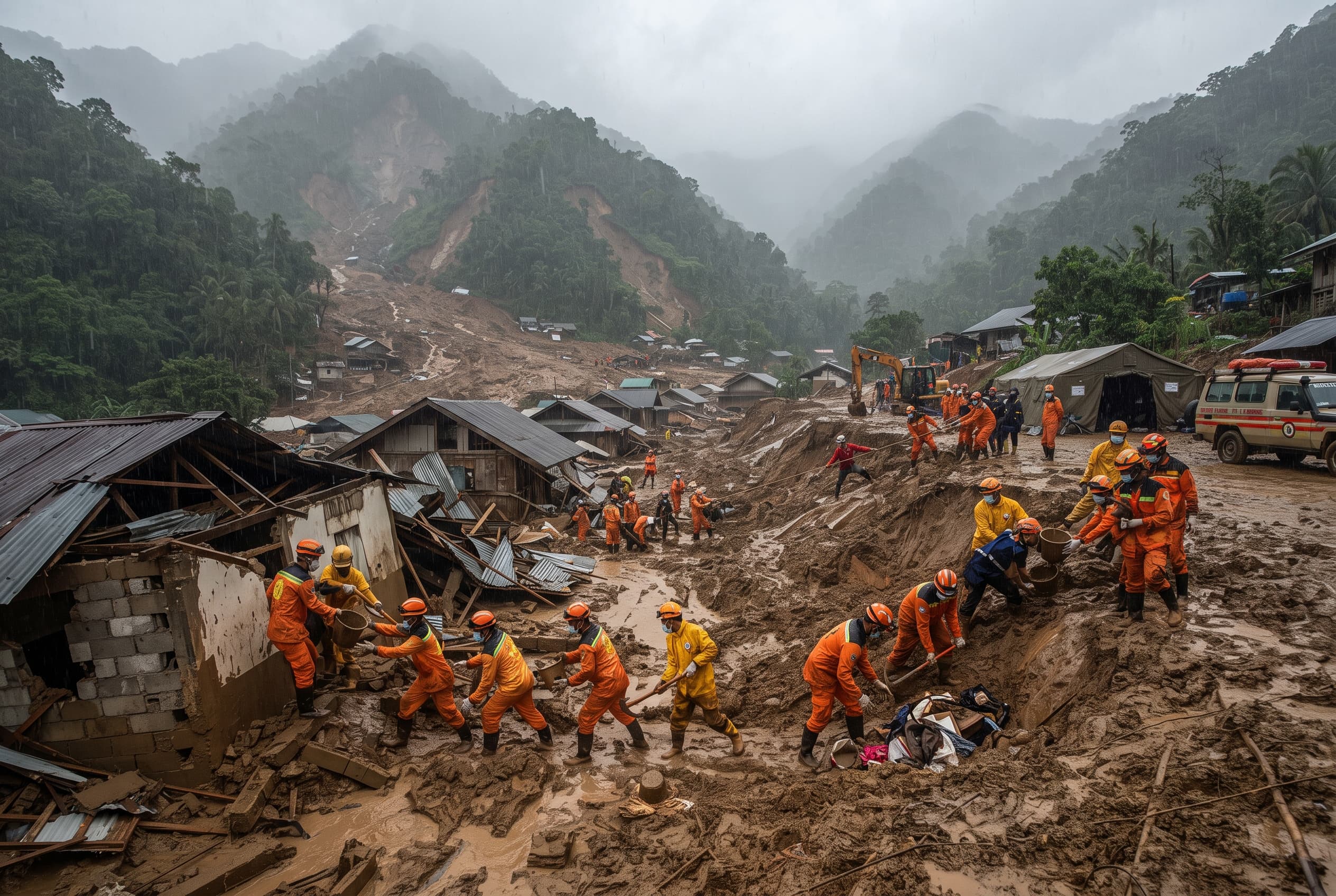
Heavy excavation machinery remains stranded miles from the primary impact zone due to secondary mudslides blocking access infrastructure along regional transit arteries. Local rescue operations depend almost entirely on manual labor, with search crews, local civil defense personnel, and surviving community members utilizing shovels and bare hands to sift through saturated soil and splintered structural debris. Preliminary structural damage assessments confirm that at least twelve residential dwellings suffered complete physical destruction when the hillside collapsed into the valley floor.
Regional disaster risk management authorities established an emergency command post on the perimeter of the slide area to coordinate logistical support and heavy equipment deployment. Medical responders cleared three survivors from the mud layer during early search attempts, transferring them to municipal hospital units for severe trauma treatment and hypothermia stabilization. High-altitude cloud cover and continuous rainfall have prevented aerial reconnaissance teams from conducting low-altitude grid mapping or deploying heavy lifting equipment via airlift.
"The mud layer exceeds four meters in depth across the primary residential quadrant," stated a regional Civil Defense responder at the perimeter base. "Ground stability remains critically low, and active soil movement along the upper ridge presents an immediate hazard to extraction teams working inside the debris field."
Geological surveys conducted along the perimeter indicate that thousands of cubic meters of unstable clay and surface soil remain suspended on the upper embankment directly above the search zone. Local municipal officials issued immediate mandatory evacuation orders for forty adjacent homesteads situated along the lower drainage basin as water levels in nearby tributaries continue to rise rapidly. Temporary emergency shelters were established in municipal sport facilities several kilometers from the active slide zone to accommodate displaced families.
The ministry of transport confirmed that secondary access roads leading into the rural subregion remain obstructed by falling rock and mud accumulation, severely restricting civilian movement and logistical supply chains. Emergency utility crews severed high-voltage power lines running across the disaster zone to eliminate electrocution risks for ground crews operating in standing water and deep mud deposits. Water distribution systems servicing adjacent hamlets sustained major physical damage, forcing local government units to deploy mobile tanker trucks to provide potable water to displaced populations.
Rescue operations are proceeding under extreme operational constraints as nightfall approaches and ambient weather conditions show no immediate signs of stabilization. Field commanders confirmed that search teams will continue ground probing operations using thermal detection units and trained search-and-rescue canine teams as long as hillside stability holds. Community members gathered at the police cordon line continue assisting authorities by supplying topographical information regarding the locations of buried residential foundations.
Search efforts remain concentrated on the central collapse zone where eyewitness accounts place the majority of the unlocated residents at the moment of the initial slope movement. Municipal health authorities have mobilized specialized psychological support teams to assist surviving relatives gathered at temporary processing centers established near the site. Disaster response units continue to monitor upper ridge lines using laser movement sensors to provide early warning detonations if secondary earth shifts occur.
The operation remains an active search and rescue mission as emergency personnel continue manual extraction efforts through deep mud and structural remnants. Official casualty counts remain preliminary while heavy equipment operators work to clear primary access roads to bring specialized hydraulic cutters and excavation machinery into the center of the affected settlement.
Published by Banx Network. This article is part of the Banx decentralized media programme, powered by the BXE token on the XRP Ledger.