
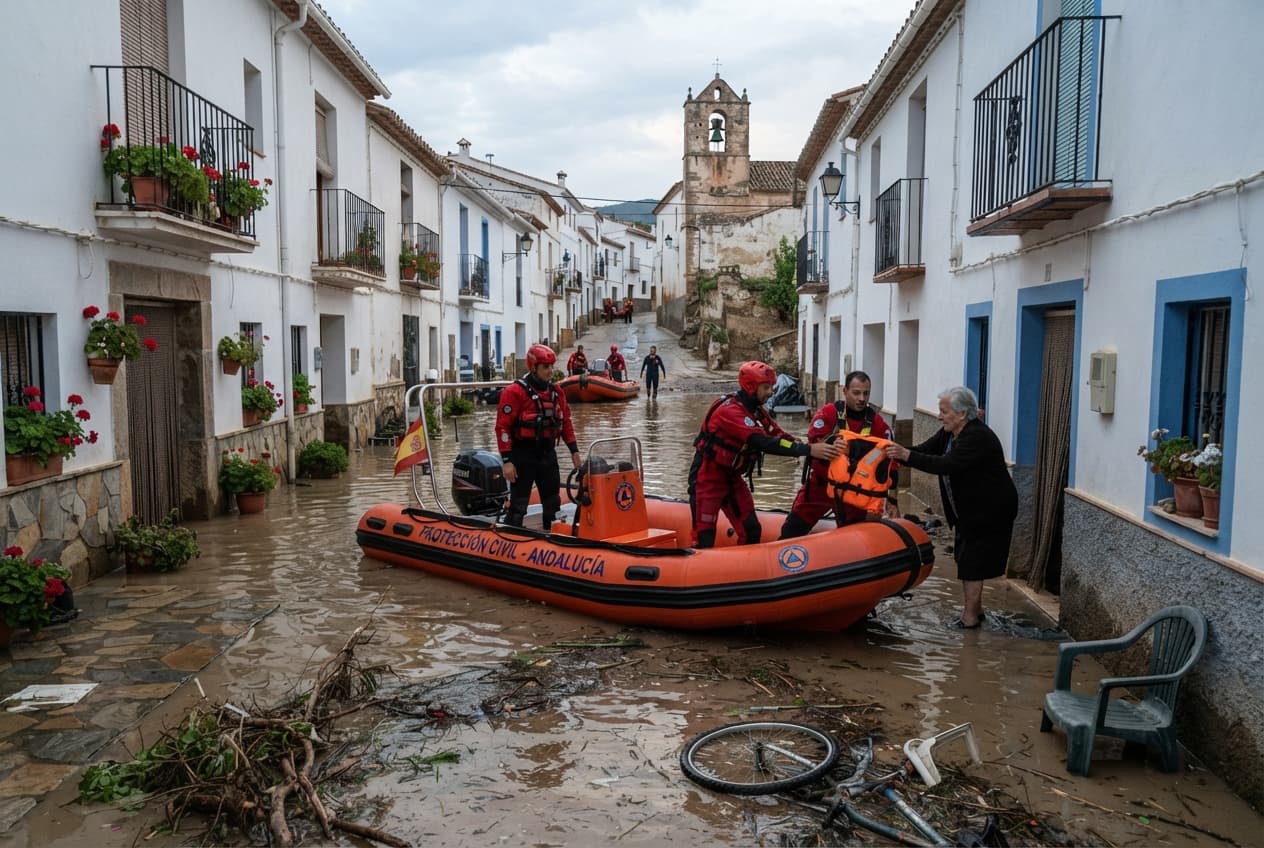
Málaga, Spain—Violent flash floods tore through coastal villages across southern Spain, inundating residential zones and leaving two local residents dead in the wake of torrential downpours. Emergency services registered hundreds of distress calls as swollen riverbeds breached their banks without warning. Local authorities issued urgent evacuation directives for low-lying settlements throughout the region.
Continuous overnight rainfall saturated regional watersheds past their critical absorption thresholds. Water levels in several major Andalusian river basins surged to historic highs, submerging agricultural fields and rural access roads. Fast-moving currents dragged vehicles off roadways and smashed through ground-floor residential properties.
Rescue squads deployed amphibious vehicles and specialized helicopters to reach stranded residents trapped on rooftops. Civil protection personnel evacuated hundreds of families from homes threatened by rising mud and debris. Municipal emergency command centers reported total disruption to local electrical grids and telecommunication lines.
"Continuous rainfall saturated the mountain soils past their breaking point, causing this sudden and destructive debris flow," said a regional civil defense coordinator at the site. "Our excavators are working around the clock to clear the roadway, but the terrain remains highly unstable."
Transport ministries suspended high-speed rail connections and closed multiple regional highways blocked by landslides. Emergency crews faced severe obstacles reaching isolated mountain hamlets due to collapsed bridge infrastructure. Regional hospitals activated mass-casualty protocols to receive injured individuals rescued from the flood zone.
Meteorological agencies maintained red-level weather alerts across multiple Andalusian provinces as storm cells lingered overhead. Local mayors urged residents to remain indoors and avoid unnecessary travel until weather conditions stabilized. Municipal shelters filled rapidly with displaced families evacuated from vulnerable riverfront communities.
State rescue coordinators confirmed that search operations would continue through the night using thermal-imaging equipment. Municipal authorities began organizing emergency supply distribution points for communities cut off by damaged infrastructure. Public works teams mobilized heavy machinery to clear mud from urban centers.
Insurance adjusters established temporary staging areas to begin assessing structural damage to residential and commercial properties. Environmental officials monitored dam capacity levels to prevent secondary structural failures from overflowing reservoirs.
The immediate danger persists as rain bands continue hammering saturated slopes across the southern coast.
Published by Banx Network. This article is part of the Banx decentralized media programme, powered by the BXE token on the XRP Ledger.


.jpg&w=3840&q=75 "Armed Cattle Rustling Attack: Samburu Raid Leaves Four Dead and Two Injured")