
Key Highlights
- First Reading:Researchers have read an ancient Herculaneum scroll end-to-end for the first time in nearly 2,000 years.
- Advanced Techniques:High-resolution X-ray imaging and AI were used to recover the text from a carbonized papyrus.
- Philosophical Insights:The scroll contains a philosophical treatise on ethics, linked to Stoicism and named Aristocreon.
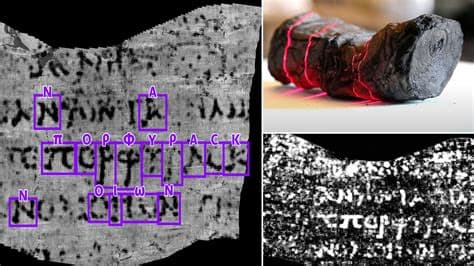
Researchers have achieved a groundbreaking milestone by successfully reading an ancient Herculaneum scroll, known as PHerc. 1667, for the first time in nearly 2,000 years. This remarkable feat was accomplished using advanced high-resolution X-ray imaging and artificial intelligence, which allowed scholars to recover the text from a sealed carbonized papyrus that had survived the catastrophic eruption of Mount Vesuvius in A.D. 79.
The scroll, often referred to as Scroll 4 in the Vesuvius Challenge, was preserved in a fragile carbon block due to the intense heat of the eruption. Unfortunately, this preservation method rendered the scroll too brittle to physically open. Previous attempts to unroll or manipulate similar scrolls had resulted in damage or destruction, leaving researchers with only partial fragments and isolated readable sections. Thus, the innovative approach taken by the research team marks a significant advancement in the field of papyrology.
Instead of attempting to physically open the scroll, the team utilized detailed 3D imaging techniques at facilities such as the European Synchrotron Radiation Facility. They reconstructed the rolled pages digitally and trained AI models to detect faint ink impressions hidden within the carbonized material. Following this, papyrologists meticulously reviewed the AI-generated readings column by column, ultimately producing a continuous Greek transcription of the surviving text.
The preserved portion of the scroll measures nearly 5 feet (approximately 1.5 meters) of continuous writing across roughly 20 columns. The recovered text appears to be a philosophical treatise on ethics, closely associated with Stoicism. Notably, the scroll’s final preserved column mentions Aristocreon, who is identified as the nephew and student of the Stoic philosopher Chrysippus. This connection helps place the manuscript within a Stoic context and suggests an early date relative to the Herculaneum library, which was known to house works of significant philosophical importance.
This project is part of the broader Vesuvius Challenge, which aims to scale the technique of “virtual unwrapping” to enable the reading of many other sealed scrolls—hundreds of which remain intact but unreadable due to their fragile condition. In addition to PHerc. 1667, the research team has reported progress on other scrolls, including improvements in ink visibility and the identification of previously unknown text elements. These advancements demonstrate that the methods developed are effective beyond a single manuscript, paving the way for further discoveries in the field of ancient texts.
The successful reading of the Herculaneum scroll not only enriches our understanding of ancient philosophical thought but also showcases the potential of modern technology in unraveling the mysteries of the past. As researchers continue to refine these techniques, the hope is to unlock the secrets of many more ancient texts that have remained silent for centuries.
Published by Banx Network. This article is part of the Banx decentralized media programme, powered by the BXE token on the XRP Ledger.



