For more than two centuries, a letter connected to Napoleon Bonaparte carried information that could be seen but not understood. Its pages contained an old cipher whose key had disappeared with time. Now, an AI engineer says he has reconstructed the message using a modern language model and computational techniques, giving historians a new reading of a document written in 1809.
The letter was intended for General Auguste de Marmont, one of Napoleon’s senior commanders. According to Carter Church, the engineer who undertook the work, Napoleon instructed his stepson Eugène to send Marmont a coded briefing concerning the disposition of French and allied forces as Austria prepared for war.
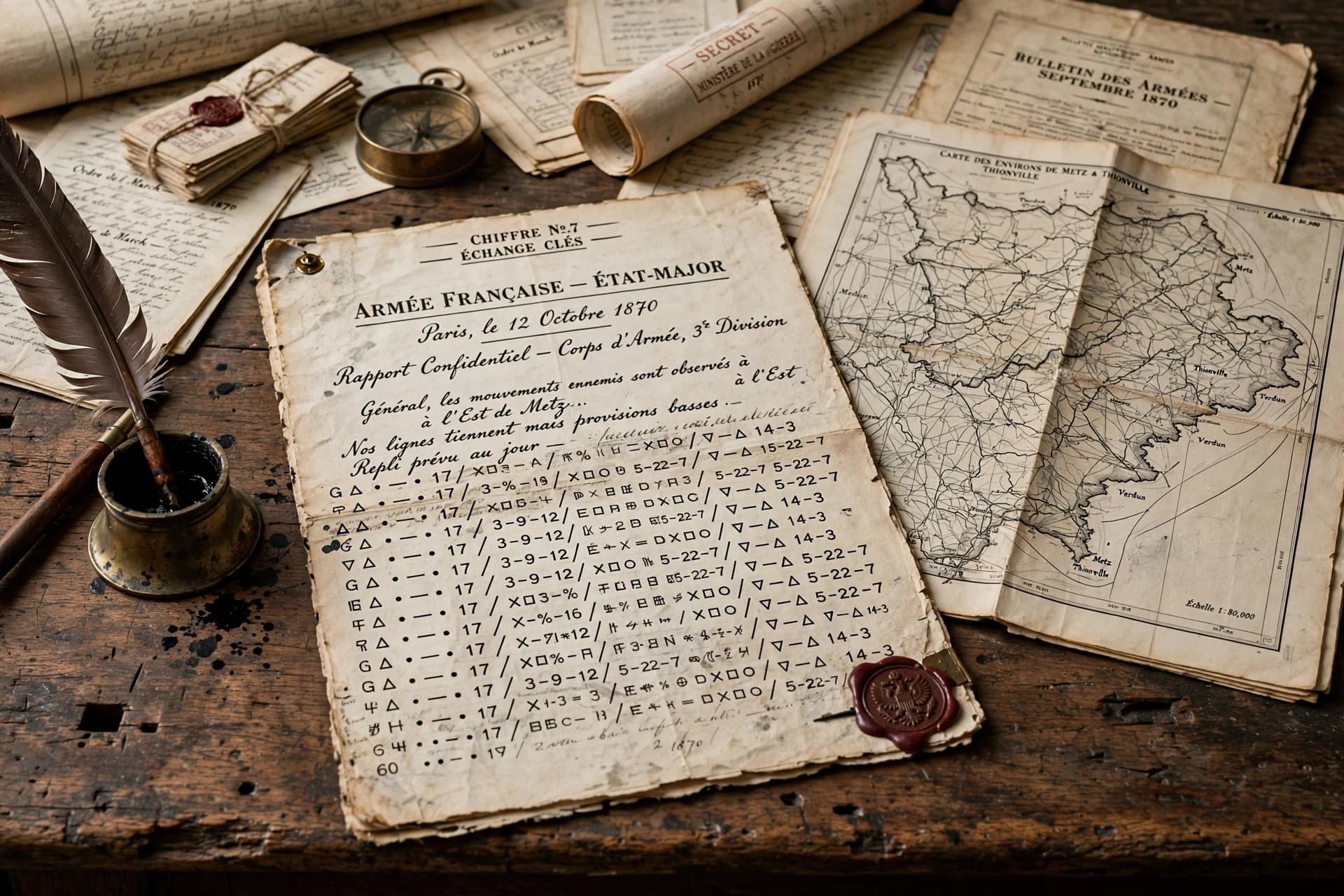
The document contains a plain French opening followed by 24 rows of coded characters, according to Church’s reconstruction. The original cipher key did not survive, leaving the document among historical codes that had resisted complete interpretation for generations. Church says the surviving material included roughly 1,300 cipher units.
Church used OpenAI’s GPT-6 Astra as part of the process. According to his account, the system first helped interpret the scanned document and identify the symbols, then worked with a partial key that had already been reconstructed by earlier researchers. A simulated-annealing approach was then used to search possible solutions for the remaining portions of the cipher.
The result was not simply a string of random words. The reconstructed message describes French and allied troop positions and numbers and discusses preparations for the approaching conflict with Austria. Church’s account places the letter in March 1809, shortly before the Austrian campaign began.
That historical context gives the document particular value. Napoleon’s forces were preparing for another major confrontation with the Habsburg monarchy, and Marmont’s forces were positioned in Dalmatia, separated from Napoleon’s main armies. A coded message describing military deployments therefore served a practical purpose: sensitive information could be transmitted without plainly exposing its contents.
The reported breakthrough also illustrates what AI can contribute to historical research without replacing the work that came before it. Earlier researchers had already documented the cipher, reconstructed portions of its system and preserved the surviving evidence. Church’s work built on those contributions rather than beginning with a completely unknown document.
There is also a useful caution in the phrase “cracked by AI.” The process involved image interpretation, historical research, partial cryptographic knowledge, computational search and comparison with known material. The result still needs the kind of scrutiny historians and cryptographers apply to any proposed decipherment, particularly when reconstructing damaged or ambiguous historical text.
Still, the episode demonstrates how an old document can acquire new possibilities when modern tools meet carefully preserved scholarship. A letter that spent 217 years behind an unreadable code now has a proposed reading, allowing historians to examine its military information and place it more precisely within the events surrounding Napoleon’s 1809 war with Austria.
AI Image Disclaimer: The accompanying artwork, if used, is AI-generated and represents a historical visualization rather than an authentic photograph of Napoleon or the original decoding process.
Sources: The Telegraph Carter Church OpenAI Yahoo News Cryptiana
Published by Banx Network. This article is part of the Banx decentralized media programme, powered by the BXE token on the XRP Ledger.