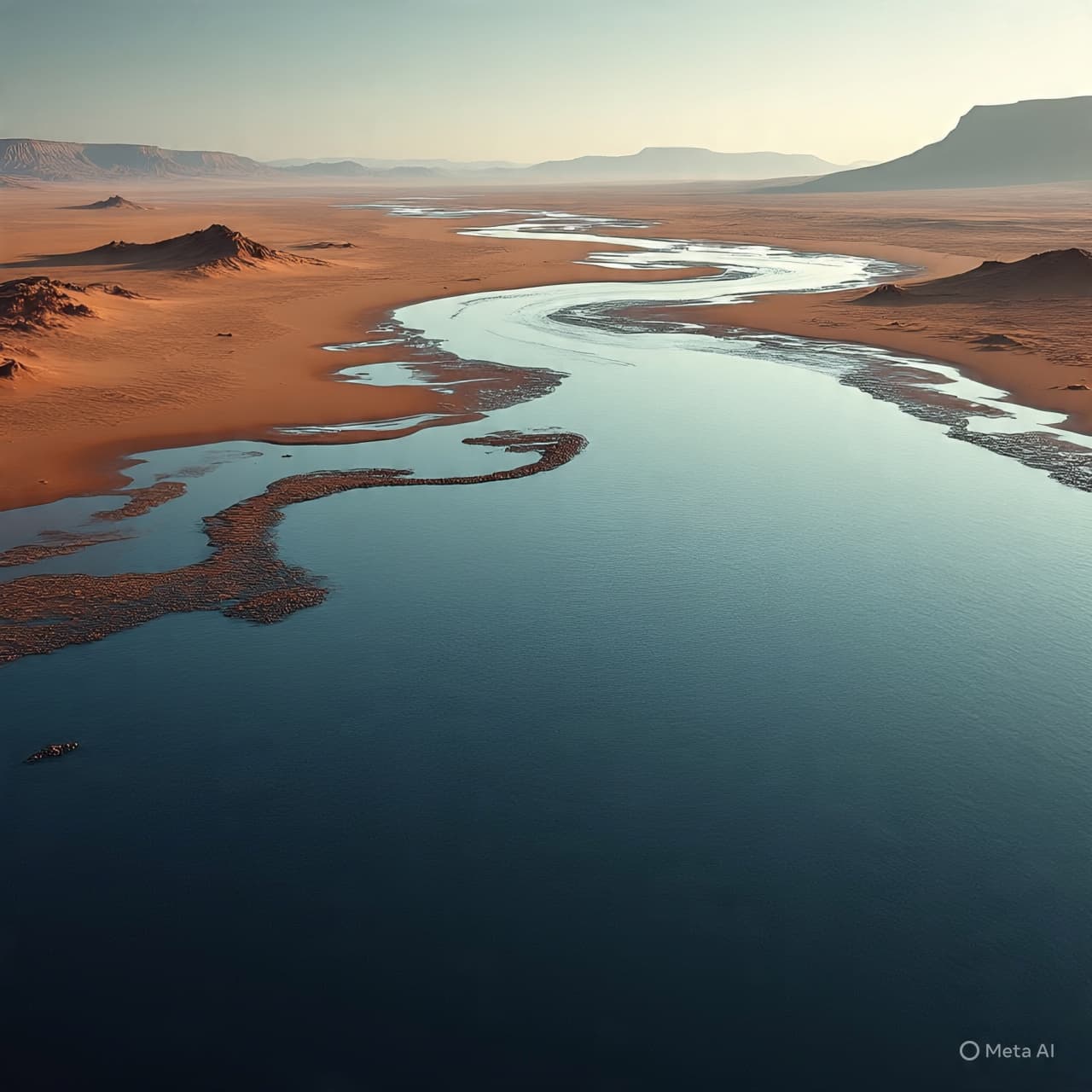
Mars has always presented itself as a place of restraint — red dust, thin air, horizons that seem to withhold as much as they reveal. And yet, every so often, the planet offers a glimpse of something larger than its present form. Scientists now say they may have caught sight of evidence pointing to a vast, ancient ocean, once spread across Mars’ northern lowlands, reshaping how the planet’s past is imagined.
The clues do not arrive as water, but as geometry. Broad plains, subtle ridges, and patterns etched into rock suggest coastlines rather than coincidence. These formations, observed through orbital data and refined imaging, appear consistent with what shorelines leave behind on Earth: long, continuous boundaries shaped by waves, sediment, and time. On Mars, they remain frozen in place, preserved by the planet’s stillness.
If confirmed, the ocean would date back billions of years, to a period when Mars was warmer, wetter, and more dynamic than the cold desert seen today. Liquid water would have required a thicker atmosphere and a climate capable of sustaining it — conditions that place early Mars closer to Earth than previously assumed, at least for a while.
What astonishes researchers is not just the scale of the proposed ocean, but its persistence. Rather than a brief flood or isolated basin, the evidence suggests a body of water that endured long enough to shape terrain, redistribute sediments, and leave a coherent geological memory. It implies stability, not accident.
These findings matter because water is never just water. It is context. An ocean changes chemistry, moderates temperature, and opens the door to habitability. While no direct signs of life are implied, the presence of a long-lived ocean reframes the kinds of questions scientists can reasonably ask about Mars’ biological potential.
There is also a quiet poignancy in the idea. An ocean without waves, without sound, without witness — gone, yet still legible. Mars did not erase its water entirely; it archived it. The planet carries its history not in motion, but in form.
As new missions prepare to drill, sample, and return Martian material to Earth, discoveries like this shift the tone of exploration. Mars is no longer just a planet that lost its water. It is a planet that once held it, shaped by it, and then endured its absence.
In the end, the glimpse of an ancient ocean is less about rewriting Mars as familiar and more about deepening its strangeness. A world that once knew tides now exists in silence, offering its shoreline only to those patient enough to read the land.
AI Image Disclaimer Illustrations were created using AI tools and are not real photographs.
Sources Planetary science research teams Mars orbital imaging studies Geological and astrobiology analysts
Published by Banx Network. This article is part of the Banx decentralized media programme, powered by the BXE token on the XRP Ledger.