Some decisions look bright and warm at the moment they are announced, like a window pushed open on a cold morning. In March 2026, British Columbia Premier David Eby stood before a group of schoolchildren and declared that the province would adopt permanent daylight time, promising families an "extra hour of sunshine." The applause came easily. The press release went out. The clocks would not fall back again. But in the laboratories of sleep scientists, the announcement produced something quieter than celebration—a steady, measured concern. They knew that the extra hour of evening light was not created from nothing. It was borrowed from the morning, and morning light is precisely what the human body clock needs most.
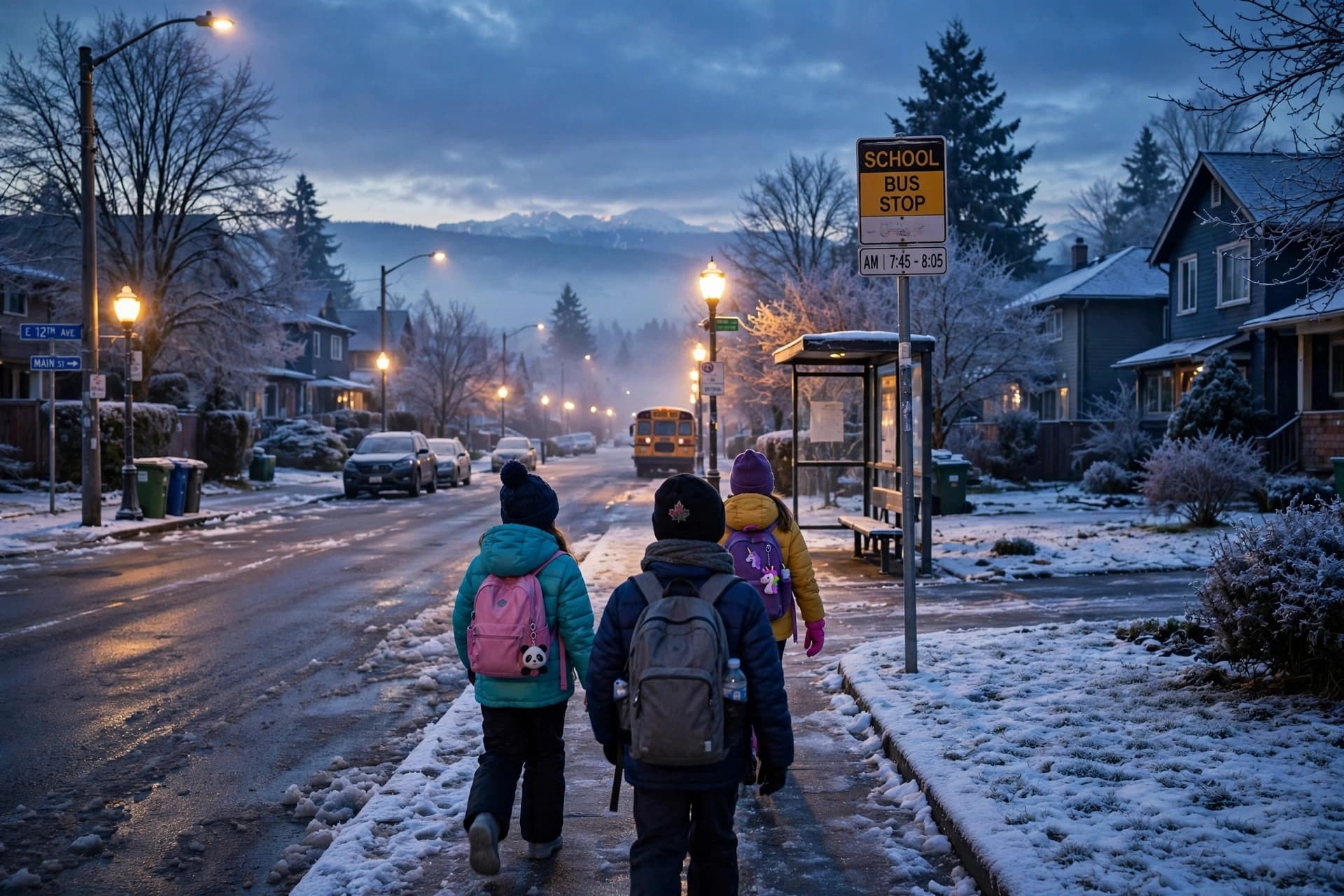
Jamie Zeitzer, a professor of psychiatry at Stanford University, had his research cited in the provincial government's news release announcing the decision. When he saw how his work was being used, he used a careful phrase: "a little odd." His judgment was direct. "Scientifically it's not a great idea, and from a health perspective I don't think it's a great idea to make this switch." Myriam Juda, a sleep researcher at Simon Fraser University, was more specific: permanent daylight time means winter morning light is delayed, and in western time-zone cities like Vancouver and Victoria, midwinter sunrise would be pushed past 9 a.m. "That means most children will be walking to school in the dark. Most commuters will be commuting in the dark, and won't get any morning light at all."
The problem is not daylight time itself, but its permanence. The body's circadian rhythm synchronizes with the sun's light-dark cycle through specialized photoreceptors in the eye, and morning light is the key signal that calibrates that rhythm. Without it, melatonin release shifts later, people are more alert at night and more tired during the day. Juda estimated that most British Columbians would lose nearly half an hour of sleep per night on average after the change. For teenagers, the effect is especially pronounced, because their sleep patterns are already inclined to shift later.
The provincial government's rationale was that concentrating limited winter daylight at the end of the day better matches most people's schedules and may help reduce collisions and improve overall well-being. It also cited a 2019 public consultation in which more than 90 percent of respondents supported permanent daylight time. But critics point out that the consultation offered only two options: keep changing the clocks twice a year, or adopt permanent daylight time. Permanent standard time—the option sleep scientists consider healthier—was never on the ballot. Zeitzer's assessment was blunt: "It's not a valid choice. It's like asking... am I a really good teacher or a phenomenal teacher?"
Raymond Lam, a professor of psychiatry at UBC, wrote a four-word verdict in the Canadian Medical Association Journal: "We got it wrong." He argued that Pacific standard time is closer to the body's natural rhythm and is the healthier choice. He expressed disappointment that policymakers chose permanent daylight time without examining the health consequences. This is not an abstract disagreement. Permanent daylight time was tried in the United States in 1974 and repealed two years later, partly after eight children in Florida were killed on their way to school in the dark. Russia, China, and Chile also tried and reversed the practice, citing health and safety concerns.
British Columbia is not alone. Alberta, Manitoba, the Northwest Territories, and northwestern Ontario also stopped falling back this November. But experts note that ending the twice-yearly clock change is itself a good thing—spring-forward has been linked to increases in heart attacks and car crashes—the question is which permanent time was chosen. Permanent standard time is healthier from a circadian perspective, particularly regarding stroke and obesity.
For families in B.C., the consequences of this decision will become concrete in the coming months: dark morning commutes, children waiting for school buses under streetlights, and a subtle, hard-to-name misalignment between the body and the clock. The policy has been made. The clocks will not fall back. But the warnings from sleep scientists will not disappear. They will persist, quietly, like the missing light of a winter morning.
Image Disclaimer: The visual accompanying this article was generated by artificial intelligence and is not a photograph of actual individuals or scenes.
Sources: CBC News, Vancouver Sun, The Province, Canadian Medical Association Journal
Published by Banx Network. This article is part of the Banx decentralized media programme, powered by the BXE token on the XRP Ledger.