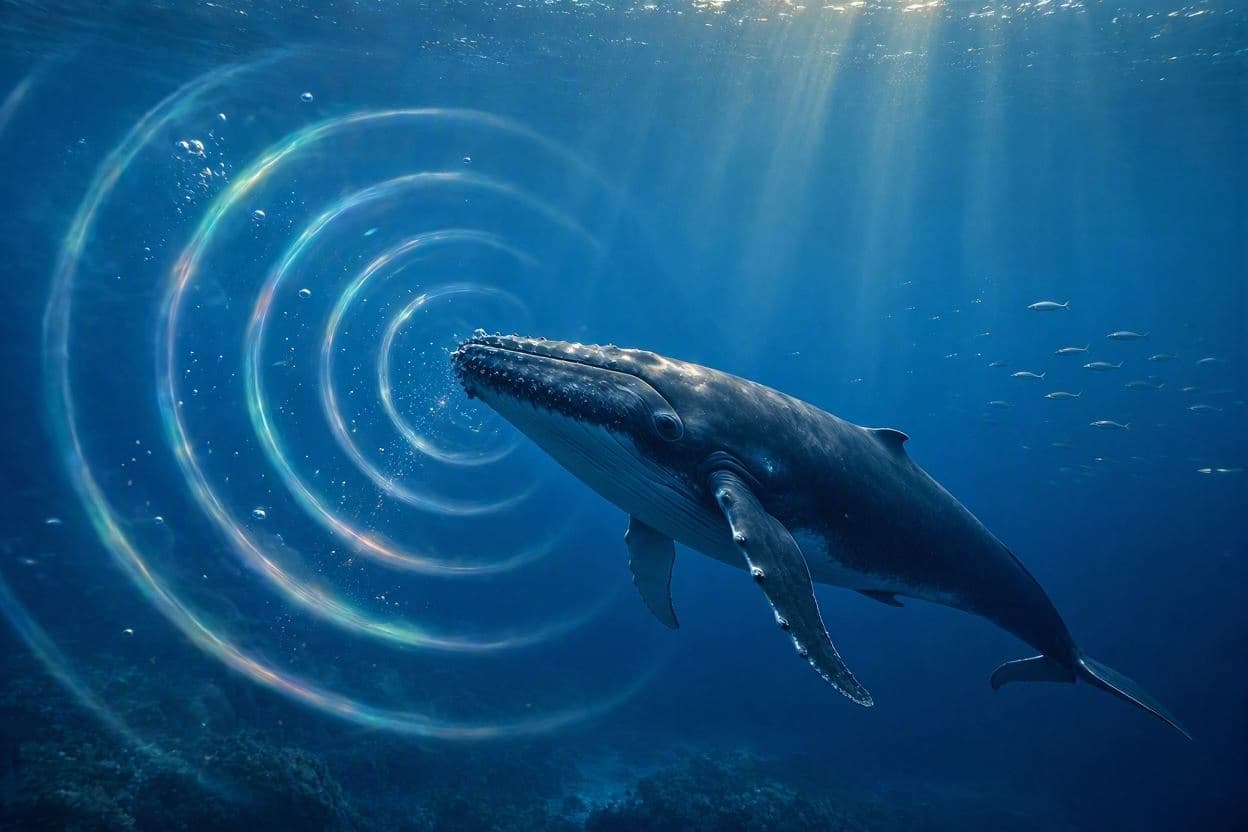
In the deep, silent expanses of the ocean, whales communicate through songs that travel for miles, carrying messages of identity and intent. These acoustic signals, complex and haunting, have long fascinated biologists. But recently, physicists have found a surprising resonance between these marine melodies and one of the most abstract concepts in modern science: Einstein’s theory of special relativity. It is a connection that bridges the biological and the physical, suggesting that the laws governing the cosmos may also whisper in the depths of the sea.
The link arises from the way sound waves behave in water compared to light waves in a vacuum. While special relativity deals with the constant speed of light and the dilation of time, similar mathematical principles apply to the propagation of sound in moving media. Researchers discovered that the frequency shifts in whale calls, caused by the movement of the animals and the currents around them, mirror the Doppler effects predicted by relativistic physics. It is a poetic parallel, where the motion of a giant mammal echoes the motion of stars.
This analogy is not just a metaphorical flourish but a tool for understanding. By applying relativistic frameworks to acoustic data, scientists can more accurately track whale movements and interpret their communications. It allows for corrections in signal processing that account for the complex environment of the ocean, improving our ability to monitor these endangered giants. The math of the universe, it seems, has practical applications in conservation.
For physicists, the discovery offers a fresh perspective on familiar equations. Seeing relativity play out in the tangible world of biology makes the abstract more accessible. It reminds us that scientific principles are universal, appearing in contexts we might never expect. From the orbit of planets to the song of a humpback, the same underlying rules govern behavior, creating a unity in nature that is both elegant and profound.
Biologists, meanwhile, gain a new lens through which to view animal behavior. Understanding the precise mechanics of sound transmission helps decode the social structures of whale pods. It reveals how they maintain contact over vast distances, navigating a world where visibility is limited but connectivity is essential. The intersection of physics and biology enriches both fields, fostering collaboration and innovation.
The comparison also highlights the importance of interdisciplinary thinking. In a world of specialized knowledge, breakthroughs often occur at the boundaries between disciplines. By bringing together experts in acoustics, marine biology, and theoretical physics, researchers have uncovered a hidden symmetry. It is a testament to the power of curiosity and the willingness to look for connections in unlikely places.
As we listen to the songs of the whales, we are reminded of our own place in the cosmic order. We are part of a universe governed by consistent laws, where even the most distant theories have roots in the immediate world. The echo of Einstein in the ocean is a reminder that science is not just about solving problems but about finding beauty in the patterns that connect all things.
This unexpected link invites us to listen more closely, not just to the whales but to the world around us. It suggests that if we pay attention, we might find that the secrets of the stars are sung in the depths of the sea, waiting for those who know how to hear them.
AI Image Disclaimer: Visuals in this article are AI-generated illustrations depicting underwater scenes and abstract wave patterns, designed to reflect the themes of acoustics and physics without showing real proprietary research data.
Sources: Phys.org, New Scientist, Live Science, The Conversation
Published by Banx Network. This article is part of the Banx decentralized media programme, powered by the BXE token on the XRP Ledger.