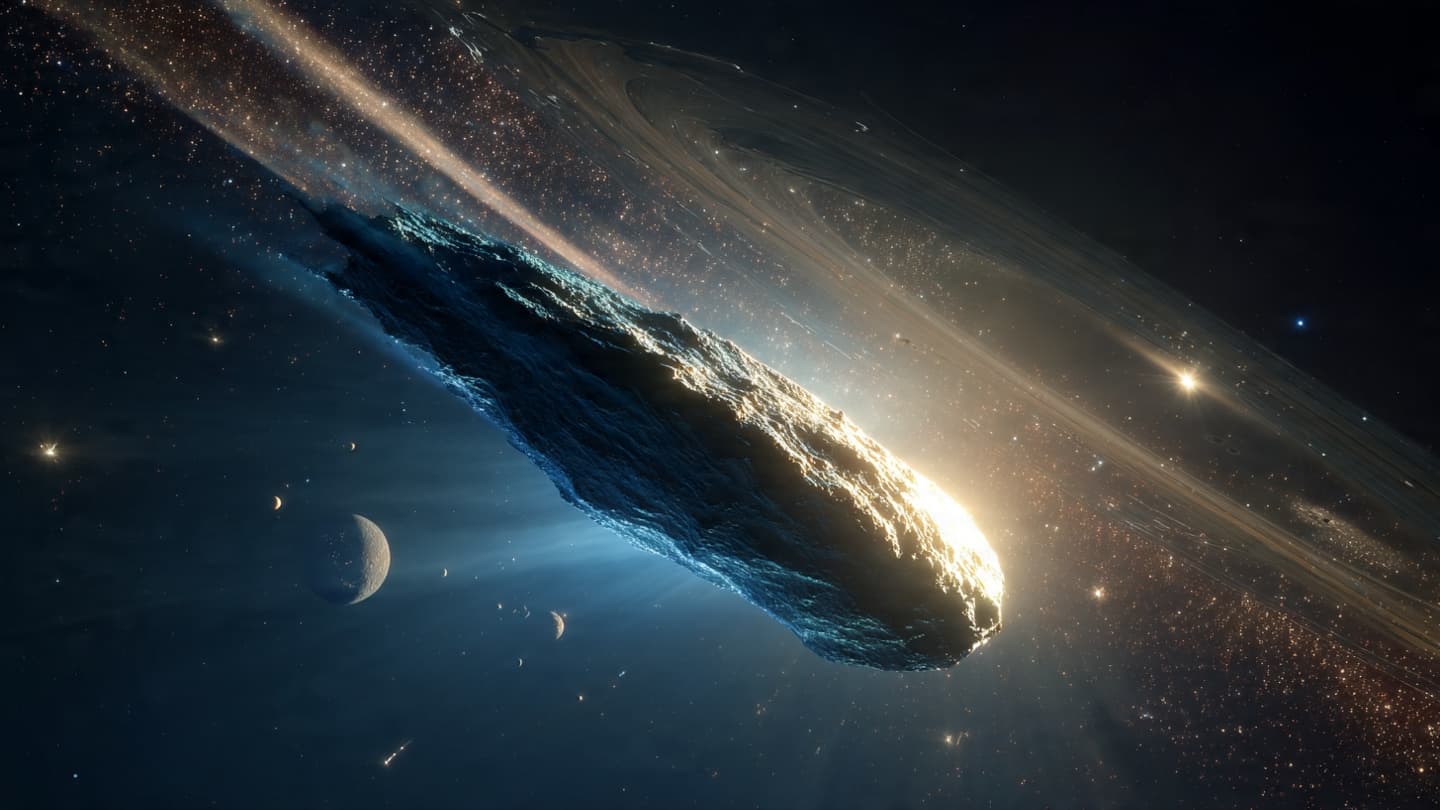
Every so often, the cosmos sends a visitor from beyond the boundaries of our solar system. Such objects travel across unimaginable distances, carrying within them fragments of histories older than planets, oceans, and perhaps even life itself. The recently identified interstellar comet 3I/ATLAS may be one of those ancient messengers.
Astronomers studying comet 3I/ATLAS suggest that the object could be as old as 12 billion years, making it significantly older than the Sun and much of the solar system. The estimate is based on analyses of the comet's trajectory, composition, and potential origin.
The object was identified as an interstellar visitor because its orbit indicates that it originated outside the solar system. Similar discoveries remain exceptionally rare, with only a handful of confirmed interstellar objects observed to date.
Scientists believe 3I/ATLAS may have formed within one of the earliest generations of stars in the Milky Way. If confirmed, the comet could offer valuable insights into conditions that existed during the galaxy's early history.
Researchers are continuing observations using telescopes around the world to better understand the object's composition and behavior. Spectroscopic studies may reveal the presence of volatile materials, dust, and other chemical signatures.
Studying interstellar objects provides astronomers with a unique opportunity to examine material formed around distant stars without launching spacecraft beyond the solar system. These natural visitors effectively bring samples of other planetary systems into observational range.
The discovery also highlights the growing capabilities of modern astronomical surveys, which are becoming increasingly effective at identifying faint and fast-moving objects crossing the solar system.
Although many questions remain unanswered, 3I/ATLAS is already attracting significant scientific interest as researchers seek to uncover clues about the early evolution of our galaxy.
AI-generated image disclaimer: Visual depictions included with this article were created using artificial intelligence to represent astronomical concepts.
Source Verification Check: Sci.News, NASA, Nature Astronomy, ESA
Published by Banx Network. This article is part of the Banx decentralized media programme, powered by the BXE token on the XRP Ledger.