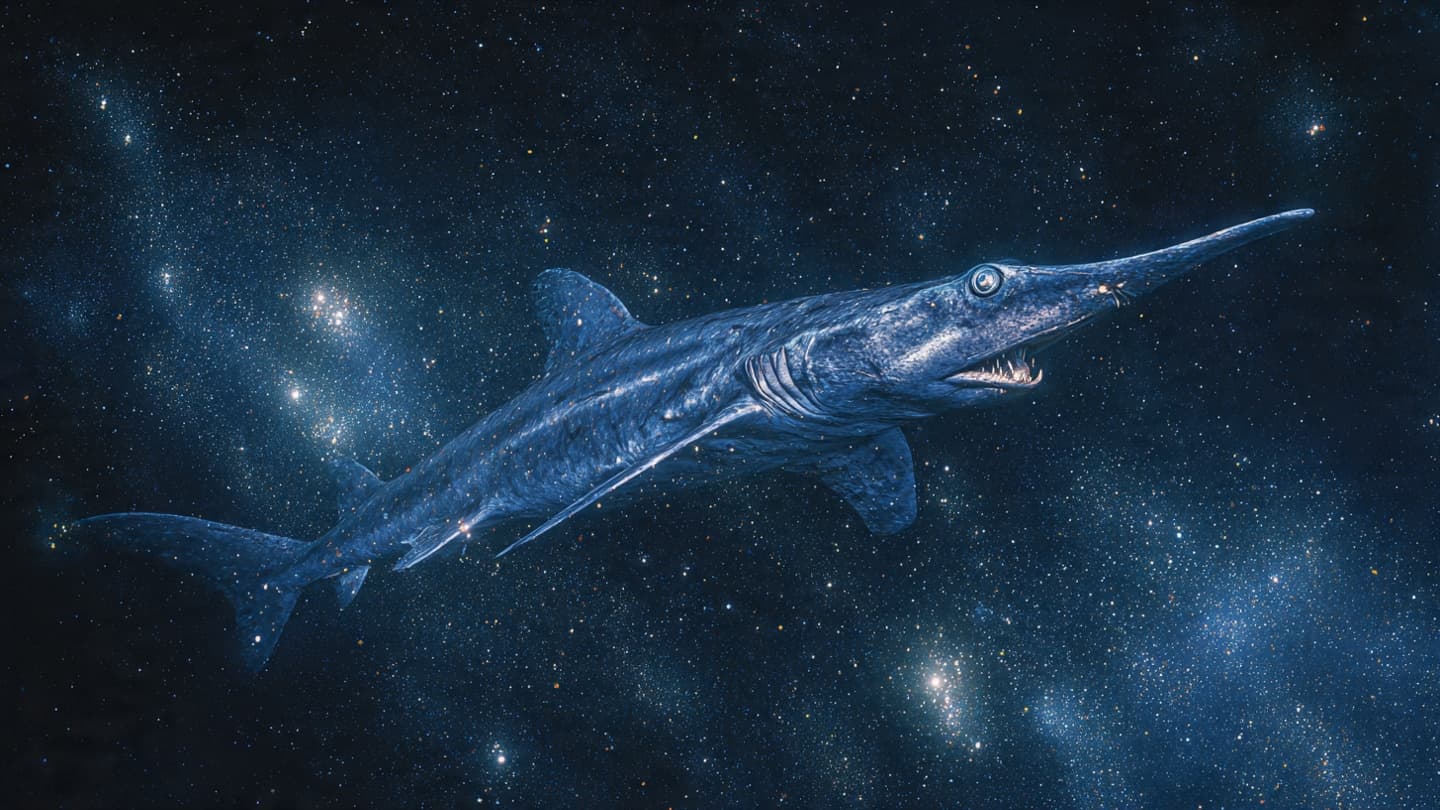
The deep ocean has long remained one of Earth's least explored frontiers, a realm where darkness conceals species seldom seen by human eyes. Among its most mysterious inhabitants is the goblin shark, an elusive animal that has fascinated scientists for decades.
Researchers have successfully captured one of the first known recordings of a goblin shark in its natural deep-sea habitat. The achievement marks a significant milestone in marine biology and deep-ocean exploration.
Goblin sharks (Mitsukurina owstoni) are often described as living fossils because their lineage dates back millions of years. Their distinctive elongated snouts and protrusible jaws have made them among the most recognizable yet rarely observed shark species.
Until now, most scientific knowledge about goblin sharks has come from specimens accidentally caught by fishing vessels. Direct observations of these animals in their natural environment have remained exceptionally rare.
Using advanced deep-sea camera systems and remotely operated technologies, researchers were able to document the shark moving through its habitat. The footage offers valuable insights into behavior, swimming patterns, and ecological interactions.
Scientists believe that observing species within their natural surroundings is essential for understanding how deep-sea ecosystems function. Such observations can reveal behaviors that are impossible to infer from preserved specimens alone.
The discovery also demonstrates how rapidly advancing underwater technologies are transforming marine science. Improved cameras, autonomous vehicles, and robotic systems are enabling researchers to explore previously inaccessible environments.
As exploration of the deep ocean continues, scientists anticipate that additional observations will deepen understanding of one of the planet's most mysterious ecosystems and the remarkable creatures that inhabit it.
AI-generated image disclaimer: Illustrative images accompanying this article were generated by artificial intelligence and do not represent actual footage.
Source Verification Check: Live Science, NOAA, Marine Biology journals, Associated Press
Published by Banx Network. This article is part of the Banx decentralized media programme, powered by the BXE token on the XRP Ledger.