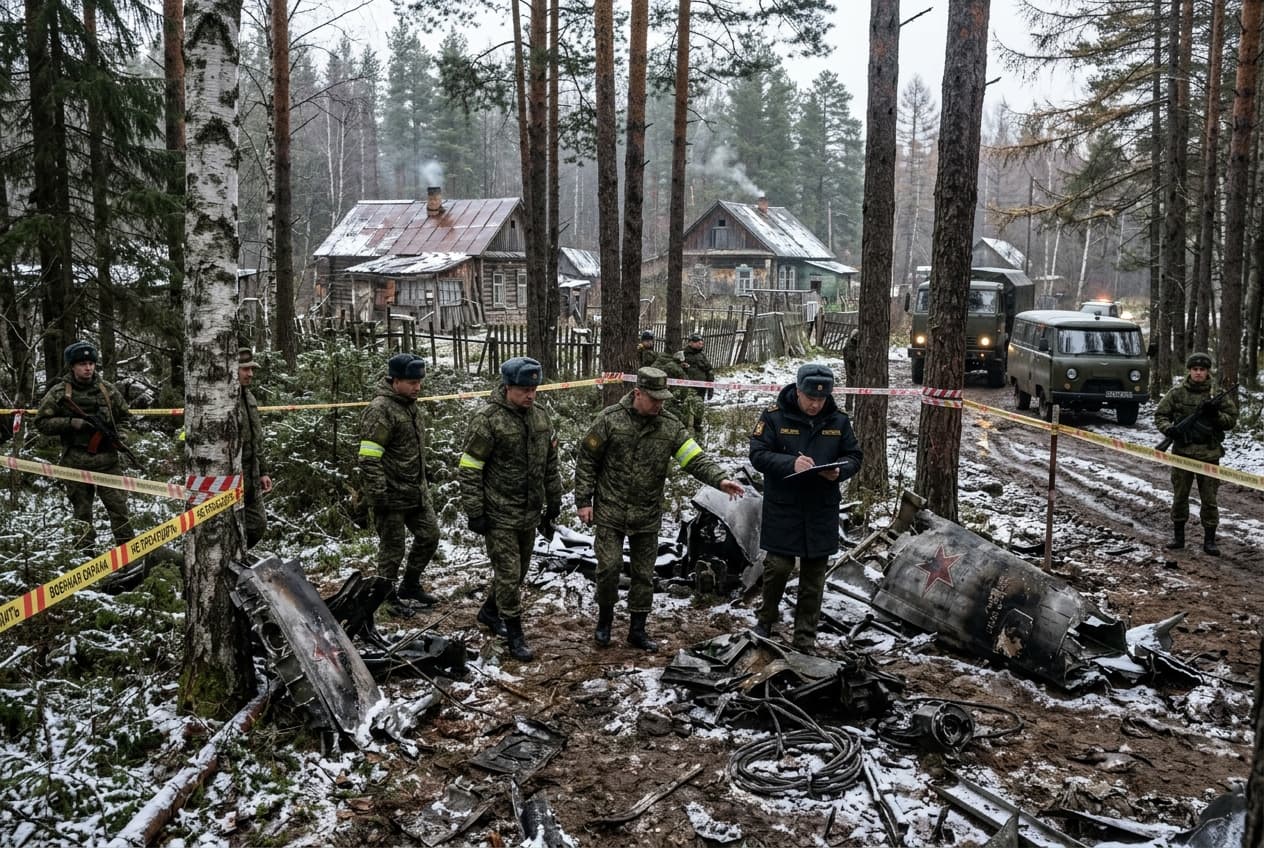
Moscow, Russia—A Russian Tu-95 strategic bomber went down during a routine training flight in the Far Eastern Amur region early Tuesday, killing six crew members on board and sending a seventh to a local medical facility with severe injuries. Emergency crews scrambled to the crash site in an uninhabited, wooded area near the village of Krasnoyarovo, approximately 30 kilometers north of the Ukrainka air base where the heavy bomber was permanently stationed.
The Defense Ministry confirmed the fatalities shortly after military search units located the burning debris field scattered across several hundred yards of wilderness. Defense officials stated the aircraft carried no weapons payload during the exercise, ruling out any immediate ordnance detonation at the impact zone.
An investigation commission led by high-ranking Air Force officers took over the crash perimeter to recover flight recorders and inspect mechanical wreckage. Internal military communiques suggest maintenance logs and ground control telemetry are already being seized at Ukrainka air base as part of the primary inquiry.
A spokesman for the Russian Defense Ministry acknowledged the loss during a brief statement broadcast by state-run agencies. "The plane crashed in an isolated sector during a planned flight regime," the spokesperson said. "Rescue parties extracted one survivor from the wreckage, who is currently undergoing emergency surgical procedures, while six crew members perished at the site".
Speculation surrounding the cause immediately focused on propulsion system failures, though authorities refused to validate initial reports. Eyewitness accounts from neighboring rural communities cited smoke trails and loud engine bursts prior to the rapid descent, but military investigators caution that forensic metallurgy will take weeks.
The Tu-95 fleet forms a core pillar of Russia’s long-range strategic aviation division, making any hull loss a significant operational blow to the eastern command. The Ukrainka base operates heavy turboprop bombers configured for extended maritime patrols and deterrent flights across the Pacific theater.
Decades of heavy flight service have placed continuous stress on these aging airframes, forcing ground crews to work around the clock on engine overhauls and electronics maintenance. Analysts monitoring regional air combat commands note that operational strain often elevates mechanical risks during basic training drills.
Investigators remain on-site in Krasnoyarovo, sifting through charred aluminum and twisted engine components under heavy military guard. Search units have recovered both flight data recorders, which are scheduled for transit to central defense laboratories in Moscow for immediate technical analysis.
Published by Banx Network. This article is part of the Banx decentralized media programme, powered by the BXE token on the XRP Ledger.