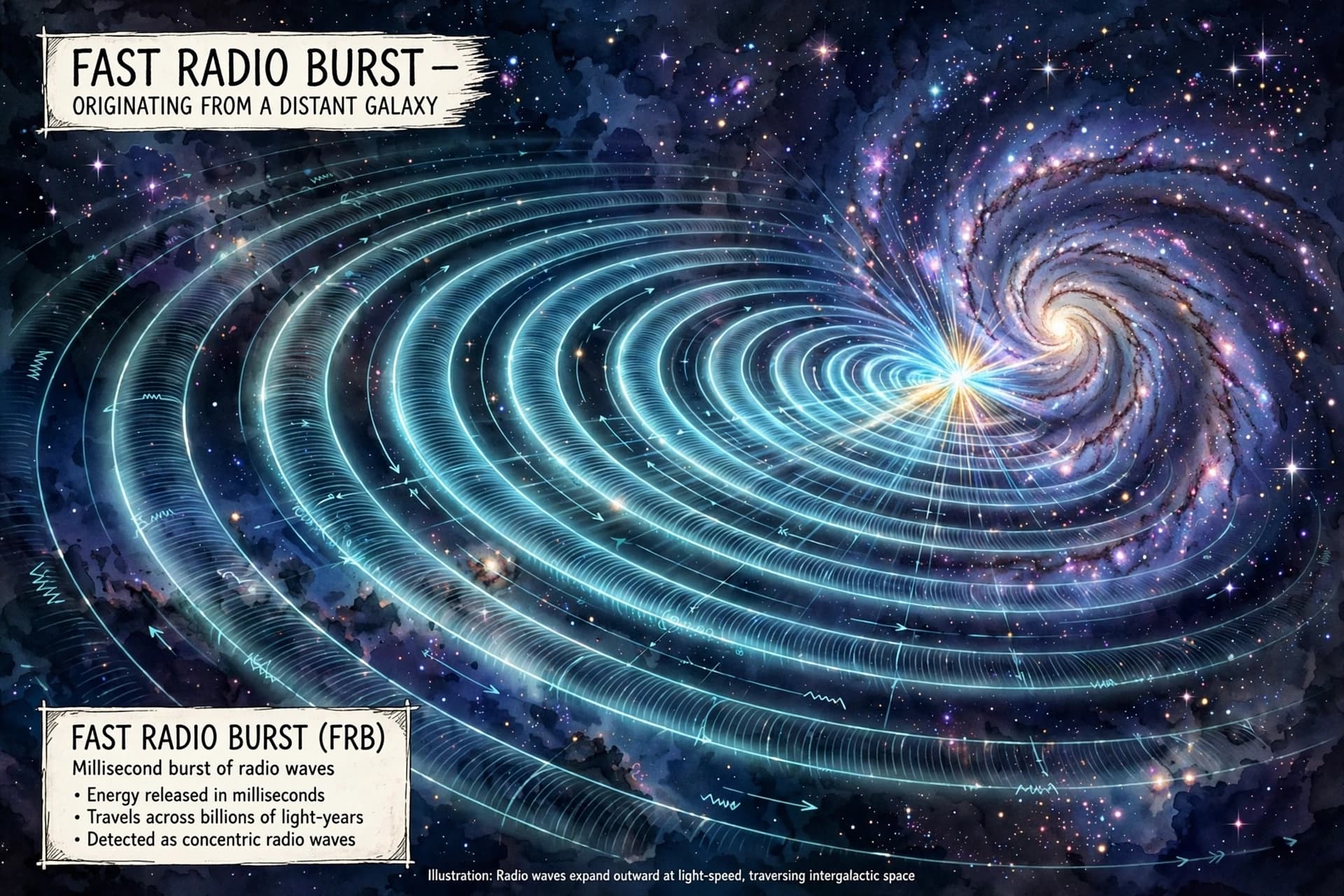
There are archives that do not sit on shelves.
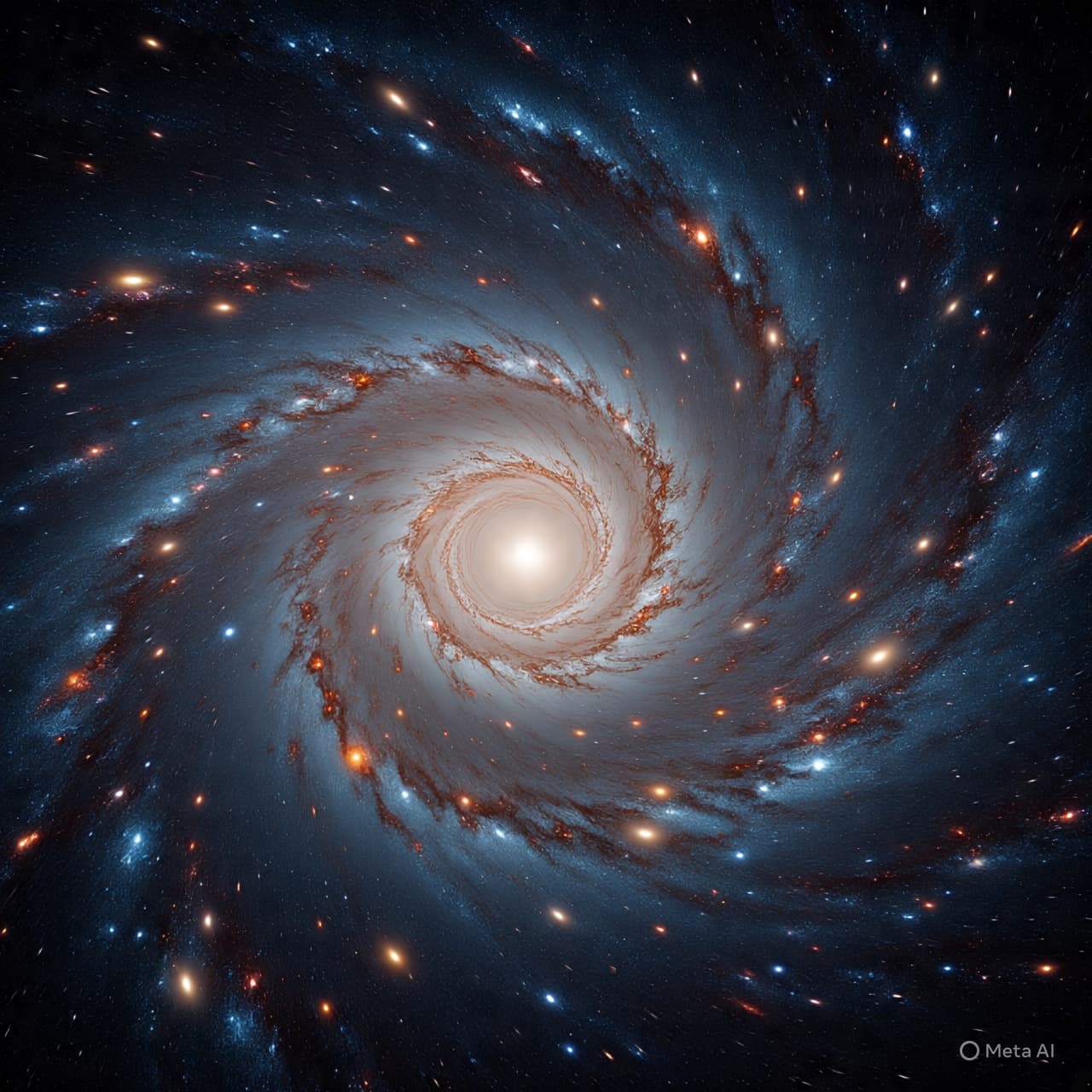
They do not gather dust in rooms or fade under careful handling. Instead, they drift—vast and luminous—spread across distances so immense that time itself becomes part of the record. In the night sky, a spiral galaxy turns slowly, its arms unfurling like a quiet gesture repeated over billions of years. Nothing is hurried there. Everything is preserved, if one knows how to look.
Astronomers have begun to call this kind of work “space archaeology,” a phrase that feels almost paradoxical. There are no ruins to brush clean, no fragments to hold in the hand. And yet, the principle remains the same: to reconstruct a past from traces left behind.
In the case of spiral galaxies, those traces are written in stars.
Each star carries a signature—its age, its composition, its motion—subtle markers that, when gathered together, begin to tell a larger story. Younger stars tend to cluster along bright, well-defined arms, where gas and dust still gather and collapse into new formations. Older stars drift farther from these regions, their orbits shaped by time, their light dimmer but steadier, like echoes of an earlier structure.
Recent studies using data from space observatories have allowed astronomers to map these stellar populations in unprecedented detail. By analyzing the distribution and chemical makeup of stars across a galaxy’s disk, researchers can begin to piece together how the spiral structure formed and evolved—whether it grew gradually, shaped by density waves moving through the disk, or emerged through interactions with neighboring galaxies, subtle gravitational conversations stretching across space.
There is no single narrative. Instead, there are layers.
Some regions of a spiral galaxy reveal signs of quiet, continuous star formation, a kind of steady breathing that has persisted for eons. Elsewhere, there are disruptions—stellar streams, asymmetries, traces of past encounters that have left their imprint in motion and composition. These are the moments when the galaxy was not alone, when something passed nearby or through it, leaving behind a distortion that still lingers in the arrangement of stars.
To read these patterns is to move backward through time without leaving the present.
Instruments aboard observatories like the Hubble Space Telescope and the Gaia mission have been central to this effort, measuring positions and velocities of stars with extraordinary precision. Combined with spectroscopic surveys, which reveal chemical abundances, these datasets allow astronomers to separate stellar populations into generations—identifying which stars were born early, in a more chaotic environment, and which emerged later, as the galaxy settled into a more stable form.
The result is not a static image, but a reconstruction of motion.
One can begin to see how spiral arms may shift, dissolve, and reappear over cosmic timescales, how stars migrate from their birthplaces, how the galaxy itself is less a fixed structure and more a process—an ongoing negotiation between gravity, gas, and time. Even the familiar elegance of a spiral shape becomes something dynamic, its symmetry only temporary, its form always in quiet transition.
There is a certain humility in this kind of study. The farther astronomers look, the less the universe appears as a collection of objects and the more it resembles a continuum—histories overlapping, influences extending beyond what can be immediately seen.
And yet, the work remains precise.
Researchers continue to refine models of spiral galaxy evolution using high-resolution observations and simulations, aiming to understand how structures like the Milky Way formed over billions of years. These efforts contribute to a broader picture of cosmic history, linking the life cycles of stars to the formation of galaxies and, ultimately, to the conditions that allow planetary systems to emerge.
Space archaeology, in this sense, is less about uncovering a lost past than about recognizing that the past has never fully disappeared.
It is still there, moving in the light.
Scientists are using data from missions such as ESA’s Gaia and NASA’s Hubble Space Telescope to analyze stellar ages, motions, and chemical compositions, enabling detailed reconstructions of spiral galaxy formation and evolution. The findings continue to refine models of how galaxies like the Milky Way developed over billions of years.
AI Image Disclaimer
These images are AI-generated and intended as visual interpretations, not real astronomical photographs.
Source Check: NASA, European Space Agency (ESA), Space.com, Scientific American, Nature Astronomy
Published by Banx Network. This article is part of the Banx decentralized media programme, powered by the BXE token on the XRP Ledger.