

Key Highlights
- Attack Time:The ambush occurred on July 22, 2026, at 6:45 p.m. local time.
- Casualties:Five paramilitary rangers were killed, and six civilians were injured.
- Ongoing Conflict:The incident reflects the ongoing insurgency in Thailand's southern provinces.
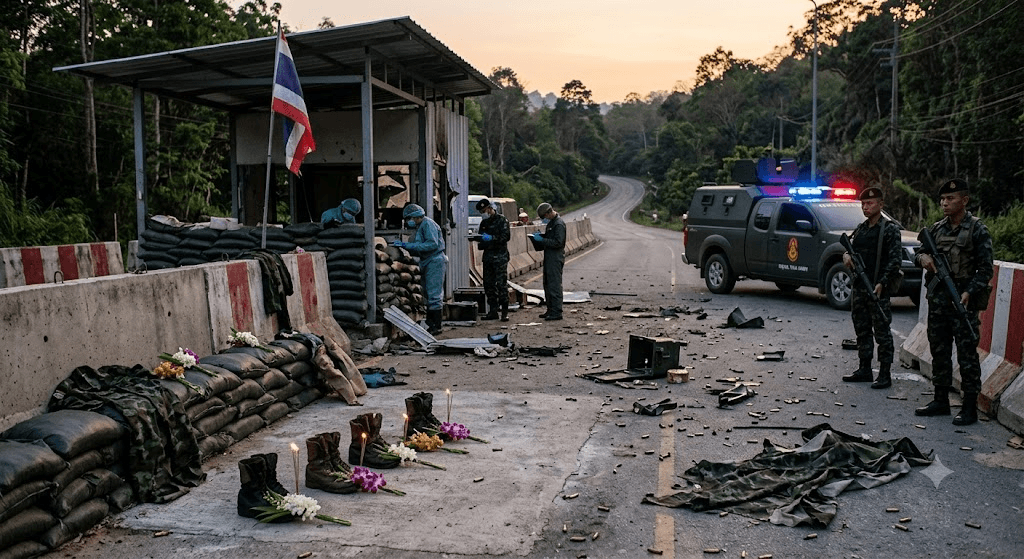
NARATHIWAT, Thailand — A highly coordinated assault by heavily armed insurgents on a security checkpoint in Thailand’s restive deep south has left five paramilitary rangers dead and six civilians injured. The nighttime ambush marks one of the deadliest strikes against Thai security forces in recent years, violently shattering a period of relative calm in the region.
The attack took place at approximately 6:45 p.m. local time on Wednesday, July 22, 2026, at the Buketa Sami roadside checkpoint in the Ra-ngae district of Narathiwat province. The outpost was manned by members of Task Force Ranger Regiment 45 when the ambush began. According to the military’s Internal Security Operations Command (ISOC) Region 4, a group of roughly 10 assailants dressed entirely in black and wearing black brimmed hats blindsided the base. Arriving in a pickup truck and on motorcycles, the attackers immediately launched a fierce barrage using military-grade firearms and pipe bombs.
The five paramilitary rangers stationed at the post bore the brunt of the explosive opening volley and were killed at the scene. In the chaotic crossfire, six passing civilians were wounded, including a three-year-old girl and a 10-year-old boy. Before fleeing the scene, the insurgents looted the outpost, seizing three AK-47 assault rifles, three bulletproof vests, and several mobile phones from the fallen soldiers. Security forces later discovered the pickup truck used in the getaway abandoned and set ablaze roughly 21 kilometers (13 miles) from the bloodied checkpoint.
The assault came just 24 hours after a car bomb detonated outside a former police station elsewhere in Narathiwat province, injuring a police officer and marking the region's first car bombing of the year. While no group has formally claimed responsibility for the checkpoint ambush, the tactics closely align with the decades-long separatist insurgency gripping Thailand’s southernmost border provinces—Narathiwat, Yala, Pattani, and parts of Songkhla. The predominantly Muslim, ethnically Malay region has seen security forces battle rebel groups seeking independence since the latest phase of the conflict erupted in 2004, claiming more than 7,800 lives.
The Thai government strongly condemned the raid, labeling it an act of terrorism. Government spokeswoman Rachada Dhnadirek stated the attack posed "a serious threat to national security" and intentionally undermined ongoing efforts to stabilize the region. Despite the flare-up in violence, Thai Prime Minister Anutin Charnvirakul emphasized that the state would not back down from diplomacy, confirming that the peace negotiation process with southern insurgent factions will continue. Formal talks between the government and the Barisan Revolusi Nasional (BRN)—the primary separatist group—have struggled for years over issues of self-governance and political representation, but both sides recently reaffirmed that dialogue remains the only viable path forward.
In the wake of the ambush, the military has placed all regional security outposts on the highest level of alert, enforcing strict vigilance as a massive manhunt continues across the province to track down the assailants.
Published by Banx Network. This article is part of the Banx decentralized media programme, powered by the BXE token on the XRP Ledger.




