There is a particular gravity to a declaration of war made from exile—a statement issued not from the capital one claims to govern, but from a hotel or a foreign ministry in a neighboring country, while the forces one seeks to defeat hold the ground one once controlled. In Riyadh on Sunday, Rashad al-Alimi, the leader of Yemen's internationally recognized, Saudi-backed government, announced the start of a major military operation to retake all territory held by the Iran-backed Houthi militia. The declaration was delivered by television, from Saudi Arabia, and it marked the formal end of any remaining hope for a negotiated settlement.
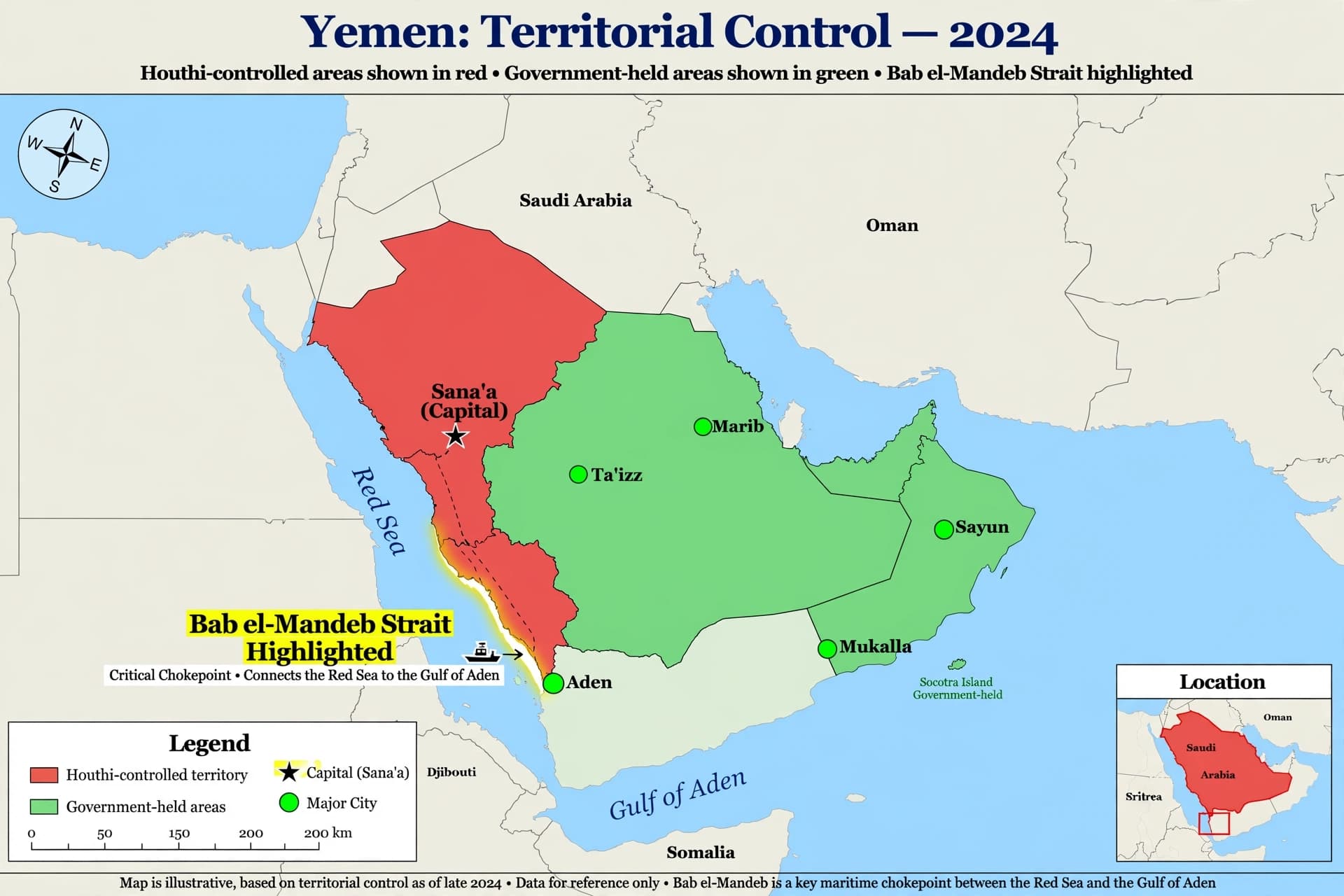
Al-Alimi's announcement came after what he described as the exhaustion of all opportunities for de-escalation. In his televised speech, he said he had ordered the armed forces and security forces to begin carrying out their assigned tasks under approved plans to reclaim the republic's remaining territory and extend state authority across the entire national territory . The decision followed weeks of Houthi advances that have reshaped the battlefield. The rebels seized the strategic Bab el-Mandeb Strait in a lightning offensive down the Red Sea coast, and in the last forty-eight hours they have made gains on strategic hilltops near Taiz, advancing on the last road connecting the city to Aden, the government's temporary capital .
The Houthis responded not with defense but with escalation. Their military spokesperson, Yahya Sarea, said the group had launched ballistic missiles and drones at Saudi Aramco facilities in Riyadh and the Khurais area, claiming the attacks caused major fires in response to what he described as fifty Saudi-led airstrikes on Yemen in the past twelve hours . There was no immediate confirmation from Saudi Arabia, and the claim could not be independently verified.
The numbers behind the conflict are staggering. More than 800 people have been killed since the fighting reignited last month, according to the World Health Organization, and the World Food Program reports that more than 150,000 people have been displaced . Three out of four families in parts of Yemen are going hungry, and the humanitarian crisis is deepening as the front lines shift .
Saudi Arabia has not publicly acknowledged any role in the new offensive. But it is providing intelligence support, and six people with knowledge of the preparations told Reuters that some regional and European nations are supplying mainly defensive military aid to the kingdom . The United States is providing intelligence but has said it will not participate directly in military operations, according to Axios .
Taiz, Yemen's third-largest city, is now at the center of the battlefield. If the Houthis take control of the road connecting the city to Aden, hundreds of thousands of civilians and thousands of government forces could find themselves effectively besieged. President al-Alimi is from the Taiz region, and a siege of the city would represent both a military and a personal blow. The government's offensive has been expected for weeks, but its announcement from Riyadh, while the Houthis maintain momentum on the ground, underscores the difficult position the internationally recognized government now occupies. The war has widened once more, and the terms of its ending remain as distant as ever.
AI Image Disclaimer: The images accompanying this article were generated by artificial intelligence and are for illustrative purposes only.
Sources: Reuters, BBC, RTVE, Yonhap News, The Age, Telegraph India, BTA
Published by Banx Network. This article is part of the Banx decentralized media programme, powered by the BXE token on the XRP Ledger.