There is a particular stillness that follows a great journey—a pause in which the traveler must decide whether to set out again or to turn toward a different kind of work. Christina Koch, who flew around the moon on Artemis II and spent nearly a year in orbit before that, has chosen the latter. On Tuesday, NASA announced that Koch will become the agency's acting deputy chief engineer, a role that carries with it a quiet farewell to the astronaut corps she has served for more than a decade.
Effective November 1, Koch will take over the position from Katherine Van Hooser, who is retiring after more than 35 years at the agency . The appointment means Koch will transition to management astronaut status and will no longer be eligible for future spaceflight assignments .
It is a natural move for someone whose career began not in the cockpit but in the laboratory. Koch holds bachelor's degrees in electrical engineering and physics and a master's degree in electrical engineering. She started at NASA as an electrical engineer at Goddard Space Flight Center in Maryland, developing scientific instruments for space missions . NASA Administrator Jared Isaacman noted that Koch has seen the agency's engineering "from both sides of the equation: developing complex systems on the ground and trusting them with her life in space" .
Koch was selected as an astronaut in 2013. Her first spaceflight, a 328-day mission to the International Space Station that launched in March 2019, set the record for the longest single spaceflight by a woman. It also included the first all-female spacewalks, conducted with fellow astronaut Jessica Meir . Earlier this year, she served as a mission specialist on Artemis II, the first crewed mission to travel around the moon since 1972 .
With Koch's transition, all four members of the Artemis II crew have now stepped away from active spaceflight assignments . Her three crewmates had previously announced their own moves, none of which involved another flight in the near future. The crew's shared journey around the moon, which took them farther from Earth than any humans have traveled, now gives way to individual paths in training, management, and engineering.
In her new role, Koch will help lead NASA's engineering community, supporting technical oversight, mission readiness, and engineering excellence across the agency's programs and projects . Isaacman said he looked forward to the impact she would have "as we return Americans to the lunar surface, build the Moon Base, get underway on nuclear power in space, and develop the capabilities that will ultimately take us on to Mars" .
Koch's transition comes at a moment when NASA is preparing for the next phases of lunar exploration and, eventually, crewed missions to Mars. Her experience—both as an engineer and as someone who has lived and worked in space for extended periods—offers a bridge between the technical and the operational, the ground and the sky. For an astronaut, stepping away from flight assignments is a significant change. But the work of exploration, as Koch's new role suggests, does not always require leaving the planet.
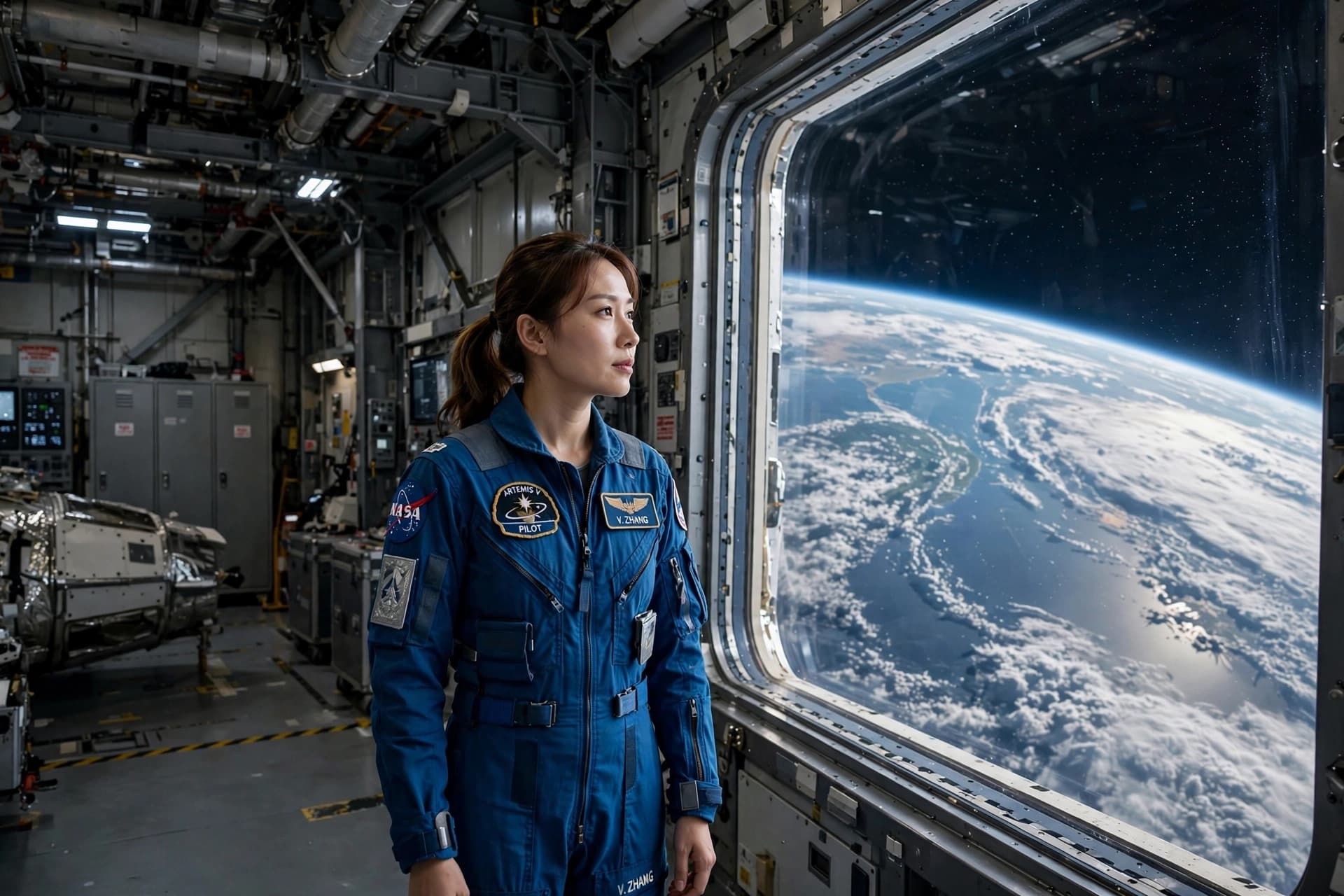
The images accompanying this article are AI-generated and are intended only to illustrate the subject matter.
Sources: Space, USA Today, NASA, El Mundo, Tacoma News Tribune
Published by Banx Network. This article is part of the Banx decentralized media programme, powered by the BXE token on the XRP Ledger.