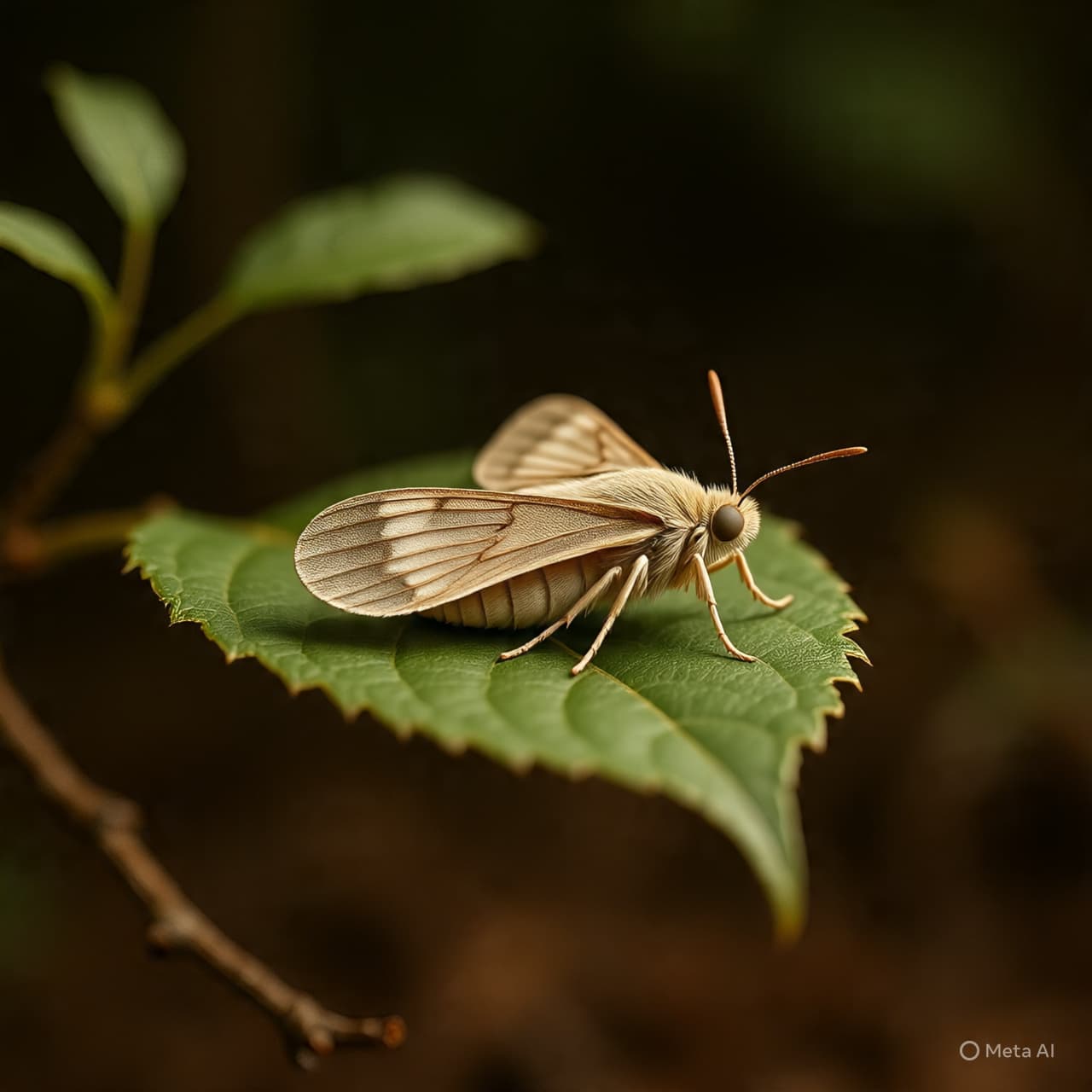
For more than 300 million years, moths have drifted through the night like living ash—soft-winged survivors of shifting continents, ice ages, mass extinctions, and the rise and fall of dinosaurs. They fluttered beneath prehistoric ferns, navigated moonlit forests long before cities glowed, and adapted quietly to a planet in constant motion. Their story is not one of spectacle, but of endurance.
So why, after surviving so much, are they now fading?
Across parts of Europe and North America, long-term monitoring studies have recorded significant declines in moth abundance and diversity. In the United Kingdom, for instance, decades of light-trap surveys have shown that many common species are becoming less common. Similar patterns have emerged in Germany and other regions, where insect biomass overall has dropped sharply over recent decades. While the figures vary by location and species, the trend has been persistent enough to prompt scientific concern.
The causes are neither singular nor simple. Habitat loss stands among the most significant pressures. As wild meadows give way to agriculture, roads, and expanding suburbs, the native plants that moth caterpillars depend upon disappear. Many species are specialists, tied to particular host plants. Remove the plant, and the life cycle quietly collapses.
Light pollution has also emerged as a modern force reshaping nocturnal ecosystems. Artificial lighting—streetlamps, billboards, residential glow—disorients moths that evolved to navigate by the moon and stars. Drawn into endless spirals around bulbs, they waste energy, become easy prey, or fail to reproduce successfully. The night itself, once a stable ecological domain, has been altered.
Pesticide use adds another layer. Chemicals designed to protect crops from insect damage do not discriminate carefully. Even when not directly lethal, sublethal exposure can impair development, reproduction, or immune function. For species already facing fragmented habitats, these pressures accumulate.
Climate change introduces further complexity. Rising temperatures shift seasonal timing, sometimes causing mismatches between caterpillar emergence and plant growth. In some regions, warming allows certain moth species to expand northward, but others decline where conditions become too dry or unpredictable. The winners and losers are not evenly distributed.
Yet moths are not merely background creatures of the night. They are pollinators, often overlooked beside bees and butterflies. Many plants rely on nocturnal visitors to transfer pollen. Moths also serve as food for birds, bats, and small mammals, forming an essential link in food webs. Their decline reverberates outward, subtly reshaping ecosystems.
It is tempting to frame the story as sudden collapse, but the reality appears more gradual—a steady thinning rather than a dramatic disappearance. Some species adapt; others do not. Urban gardens planted with native flora can provide refuge. Reduced pesticide use and mindful lighting design offer partial mitigation. Conservation efforts in certain areas have shown that insect populations can stabilize or recover under supportive conditions.
Researchers continue to gather long-term data to clarify patterns and refine responses. Monitoring programs, citizen science projects, and ecological modeling contribute to a more nuanced understanding. The picture is still forming, and it differs by continent and habitat type.
What remains clear is that moths, though ancient, are not immune to modern change. Their evolutionary resilience was shaped by natural upheavals, not by rapid industrial transformation. The speed and scale of human-driven environmental shifts present a challenge unlike those of the distant past.
For now, the night still holds their presence. On warm evenings, wings still brush against porch lights, and soft silhouettes still cross the moon. But the quiet data beneath those moments suggests a transition underway.
Scientists continue to study the trend, examining land-use patterns, climate variables, and chemical exposure to better understand the causes and possible solutions. The outcome is not yet fixed. As research progresses, the story of the moth may become less about disappearance and more about adaptation—depending, in part, on how the modern landscape evolves.
AI Image Disclaimer Illustrations were produced with AI and serve as conceptual depictions.
Source Check
Credible coverage and reporting found in:
BBC The Guardian National Geographic The New York Times Scientific American
Published by Banx Network. This article is part of the Banx decentralized media programme, powered by the BXE token on the XRP Ledger.