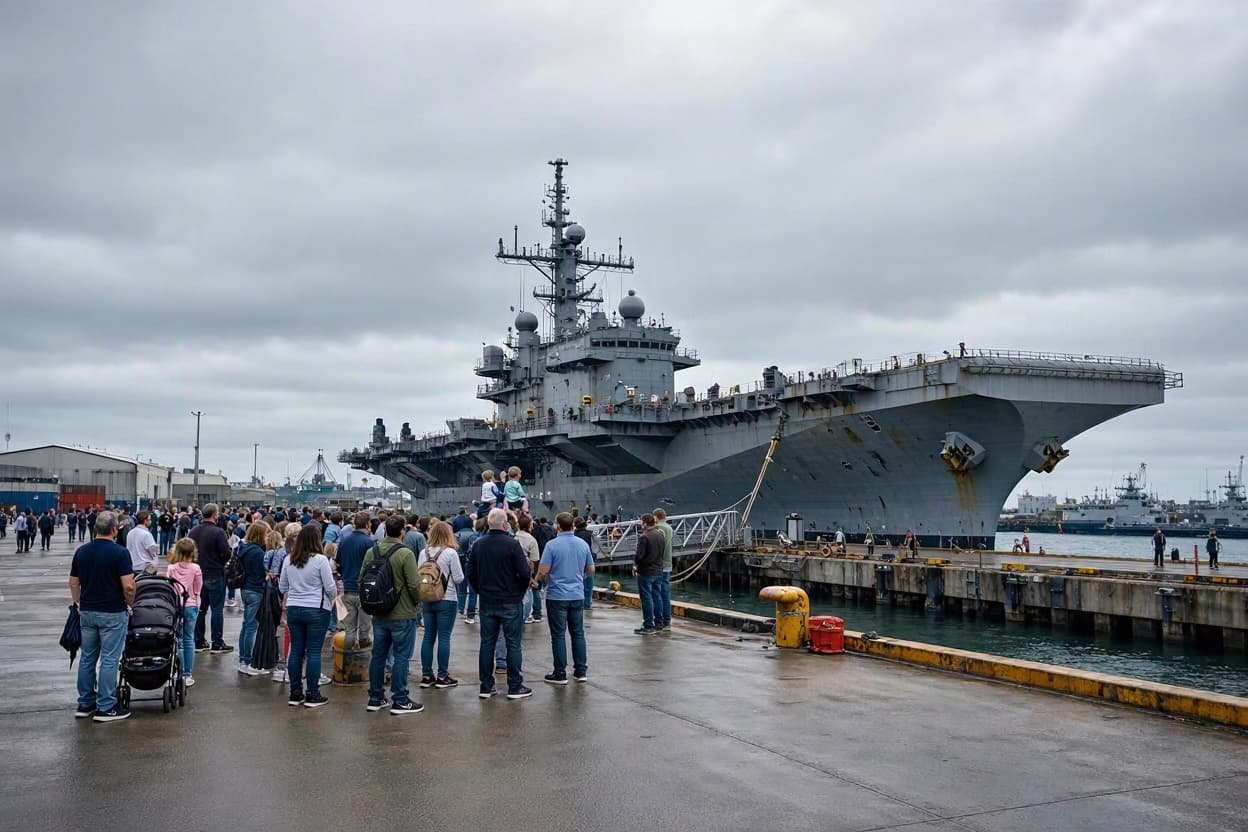
There is a particular homecoming that belongs to those who have been at sea too long—a return measured not in miles but in the slow unwinding of months of tension, of missed births and unanswered calls, of a ship that became both refuge and confinement. On Thursday, the USS Abraham Lincoln arrived at Naval Base San Diego, ending a deployment that had stretched across nearly eleven months and left its mark on the thousands who served aboard.
The nuclear-powered carrier left San Diego in November 2025 for a mission in the South China Sea, but was redirected to the Middle East before the United States and Israel launched strikes against Iran on February 28 . What followed was a record-setting stretch of 265 consecutive days at sea without a port call—the longest such stretch in modern U.S. Navy history .
The human cost of that endurance has been documented. In September, the Trump administration acknowledged in a letter to a Democratic lawmaker that eight sailors had attempted suicide during the deployment. One sailor went overboard in early August and was rescued; another attempted to jump in March but was stopped by shipmates . Families and members of Congress had raised alarms in August about conditions aboard, including food shortages that reduced meal options from two to one for a time
Defense Secretary Pete Hegseth flew to the carrier on Wednesday to present the crew with the Presidential Unit Citation, the highest honor a unit can receive. He pushed back against what he described as efforts to turn the Lincoln into "a symbol of dysfunction or low morale," praising the crew's resilience and saying President Trump "tracked your activities from day one and couldn't be more proud" .
The operational record was, by any measure, substantial. According to the citation Hegseth read, the Lincoln and its strike group executed 3,693 combat missions, delivered 1.37 million pounds of ordnance, launched 450 Tomahawk cruise missiles, shot down 77 one-way attack drones, sank 64 Iranian warships, and destroyed 21 anti-ship cruise missiles .
But for the families waiting on the docks of Coronado, the numbers mattered less than the reunion. Sixty-four fathers met their babies for the first time. Alba Solano, waiting with her daughter, described the communication difficulties of the past months—emails, occasional texts, phone calls that "never worked" . Fernando Cota, waiting for his 20-year-old daughter, said simply, "It's almost been a year" .
The Lincoln is the second carrier to endure an unusually long deployment in support of the Iran war and receive the Presidential Unit Citation afterward. The USS Gerald R. Ford returned from a 326-day deployment in May, the longest for an aircraft carrier in fifty years .
The ship will remain in San Diego for maintenance. For the crew, the work now is the quiet work of return—of relearning the rhythms of home, of sleep without the hum of engines, of the ordinary days that deployment makes impossible.
AI Image Disclaimer: The imagery in this article was generated using AI tools and is intended solely for editorial illustration.
Sources: Franceinfo, Agerpres, South China Morning Post, CGTN Türk, tvrinfo.ro, ERT News
Published by Banx Network. This article is part of the Banx decentralized media programme, powered by the BXE token on the XRP Ledger.