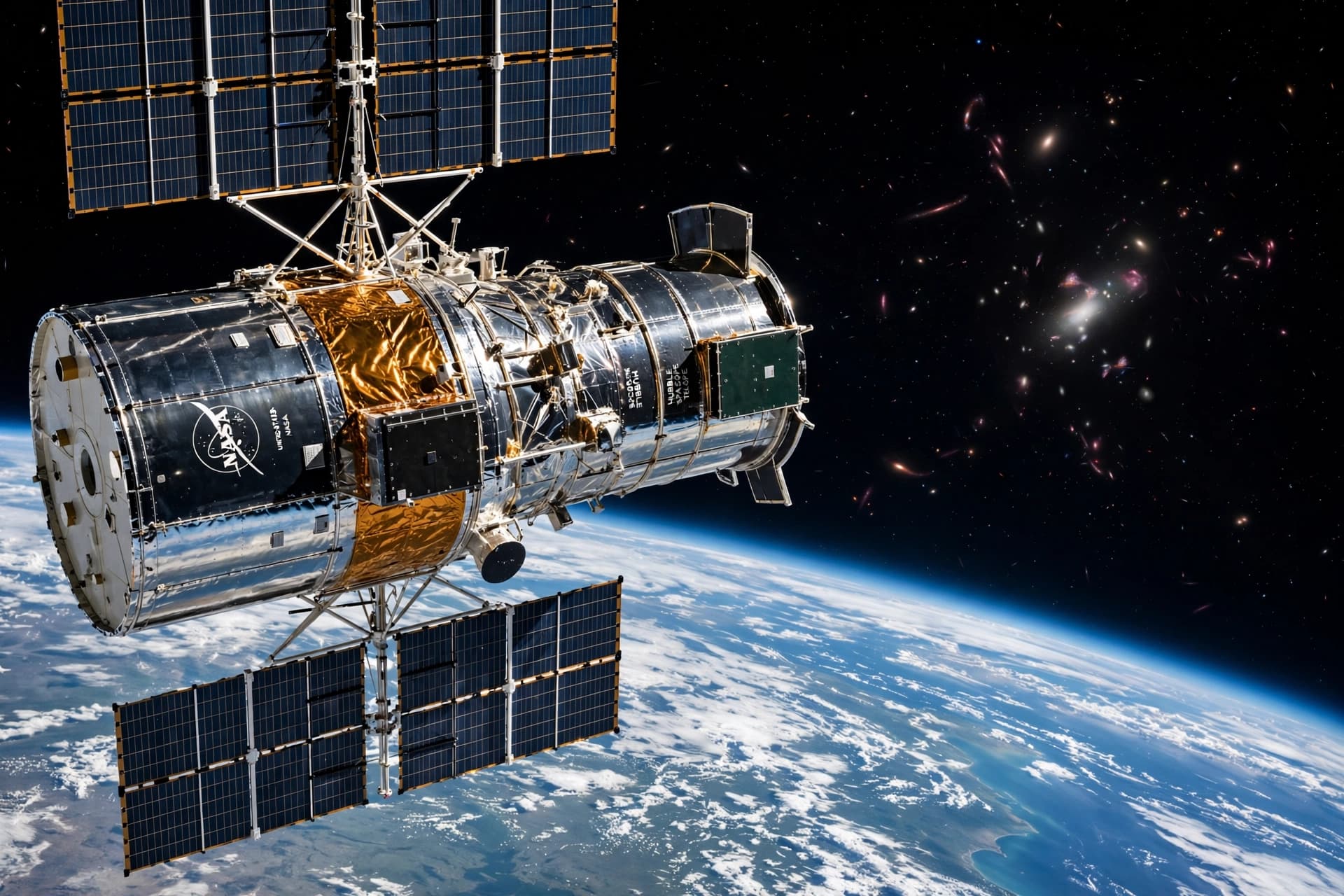
There is a kind of poetry in a telescope reaching a milestone while doing what it does best. On September 19, 2026, NASA's Hubble Space Telescope completed its 200,000th orbit around Earth, a journey spanning more than 5 billion miles over 36 years . It was designed for fifteen years. It has now spent more than twice that long watching the universe from low Earth orbit, and on the day of its milestone, it was not resting. It was hunting for a supernova.
The target was Athena, a stellar explosion discovered by the James Webb Space Telescope in 2025 . Between Athena and Earth lies a massive galaxy cluster called MACS J0417, whose gravity acts as a lens, bending and magnifying light from objects behind it . Because light from the supernova can travel along multiple paths around the cluster, the same explosion appears more than once in the sky, separated by months or years depending on the path taken . Hubble was watching for one of those reappearances.
This technique, known as gravitational lensing time-delay cosmography, was proposed in 1964 by Norwegian astrophysicist Sjur Refsdal . The idea is elegant: if you know how long it takes for different images of the same supernova to appear, you can calculate the geometry of the lens and, from that, the rate at which the universe is expanding—the Hubble Constant. The method was first tested in 2015, when Hubble detected a supernova named after Refsdal reappearing exactly when models predicted . Now, Athena offers another opportunity to refine that measurement.
The Hubble Constant is one of the most important numbers in cosmology, and it is also one of the most contested. Different techniques for measuring it produce noticeably different values, and the cause of that discrepancy—known as the Hubble tension—remains unresolved . Independent methods like the Refsdal technique are therefore valuable, offering a way to cross-check other measurements and perhaps reveal where the disagreement lies.
Hubble's ability to observe in ultraviolet and visible light makes it uniquely suited to this task. Webb and the upcoming Roman telescope are designed primarily for the infrared, so Hubble still has no replacement in the ultraviolet and visible parts of the spectrum . Even with one gyroscope, even with slower pointing, it remains in high demand. Astronomers submit roughly seven observation proposals for every available hour of telescope time .
The milestone orbit was not the first time Hubble had proven its worth beyond its expected lifetime. After launch in 1990, a flaw in its primary mirror was discovered—an error of about two micrometers that blurred its images . Five servicing missions repaired and upgraded the telescope, installing corrective optics and new instruments. The last servicing mission in 2009 installed a docking fixture for a future spacecraft that could raise its orbit, though no such mission has yet been flown . Without intervention, Hubble will eventually re-enter Earth's atmosphere in the early or mid-2030s .
Athena is predicted to reappear between now and early March 2027 . When it does, Hubble will be watching. Measuring the timing of its reappearances will help map the mass of MACS J0417 and refine the Hubble Constant. The telescope has now circled Earth 200,000 times. It has traveled farther than any human-made object except the Voyager probes. And it is still, after all these years, doing the work it was built for—looking at the sky and telling us what it sees.
---
AI Image Disclaimer: This article contains AI-generated imagery created for editorial purposes only.
Sources: NASA Science, Universe Space Tech
Published by Banx Network. This article is part of the Banx decentralized media programme, powered by the BXE token on the XRP Ledger.