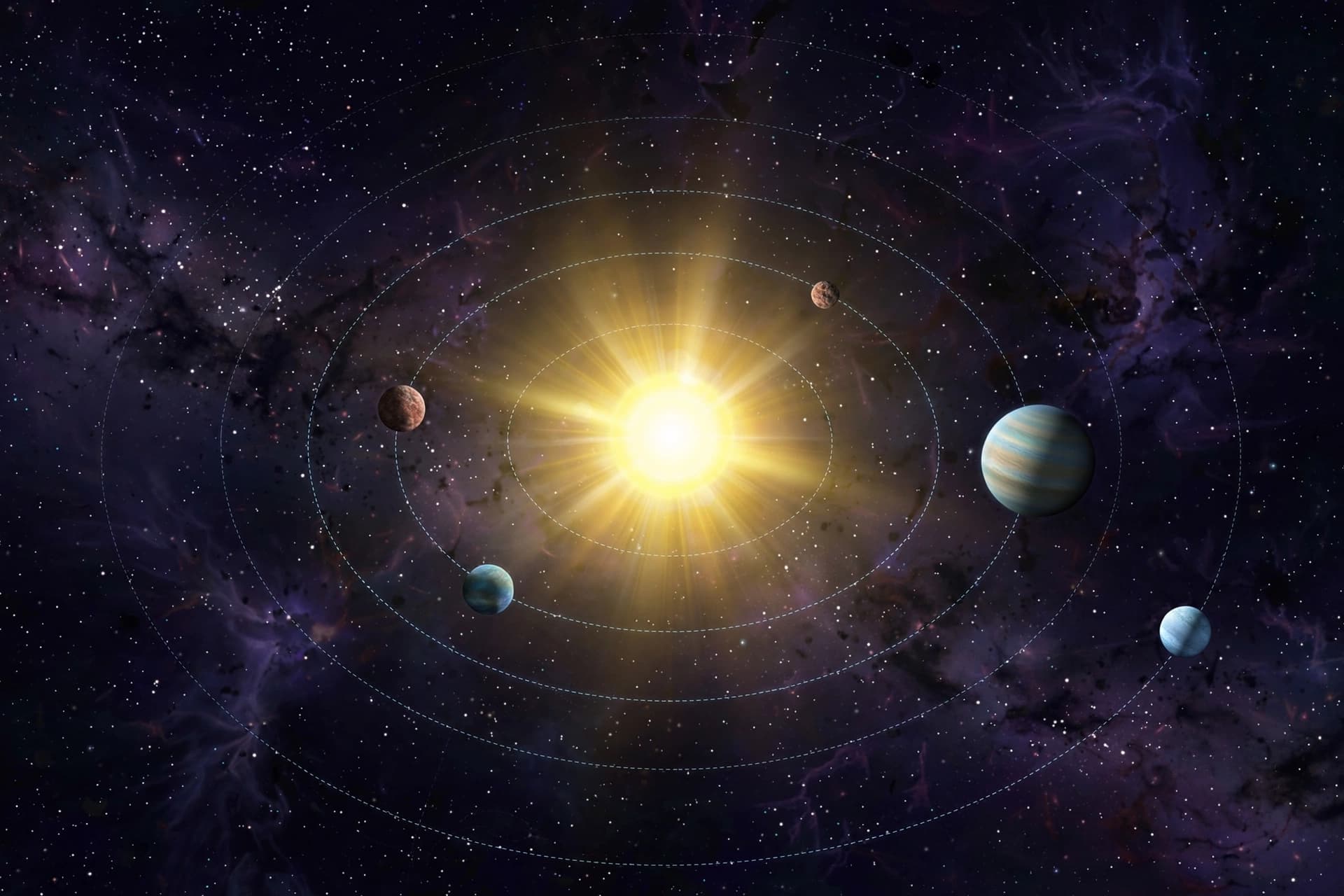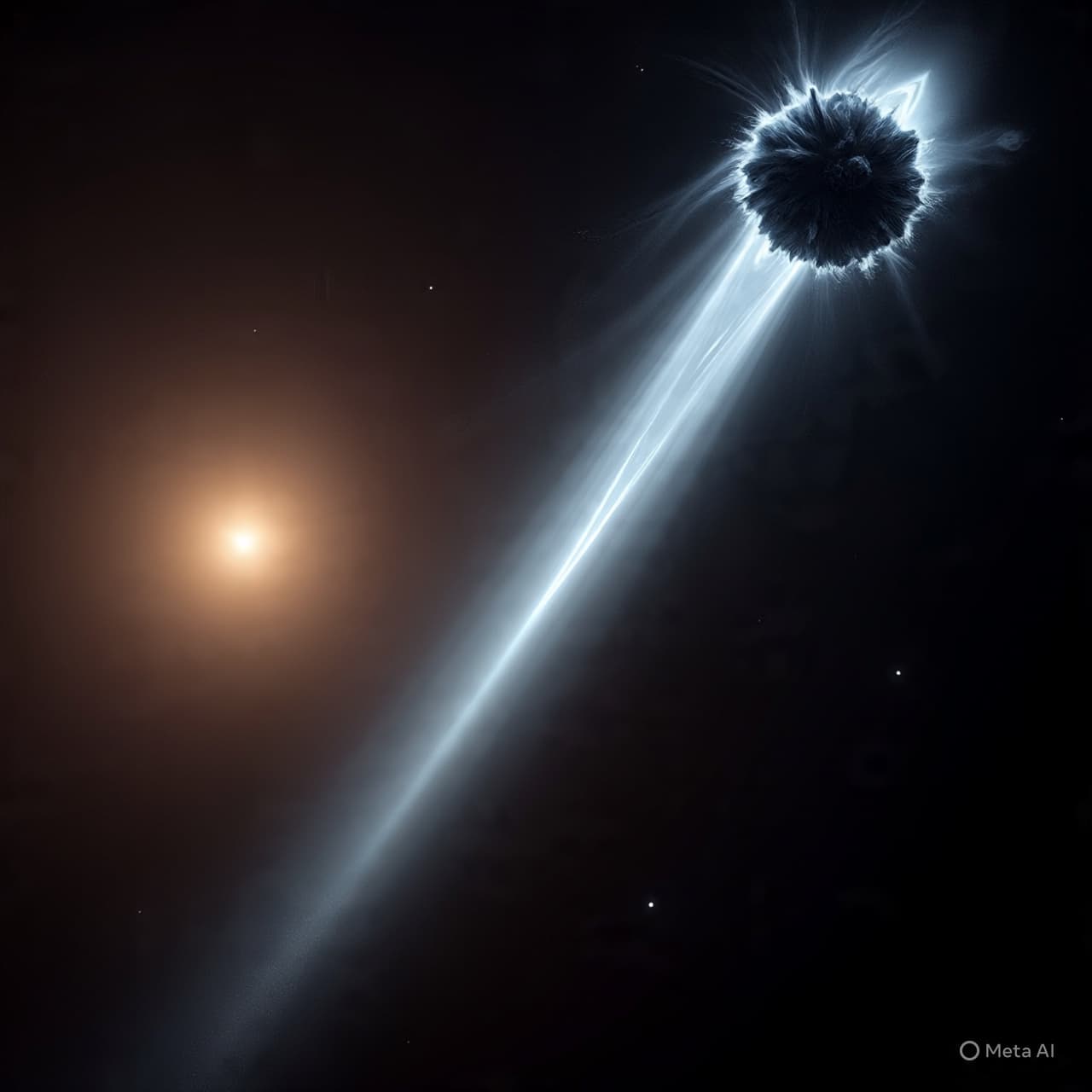
Beyond the familiar confines of our solar system, among the scattered debris of interstellar space, a lone traveler drifts — unseen except by the watchful eyes of astronomers peering through vast lenses. This is 3I/ATLAS, a cometary visitor whose path is swift and hyperbolic, marking it unmistakably as an object from another star. It moves silently through the cosmic ocean, a speck against the backdrop of distant suns, yet it carries a mass that dwarfs its predecessors: perhaps a billion metric tons, hundreds of thousands of times the weight of the first interstellar visitor, 1I/‘Oumuamua.
One imagines the comet as a quiet colossus, its icy heart encased in dust, holding within it the frozen echoes of a planetary system far beyond our own. Unlike the elongated, enigmatic ‘Oumuamua, which puzzled astronomers with its slender shape and unusual trajectory, 3I/ATLAS is substantial — a vessel of ice and rock whose mass resists the gentle nudges of solar radiation and outgassing. Its journey through the solar system is not easily diverted, a fact that hints at the hidden heft it bears, measured in billions of tons yet moving silently through the void.
Astronomers have calculated its nucleus to be several kilometers across, a size that alone suggests extraordinary mass. This enormous weight explains why, unlike smaller interstellar objects, it shows little deviation from a purely gravitational path. Each photon of sunlight, each particle of space dust colliding with it, has only the faintest effect on its motion — a subtle testament to the scale of matter it carries. In comparison, ‘Oumuamua, small and light, responded more noticeably to the forces of its environment, drifting and twisting as it passed through our inner solar system.
The contrast between these two interstellar travelers offers a quiet meditation on cosmic scale and perspective. One object, fleeting and ghostly; the other, robust and ponderous. Both come from beyond, reminders that our sun is but one light in a crowded galaxy, and that the space between stars is not empty but populated by objects of unimaginable variety. They move according to the same laws, yet their stories are profoundly different — one whispers, the other moves with a subtle, enduring weight that belies its silent passage.
In practical terms, the immense mass of 3I/ATLAS makes it a fascinating subject for study. Its gravitational resilience allows researchers to measure its trajectory more precisely, to infer composition from subtle spectral readings, and to understand the diversity of material traveling between stars. For now, it continues its journey, already receding from the sun’s warmth, carrying the frozen story of a distant system into the depths of space once more.
In straightforward news language, astronomers estimate that 3I/ATLAS, the third confirmed interstellar object, has a mass on the order of a billion metric tons, far exceeding that of 1I/‘Oumuamua by at least a hundred thousand times. Observations of its trajectory and lack of non-gravitational acceleration suggest a substantial, multi-kilometer nucleus. The comparison underscores the wide diversity of interstellar objects passing through our solar system and the continuing opportunities to study matter from beyond our own star.
Disclaimer: Visuals are AI-generated and serve as conceptual representations.
Published by Banx Network. This article is part of the Banx decentralized media programme, powered by the BXE token on the XRP Ledger.