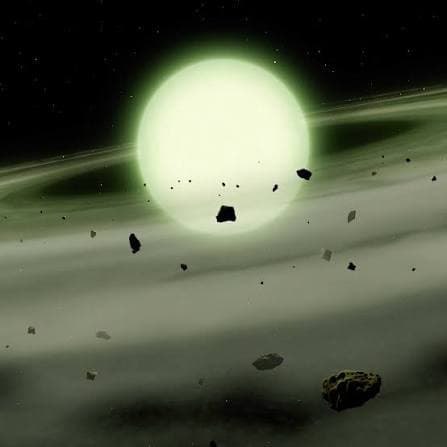
There are movements in the universe that unfold without light.
Far beyond the reach of ordinary sight, enormous bodies drift through space in silence, guided only by gravity. Their paths curve slowly over millions of years, sometimes drawing them together into an unseen orbit, a gradual spiral that tightens with time.
Eventually, the quiet motion becomes something else entirely.
Two black holes—each the collapsed remnant of once-massive stars—circle one another in a tightening dance. With every revolution, their orbit shrinks. The distance between them narrows. Gravity deepens its grip.
Then, in a fraction of a second, the spiral ends.
The black holes collide.
When such a merger occurs, the event does not erupt in light or flame. Instead, it releases energy in a subtler but more profound form: gravitational waves, ripples in the fabric of spacetime itself. These waves move outward at the speed of light, stretching and compressing space as they travel across the universe.
Recently, astronomers recorded one such signal—an event powerful enough to draw particular attention.
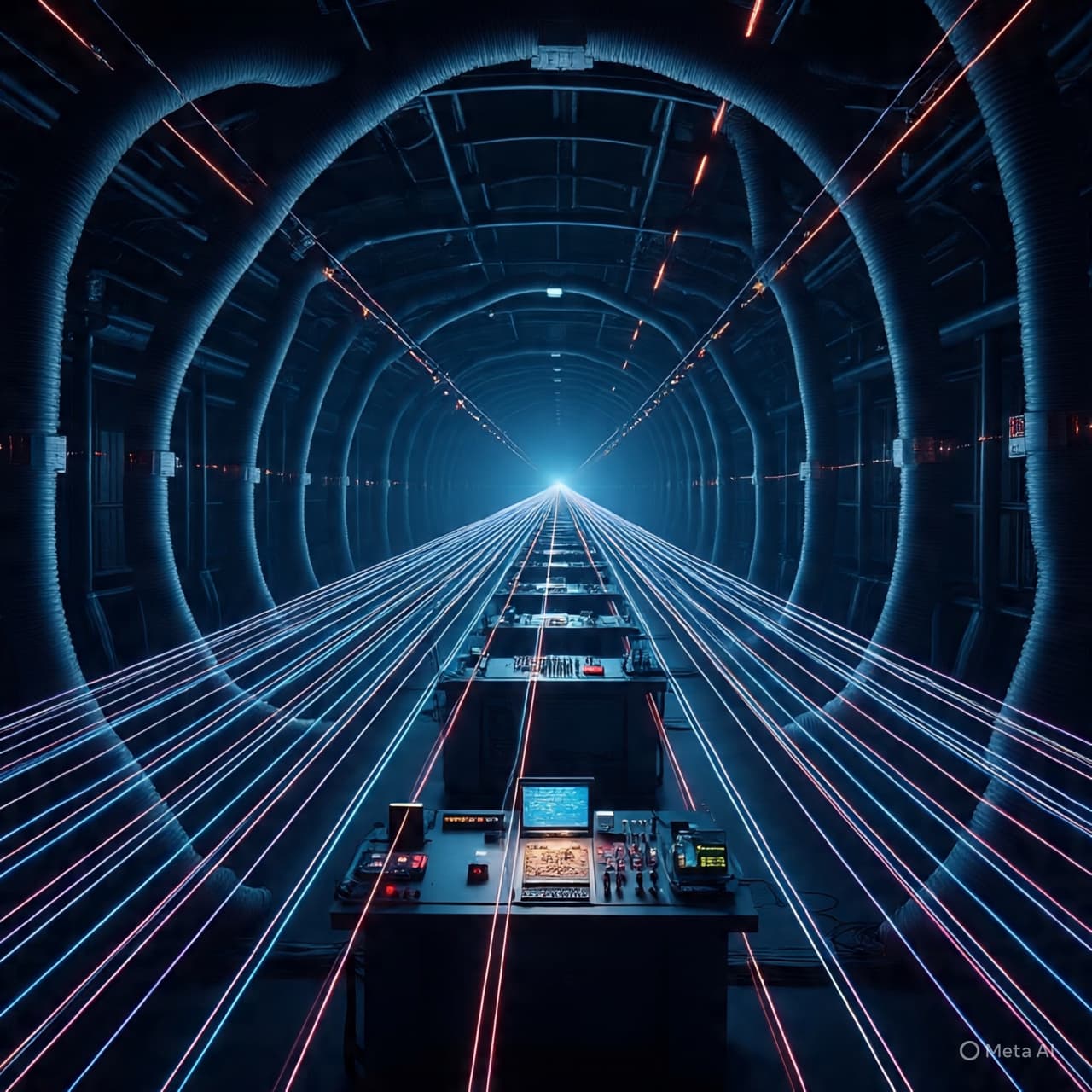
The gravitational waves were detected by observatories designed to listen for these cosmic disturbances, including the Laser Interferometer Gravitational-Wave Observatory (LIGO) and the Virgo detector. The signal revealed that two black holes, together totaling roughly 100 times the mass of the Sun, had merged somewhere deep in the universe.
As the pair spiraled together, they released immense energy through gravitational radiation. For a brief moment, the power carried away by these waves rivaled the energy output of all the stars in the observable universe combined.
Yet the story may not end with gravitational waves alone.
In an intriguing twist, astronomers examining observations from space-based telescopes noticed something else: a faint gamma-ray flash appearing around the same time as the gravitational-wave signal. Gamma rays represent the most energetic form of light, often associated with violent astrophysical events such as supernovae or neutron star collisions.
Black hole mergers, however, are usually expected to remain dark.
Unlike collisions involving neutron stars, black holes do not typically carry surrounding material that can produce electromagnetic radiation. When two of them merge in empty space, the event should unfold invisibly except for the gravitational waves it emits.
This makes the possible gamma-ray signal particularly intriguing.
One possibility is that the black holes were surrounded by a thin disk of gas left behind from earlier stellar activity. If such material were present, the violent merger might have disrupted it, generating a burst of high-energy radiation.
Another possibility is coincidence—a gamma-ray event occurring nearby in time but unrelated to the merger itself.
Astronomers are examining the timing and location of the observations carefully, searching for evidence that might confirm or dismiss a true connection. The difficulty lies in the vastness of the sky. Gravitational-wave detectors can estimate where a merger occurred, but the region they identify often spans large portions of space.
Within that uncertainty, many other events may also unfold.
Still, the detection offers a reminder of how rapidly the study of the universe is evolving. Only a decade ago, gravitational waves had never been directly observed. Today, observatories routinely record the subtle tremors left behind by distant cosmic collisions.
Each signal carries a fragment of the universe’s hidden activity.
In this case, scientists report that gravitational waves from a merger of two black holes with a combined mass of about 100 solar masses were detected, and a possible gamma-ray flash occurring at roughly the same time is being investigated to determine whether it was connected to the event.
AI Image Disclaimer These illustrations were generated with AI tools to visually represent scientific ideas described in the article.
Source Check
Nature Space.com ScienceAlert Phys.org Scientific American
Published by Banx Network. This article is part of the Banx decentralized media programme, powered by the BXE token on the XRP Ledger.