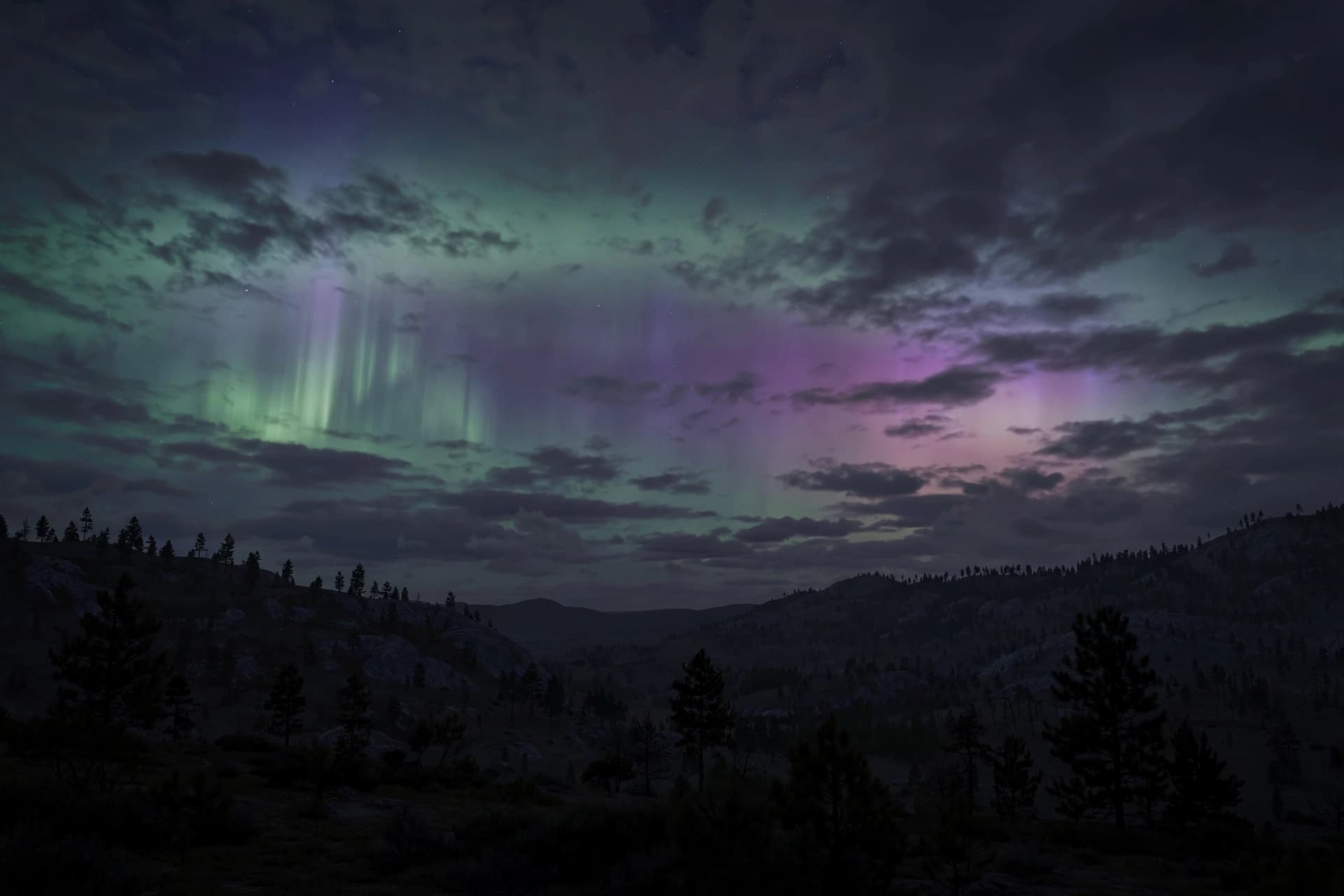
There are times when the sky seems to gather its events into a single frame, as if distance itself were folding inward. A streak of fire across the night, a sudden brightness where none was expected—and somewhere beyond, unseen but tracked, a traveler passing through from another system entirely. It becomes difficult, in such moments, not to connect what is separate.
The recent rise in fireball sightings across the United States has created just such a feeling. Reports have accumulated—bright meteors, sonic booms, brief interruptions in the stillness of the upper air. At the same time, astronomers have been following the passage of 3I/ATLAS, a rare interstellar visitor moving on a path that does not belong to the Sun’s long-bound family of objects.
It is a natural question: whether these two movements, one immediate and luminous, the other distant and measured, might share a common origin.
Yet the geometry of space resists this alignment. The comet itself has remained far from Earth, passing at a distance of roughly 1.8 astronomical units—well beyond the reach where its debris might intersect our atmosphere. Its trajectory, hyperbolic and unbound, carries it through the solar system only once, without leaving behind a persistent stream of material like those that produce annual meteor showers.
The fireballs, by contrast, belong to a different rhythm. Data from the American Meteor Society suggests that 2026 has indeed seen an unusually high number of reported events, with over 2,000 sightings in the first quarter alone. Some of these have been particularly energetic, involving large meteoroids that penetrate deeper into the atmosphere before fragmenting.
But even this apparent surge carries its own context. The increase, while notable, sits only slightly above previous high years, suggesting variation rather than transformation. Seasonal effects, observational coverage, and natural fluctuations in incoming space debris all contribute to what appears, from the ground, as a sudden pattern.
More directly, analyses of the recent fireballs indicate energies and trajectories inconsistent with material originating from 3I/ATLAS. Some events have involved multi-ton objects releasing energy equivalent to tens or even hundreds of tons of TNT—far exceeding what would be expected from small cometary dust particles drifting from such a distant source.
The distinction, though subtle, is important. Comets can produce meteor showers when Earth passes through streams of debris they have shed over repeated orbits. But an interstellar object like 3I/ATLAS does not linger. It passes through once, leaving little opportunity for Earth to intersect any material in a meaningful way.
And so the two stories remain parallel rather than connected. One unfolds close to Earth, in the fragile boundary where atmosphere meets space, where small fragments ignite and vanish. The other moves quietly through the broader architecture of the solar system, observed through telescopes and calculations, carrying information from a place far beyond.
What remains is not a single explanation, but a reminder of scale. The sky is not one system but many, layered and simultaneous. Events that appear linked from a human vantage point may, in fact, belong to entirely different orders of motion.
There is a certain humility in that realization. Not every convergence is a connection. Sometimes, the sky is simply busy.
Recent analyses indicate that the surge in meteor fireballs observed in early 2026 is not related to the interstellar comet 3I/ATLAS. The comet’s trajectory and distance from Earth make such a connection unlikely, while the increase in fireball reports is attributed to natural variability and observational factors. Research and monitoring continue.
AI Image Disclaimer
Illustrations were created using AI tools and are not real photographs.
Sources
EarthSky NASA Scientific American Astrobiology.com American Meteor Society
Published by Banx Network. This article is part of the Banx decentralized media programme, powered by the BXE token on the XRP Ledger.