There are nights when the sky seems unchanged, a familiar expanse stretching quietly above, holding its distances with calm indifference. Yet within that stillness, motion persists—objects circling unseen, tracing paths that repeat and overlap, forming patterns too large to grasp at once. Over time, these patterns gather, becoming something more deliberate, more constructed.
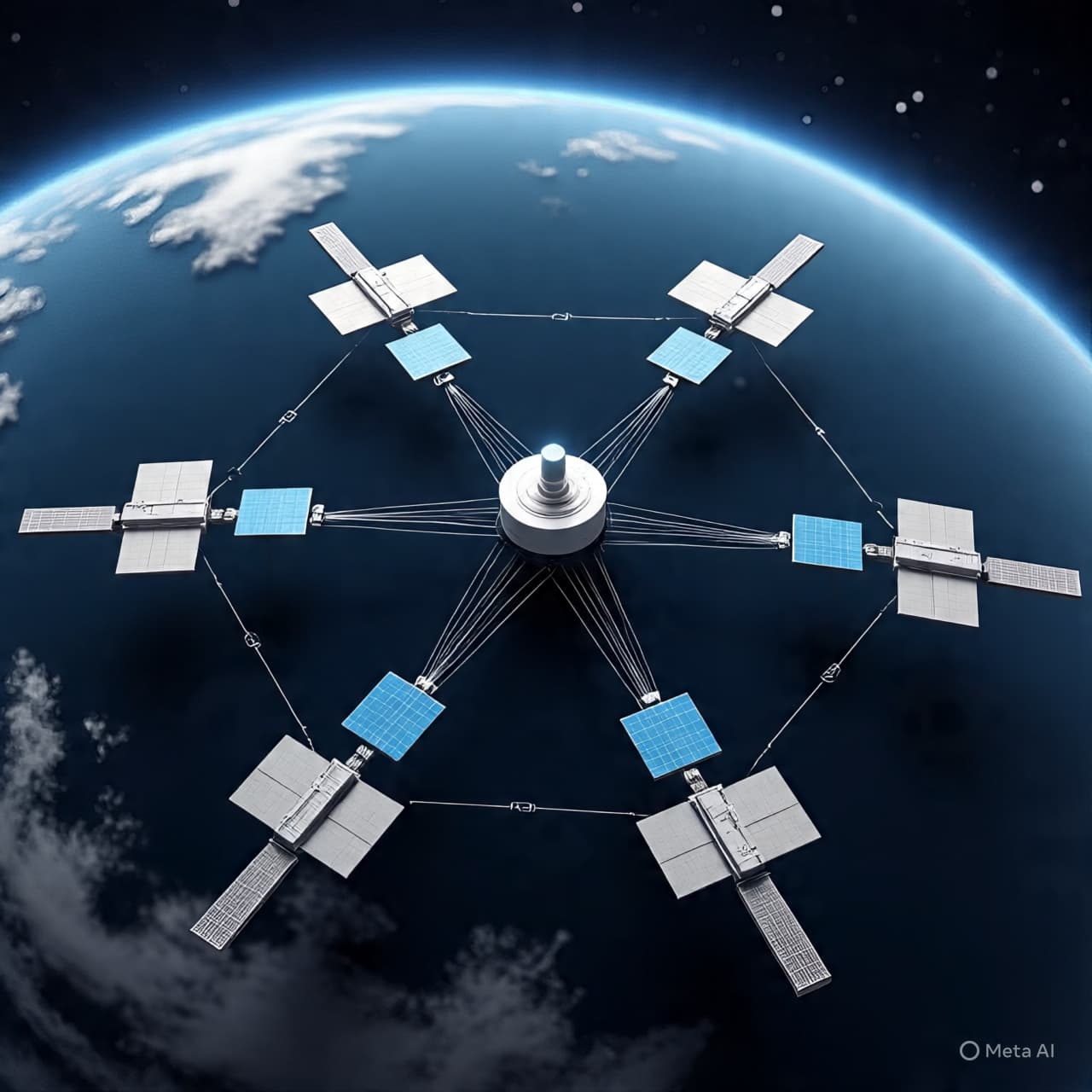
With the launch of its 10,000th active Starlink satellite into low Earth orbit, SpaceX marks a milestone that reflects not a single moment, but an accumulation. Each satellite, small in isolation, contributes to a network that has grown steadily, orbit by orbit, into one of the most extensive infrastructures ever placed beyond the atmosphere.
The Starlink constellation was conceived as a means of delivering high-speed internet to regions where connectivity remains limited or inconsistent. By positioning satellites in low Earth orbit, closer to the planet than traditional geostationary systems, the network reduces latency and improves performance. Signals travel shorter distances, allowing communication to feel more immediate, less delayed by the vastness it must cross.
As the constellation expands, its presence becomes both functional and visible. Observers on the ground have noted the passage of satellite trains—lines of light moving in sequence across the night sky, briefly altering its familiar stillness. For some, these movements are a reminder of technological reach; for others, they introduce questions about how the sky itself is changing.
Beyond visibility, there are practical considerations that accompany such growth. Managing a large number of satellites in low Earth orbit requires careful coordination to avoid collisions and to mitigate the accumulation of space debris. SpaceX has incorporated automated collision-avoidance systems and plans for deorbiting satellites at the end of their operational life, though the long-term sustainability of increasingly crowded orbital paths remains a subject of ongoing discussion.
There is also the matter of balance—between access and impact. The expansion of satellite networks has the potential to extend connectivity to remote communities, supporting communication, education, and economic activity. At the same time, astronomers and researchers continue to examine how large constellations affect observations of the night sky, where even faint streaks of reflected light can influence sensitive measurements.
The milestone of 10,000 active satellites does not signal completion, but continuation. Plans for further launches remain, and the network is expected to grow in both scale and capability. Each addition refines coverage, fills gaps, and strengthens the system as a whole.
There is a certain quiet persistence in this process. The satellites do not remain fixed; they move continuously, circling the Earth in patterns that repeat yet evolve. Together, they form a network that exists not in a single place, but in motion itself—a structure defined by its constant return.
SpaceX has launched its 10,000th active Starlink satellite into low Earth orbit, marking a significant expansion of its global internet constellation. The company continues to deploy satellites to improve coverage and performance, while addressing concerns related to orbital congestion and astronomical observations.
AI Image Disclaimer
Visuals are AI-generated and serve as conceptual representations rather than real images.
Source Check
SpaceX Reuters BBC News SpaceNews The Verge
Published by Banx Network. This article is part of the Banx decentralized media programme, powered by the BXE token on the XRP Ledger.