At dusk’s waning light, when the sky’s warmth lingers like a folded secret, it’s easy to forget how much remains unseen — not just in our own world but in neighbors cloaked in heat and cloud. Venus, the brilliant evening star, offers a shimmer that belies complexity beneath its sulfurous skies, a veiled dialogue between atmosphere and stone. In the expanse of space, where suns rise and set over distant horizons, Venus endures as a world both familiar and profoundly different from our own.
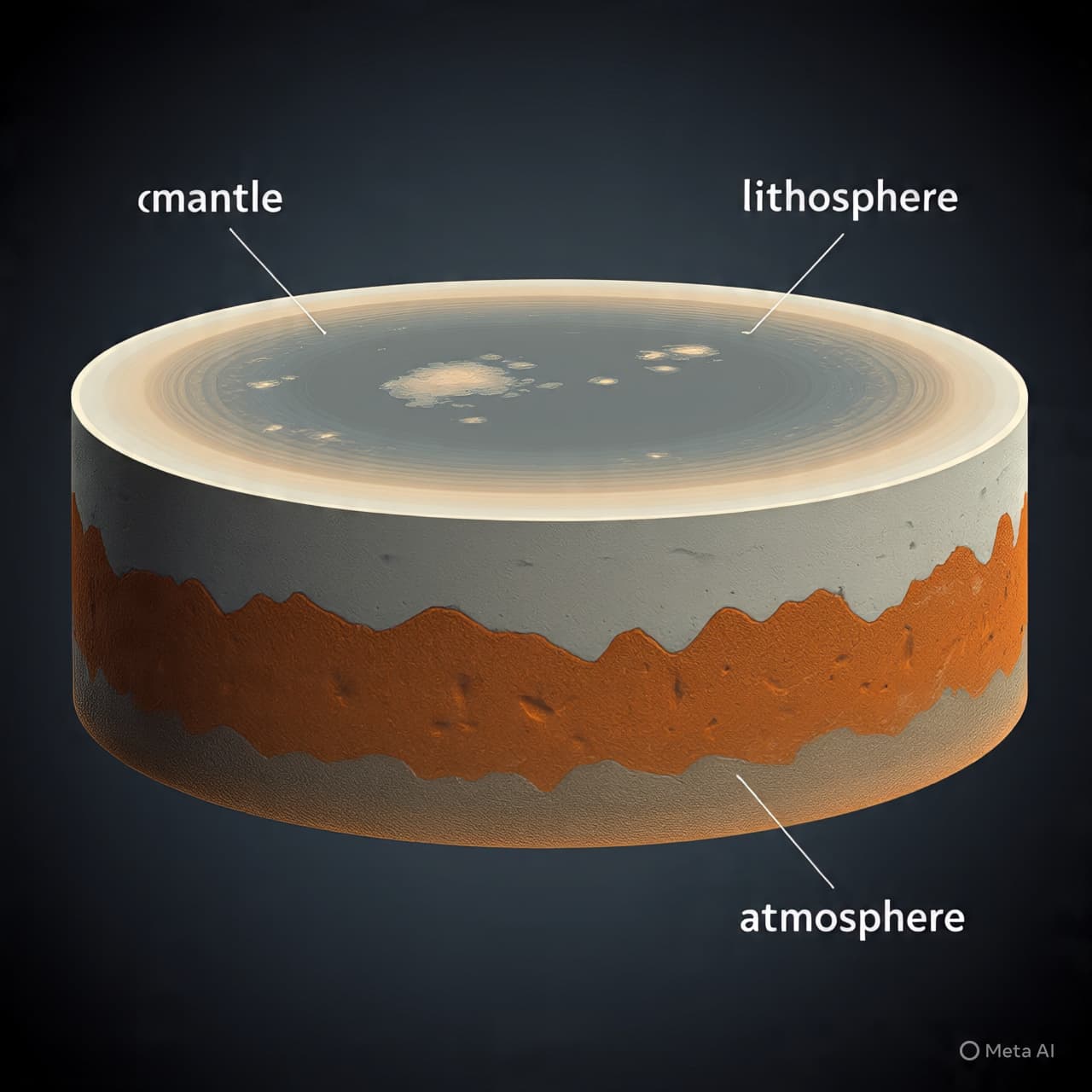
Scientists, in their quiet pursuit of planetary truth, have woven together models that reach far below Venus’s roiling exterior. With a coupled interior‑lithosphere‑atmosphere model, they are attempting to trace the deep rhythms of this world’s thermal history — the interplay between heat trapped within, the thick lithosphere that encases it, and the heavy atmosphere that swathes its surface. In doing so, researchers seek to illuminate how Venus’s crust, mantle, and core have evolved in concert with its climate over eons.
This approach acknowledges that a planet’s interior and exterior are not separate tales but sections of the same long story. By simulating the pathways of heat flow from the core up through the mantle and lithosphere, and then into the dense envelope of carbon dioxide and sulfuric clouds above, scientists can explore scenarios that are otherwise unobservable. These models suggest that Venus’s interior may have followed one of several evolutionary paths — from steady cooling to phases where volcanic activity wanes, to patterns of internal oscillation that echo through the planet’s geology and atmosphere alike.
Intriguingly, many plausible histories from these simulations preserve at least an Earth‑like amount of water deep within Venus’s mantle, even as its surface remains scorched. Some scenarios imply that parts of the interior remain volcanically active today, sending molten rock upward and contributing to the young age of much of its crust. Others suggest that Venus may once have hosted a magnetic field driven by a convecting core, now stilled — a silent echo of past dynamics that leave their imprint only in the present absence of such a field.
These insights dovetail with broader scientific efforts to understand how conditions deep within a planet can shape its surface and skies. Radar mapping and crater counts show Venus’s crust to be surprisingly young and relatively uniform, hinting at episodes of resurfacing and mantle overturns that may have altered the planet’s face in dramatic sweeps. The lack of Earth‑like plate tectonics and the strong greenhouse atmosphere reflect not just external forces but the deeper exchanges of heat and materials that are woven into the planet’s very fabric.
In this meditative merging of models and observation, we see a world that does not simply sit under an oven‑like sky but breathes, in its own immense time, through cycles of heat and renewal. Venus’s interior tells a tale of transitions and potential, of heat transported upward and of the atmosphere that both traps and resists that warmth. The research offers a richer picture of how terrestrial planets evolve — how their cores cool, how their crusts take shape, and how atmospheres and interiors entwine in a long, silent waltz.
In essence, the investigation of Venus’s deep past — its thermal history, crustal evolution, and core dynamics — provides a grounded scientific narrative about a world close in scale but distant in temperament. The study’s predictions, rooted in physics and simulation, create a framework that future missions and observations can test, gently drawing back the opaque curtain that has long cloaked our sister planet.
AI Image Disclaimer: Visuals are AI‑generated and serve as conceptual representations.
Sources: Astrobiology.com reporting, ArXiv research preprint, planetary geodynamics literature.
Published by Banx Network. This article is part of the Banx decentralized media programme, powered by the BXE token on the XRP Ledger.