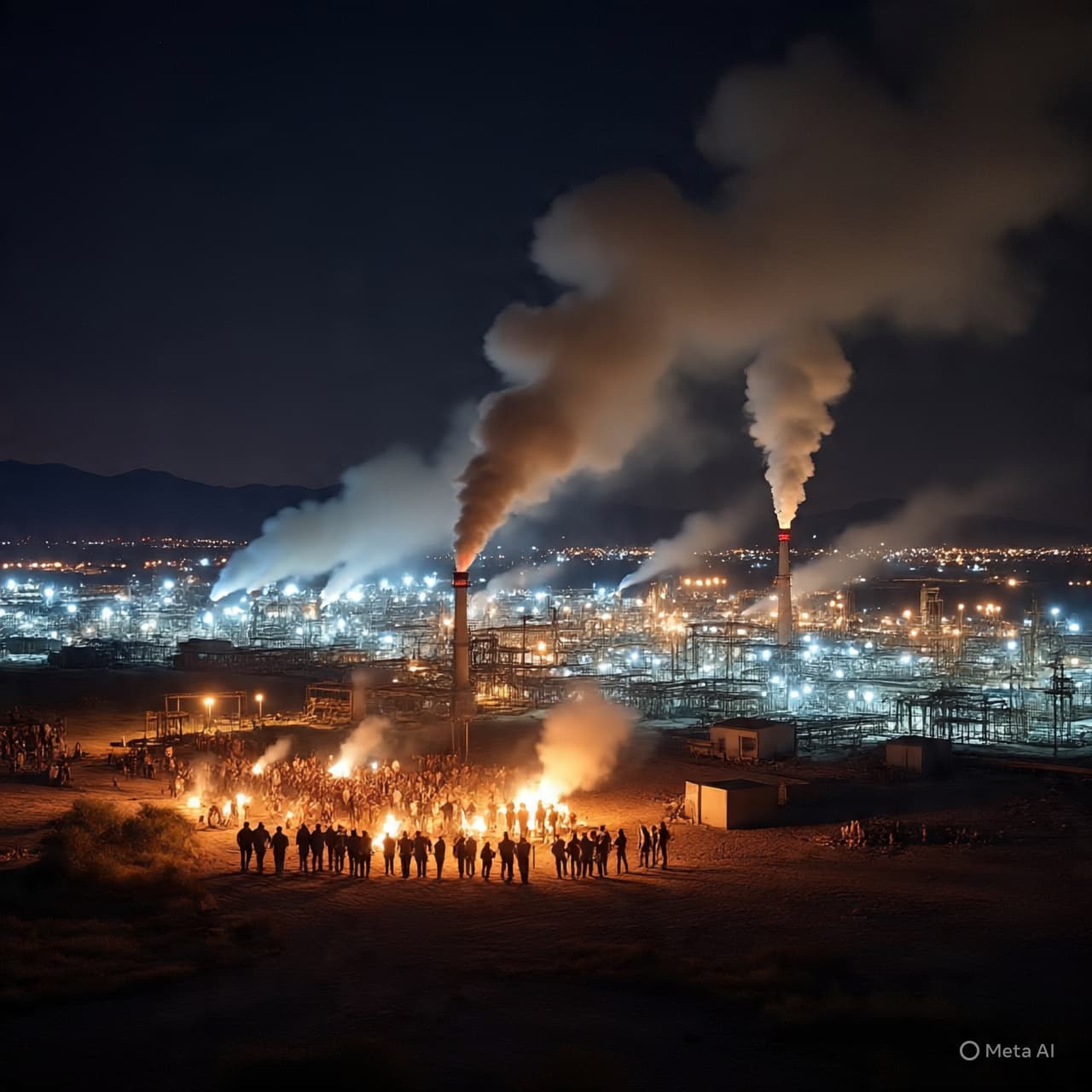
Before dawn, the desert holds its breath differently. The wind moves across ridgelines and refinery towers with a low, patient hum, as if the earth itself were waiting for something unnamed. In the early hours, that waiting was broken by the distant percussion of airstrikes—flashes over strategic facilities, tremors carried through concrete and glass. The night sky above Iran, usually vast and untroubled, flickered with the brief geometry of missiles and interception systems, and for a moment the horizon seemed to pulse like a living thing.
The United States and Israel confirmed a coordinated military operation targeting what officials described as key Iranian military and nuclear-related infrastructure. Defense statements emphasized precision and limited objectives: storage depots, command centers, missile platforms. The language was measured, technical, built to reassure as much as to assert. Yet even the most careful vocabulary cannot soften the sound of aircraft crossing borders or the sight of smoke rising against first light.
In Tehran and other cities, residents woke not to routine alarms but to a scatter of messages—news alerts, phone calls, the distant thud of impact. Social media filled with fragments: trembling windows, columns of flame in the distance, the strange quiet that follows a strike. Iranian authorities reported damage to several sites and vowed retaliation. State television carried images of emergency crews and statements promising resilience, framing the attack as aggression against sovereignty.
From Washington, President Donald Trump addressed Iranians directly, urging them to “take over your government.” The appeal, delivered alongside warnings of further consequences, marked a shift from purely military framing to something more overtly political. In Israel, leaders described the strikes as a necessary act of preemption against what they characterized as an accelerating threat. For both governments, the operation was presented as a defensive necessity, a line drawn under mounting tensions.
But lines, once drawn in fire, rarely stay confined to maps.
The region has lived for years in a state of suspended breath—sanctions tightening and loosening, negotiations faltering and reviving, proxy conflicts flaring in shadowed corners from Lebanon to the Gulf. Iran’s nuclear program has long been the axis around which these tensions turn, monitored by international inspectors, debated in diplomatic halls, cited in speeches that drift between caution and confrontation. Each new development arrives layered atop old grievances, old mistrusts.
As daylight spread across the Iranian plateau, markets opened hesitantly. Oil prices edged upward in early trading, reflecting the nervous calculus of global supply routes that pass through narrow straits and contested waters. Governments across Europe and Asia issued calls for restraint. The United Nations urged de-escalation. In capitals near and far, diplomats moved quickly—private calls, emergency briefings, the choreography of crisis.
Inside Iran, the president and senior officials condemned the strikes and signaled that retaliation would be “measured but firm.” The Islamic Revolutionary Guard Corps spoke of consequences. Yet beyond official statements, there is the quieter, less legible terrain of public feeling. Some citizens, weary of economic hardship and isolation, listened to foreign appeals with skepticism; others reacted with anger at what they viewed as external interference. National identity, like the desert wind, shifts direction but rarely disappears.
In Israel, air defense systems remained on alert, their radars scanning the edges of the sky. In the United States, lawmakers divided along familiar lines—some praising decisive action, others warning of entanglement and unintended escalation. The memory of past Middle Eastern wars, their long shadows and unanticipated costs, hovered unspoken in many commentaries.
War, even when described as limited, rearranges the rhythm of ordinary life. Flights reroute. Parents hesitate at school gates. Investors pause. In border regions, soldiers wait in fortified positions, listening for signals that may or may not come. The human scale of such moments is often overshadowed by maps and acronyms, yet it is there—measured in heartbeat and breath.
By afternoon, the smoke over targeted sites thinned into pale streaks against a bright sky. Analysts debated next steps: Would Iran respond directly, or through regional proxies? Would further strikes follow, or would the operation stand as a contained message? The answer, as always, rests in decisions made behind closed doors, in rooms far removed from the streets that absorb the consequences.
As night prepares to return, the region holds itself in a new kind of stillness—no longer the quiet before an event, but the quiet after. The facts are stark: confirmed strikes, political appeals, vows of retaliation, markets unsettled, diplomats engaged. Yet beneath those facts lies something less tangible: the fragile balance between force and restraint, between sovereignty and intervention, between a government and the governed.
The desert will cool again. The wind will move across the same ridgelines. But somewhere in the distance, the memory of fire will linger, a reminder that in this part of the world, history is never entirely past—it waits, like heat beneath the sand, ready to rise.
AI Image Disclaimer Illustrations were created using AI tools and are not real photographs.
Sources Reuters Associated Press BBC News The New York Times Al Jazeera
Published by Banx Network. This article is part of the Banx decentralized media programme, powered by the BXE token on the XRP Ledger.