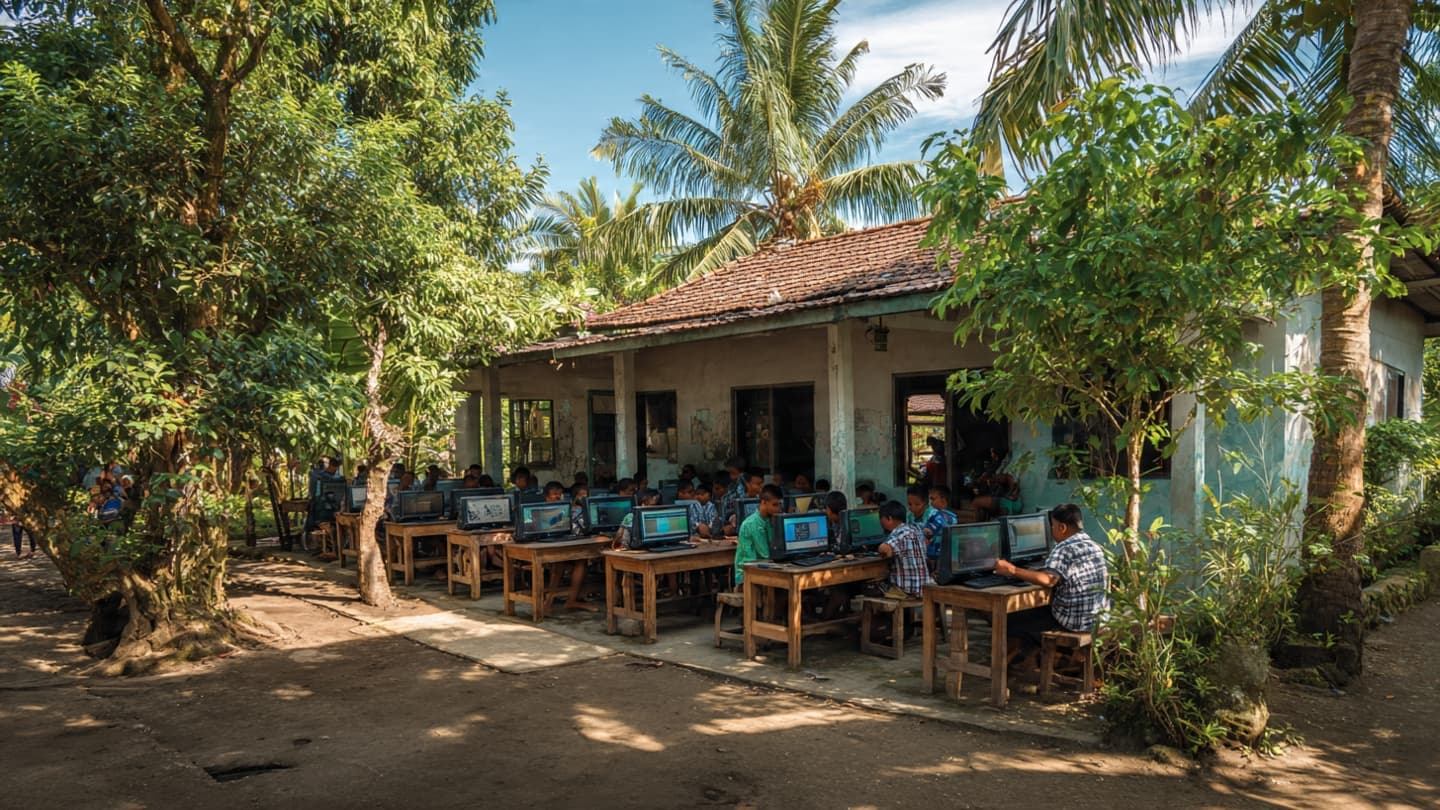
Across Indonesia, distance has always been measured in more than kilometers. It lives between islands, across mountains, beyond roads that disappear into forests, and in the long pauses between one community and another. Now, some of those distances are being crossed not by roads or bridges, but by a signal moving quietly through the sky.
The SATRIA-1 satellite is providing internet connectivity to 31,803 public-service locations across the country, according to data from BAKTI, the Telecommunications and Information Accessibility Agency under the Ministry of Communication and Digital Affairs. The figure, recorded in early June, includes schools, government offices, health facilities and other public locations.
Education forms the largest part of that network. Of the connected locations, 21,718, or about 68 percent, are educational facilities. Another 6,353 locations are government offices, while 1,880 are health facilities. The remainder includes community centers, places of worship, tourism facilities, businesses and public transportation services.
The numbers describe something larger than an internet project. For a school in a remote area, connectivity can become a route toward digital learning materials and communication beyond its immediate surroundings. For a health center, it can provide another channel through which information and services may travel. For a village office, the connection can shorten the distance between local administration and the wider state.
SATRIA-1 carries a total capacity of 150 gigabits per second and uses very-high-throughput satellite technology in the Ka-band. It began operating after its 2023 launch, becoming part of Indonesia’s broader effort to extend connectivity to places where conventional terrestrial infrastructure remains difficult to build.
Its role is therefore not to replace fiber-optic networks or cellular towers, but to complement them. Indonesia has been extending terrestrial networks while using satellite infrastructure for areas where geography makes conventional deployment more complicated. The result is a layered digital map, with cables, towers and satellites serving different parts of the archipelago.
The physical infrastructure behind the satellite is extensive as well. SATRIA-1 is supported by 11 gateways positioned across places including Batam, Pontianak, Banjarmasin, Cikarang, Manado, Ambon, Kupang, Manokwari, Timika, Jayapura and Tarakan. These facilities connect the satellite system with Indonesia’s national internet network.
What remains difficult to measure is the quieter effect of connectivity. A faster connection does not automatically change a classroom, clinic or village economy overnight. Its value emerges gradually, through teachers accessing resources, health workers communicating more efficiently and residents gaining access to services that once required longer journeys.
As Indonesia continues expanding its digital infrastructure, the meaning of connectivity is becoming increasingly practical. SATRIA-1 is now serving tens of thousands of public facilities, particularly in areas where terrestrial networks remain limited. The satellite does not erase Indonesia’s geography, but it offers another way to cross it.
SEO-friendly slug: satria-1-satellite-internet-connectivity-indonesia-remote-areas
Hashtags: #Indonesia #SATRIA1 #Technology #DigitalConnectivity #InternetAccess #Education #HealthTech
Image Disclaimer Illustrations are AI-generated conceptual visuals and should not be interpreted as authentic photographs.
Sources ANTARA Ministry of Communication and Digital Affairs
Published by Banx Network. This article is part of the Banx decentralized media programme, powered by the BXE token on the XRP Ledger.