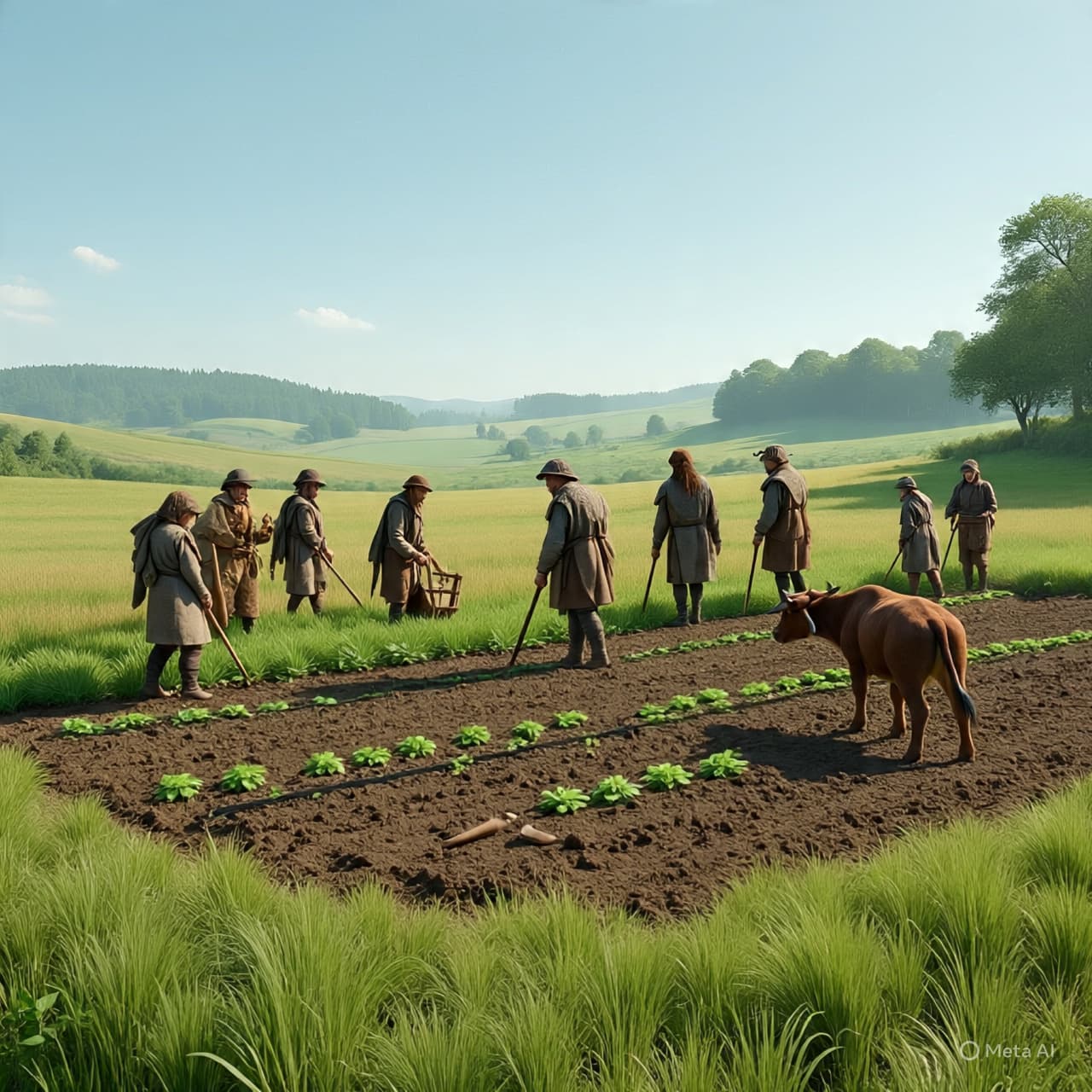
Long before cities rose and borders appeared on maps, Europe was a continent of forests, rivers, and wandering paths. Small communities moved with the rhythm of the seasons, hunting animals and gathering wild plants. Their lives were guided by landscapes rather than by fields, and survival depended on the deep knowledge of forests, rivers, and changing skies.
Then, slowly and almost quietly, another way of life began to arrive.
Thousands of years ago, groups of early farmers began moving into Europe from regions to the southeast. They carried with them seeds, domesticated animals, and the knowledge of how to shape land into fields. Their arrival did not happen all at once. Instead, it unfolded gradually—village by village, valley by valley—like a new chapter slowly written across the continent.
For many years, archaeologists wondered how these farming communities interacted with the hunter-gatherer groups already living in Europe. Did they remain separate? Did they compete? Or did their stories eventually blend together?
Now, ancient DNA is offering a more intimate answer.
Recent genetic studies examining remains from prehistoric Europe suggest that women from farming communities often formed partnerships with men from local hunter-gatherer populations. These relationships appear to have played an important role in the gradual mixing of cultures that shaped Europe’s early societies.
The research comes from detailed analysis of ancient genomes recovered from burial sites dating back thousands of years. By studying genetic markers passed through maternal and paternal lines, scientists can trace patterns of ancestry within ancient populations. These patterns sometimes reveal subtle social dynamics that archaeology alone cannot easily show.
In this case, the genetic signatures pointed to a striking pattern.
The maternal ancestry of some individuals appeared closely connected to farming groups that had migrated into Europe. Yet their paternal ancestry often reflected local hunter-gatherer populations who had lived on the continent for generations. In simple terms, it suggests that women from farming communities sometimes joined hunter-gatherer groups, forming families that blended two very different ways of life.
Such unions may have carried practical advantages.
Early farming societies possessed knowledge of agriculture—how to cultivate grains, raise livestock, and establish more permanent settlements. Hunter-gatherer communities, meanwhile, held deep understanding of local landscapes, seasonal animal movements, and the ecosystems of forests and rivers. When these communities came together, their combined knowledge may have helped shape new hybrid cultures.
Rather than a sudden replacement of one way of life by another, the transition toward farming in Europe may have unfolded through generations of cultural exchange, cooperation, and adaptation.
The DNA evidence also hints at the human stories behind these changes. Migration is often imagined as a movement of entire populations. Yet in reality, the transformation of societies frequently occurs through individuals—through marriages, partnerships, and families that link different groups together.
In prehistoric Europe, these personal connections may have helped farming practices spread gradually across the continent. As families blended traditions, fields began appearing beside forests, and seasonal camps slowly evolved into more settled communities.
Over centuries, these changes reshaped the landscape of Europe.
The forests that once defined much of the continent began to give way to farmland. Villages emerged, and populations grew. Yet beneath those changes lay a quieter story—one written not only in tools and pottery, but also in the genetic memories carried by descendants thousands of years later.
For researchers, the findings offer another reminder that human history is rarely a simple story of replacement or conflict. More often, it unfolds through encounters, exchanges, and relationships that connect different worlds.
Ancient DNA continues to refine this picture, revealing how early Europeans navigated the meeting of two very different lifestyles. And while many details remain to be explored, the emerging evidence suggests that cooperation and shared lives may have played a larger role than once imagined.
In the end, the transition from forests to fields was not merely an agricultural revolution. It was also a deeply human story—one shaped by journeys, relationships, and the quiet merging of cultures across generations.
AI Image Disclaimer Images in this article are AI-generated illustrations, meant for concept only.
Sources
Nature Science The Guardian Live Science Smithsonian Magazine
Published by Banx Network. This article is part of the Banx decentralized media programme, powered by the BXE token on the XRP Ledger.