

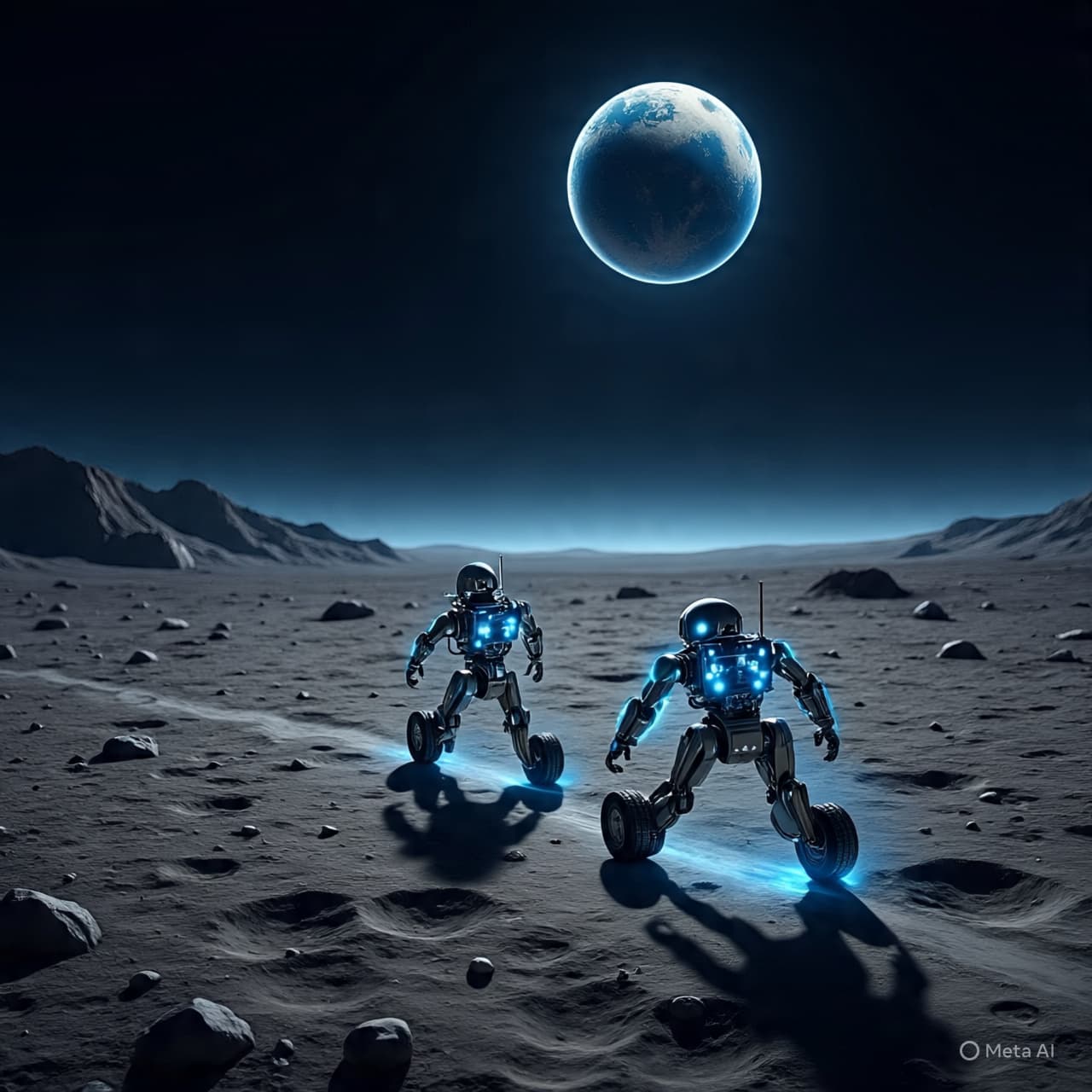
Key Highlights
- Legged robots are designed to navigate uneven terrains on the Moon and Mars.
- These robots can adapt their movements, making them suitable for challenging landscapes.
- Their development is crucial for future resource identification and scientific discovery.
Legged robots are emerging as a transformative force in space exploration, poised to extend our reach beyond Earth. Unlike traditional wheeled rovers, which require relatively smooth surfaces, these innovative machines are engineered to traverse the rugged terrains of the Moon and Mars. Their ability to walk—step by step—across rocks, slopes, and craters opens up new possibilities for exploration in environments that have long posed challenges to robotic missions.
The concept of legged robots is not entirely new; however, recent advancements in engineering have paved the way for their practical application in extraterrestrial environments. Engineers have been developing systems that can maintain balance in low-gravity conditions while adapting to unpredictable terrain. These robots, often inspired by animal locomotion, possess the ability to adjust their gait, redistribute weight, and recover from slips, making them far more versatile than their wheeled counterparts.
On the Moon, where the surface is littered with fine dust and sharp rocks, the mobility of legged robots could prove invaluable. They could navigate steep crater rims or venture into shadowed regions that may harbor water ice and other essential resources. Similarly, on Mars, where the search for signs of past life is ongoing, these robots could access previously unreachable areas, potentially leading to groundbreaking scientific discoveries.
What distinguishes these legged robots is not just their movement capabilities but also their interaction with the environment. Equipped with advanced sensors and sampling tools, they can analyze soil composition, detect chemical signatures, and gather data in ways that traditional rovers cannot. Their mechanical movements are designed to be adaptable, allowing them to respond to the complexities of their surroundings rather than simply following a predetermined path.
In addition to their mobility, legged robots are designed for efficiency. By navigating challenging terrains more directly, they may reduce the time and energy required to reach areas of interest. This efficiency is particularly crucial for lunar missions, where identifying usable materials is a key step toward establishing a sustained human presence.
Despite the promise of legged robots, the path to their deployment in space is gradual. Testing these systems on Earth—often in desert or volcanic environments—provides only a glimpse of the conditions they will encounter in space. Factors such as low gravity, extreme temperatures, and communication delays add layers of complexity that require careful calibration and extensive testing.
As space agencies and research institutions continue to explore hybrid approaches, combining wheeled and legged mobility, the future of robotic exploration looks promising. Legged robots are not intended to replace existing technologies but rather to complement them, enhancing the flexibility of our exploration toolkit.
This shift towards legged robots symbolizes a deeper engagement with the landscapes we seek to explore. Walking, in its essence, is about adapting to the environment, and while these robots do not possess human-like feelings, their design reflects this principle of exploration as a process of adjustment.
In the coming years, legged robots are expected to play an increasingly significant role in missions focused on resource identification on the Moon and the ongoing search for life on Mars. Their development is active, with prototypes undergoing rigorous testing and refinement, marking a measured step forward in our quest to understand the cosmos.
For now, these machines stand ready to learn how to traverse worlds that have yet to fully reveal their secrets, embodying the quiet determination that defines the spirit of exploration.
AI Image Disclaimer Images in this article are AI-generated illustrations, meant for concept only.
Published by Banx Network. This article is part of the Banx decentralized media programme, powered by the BXE token on the XRP Ledger.




