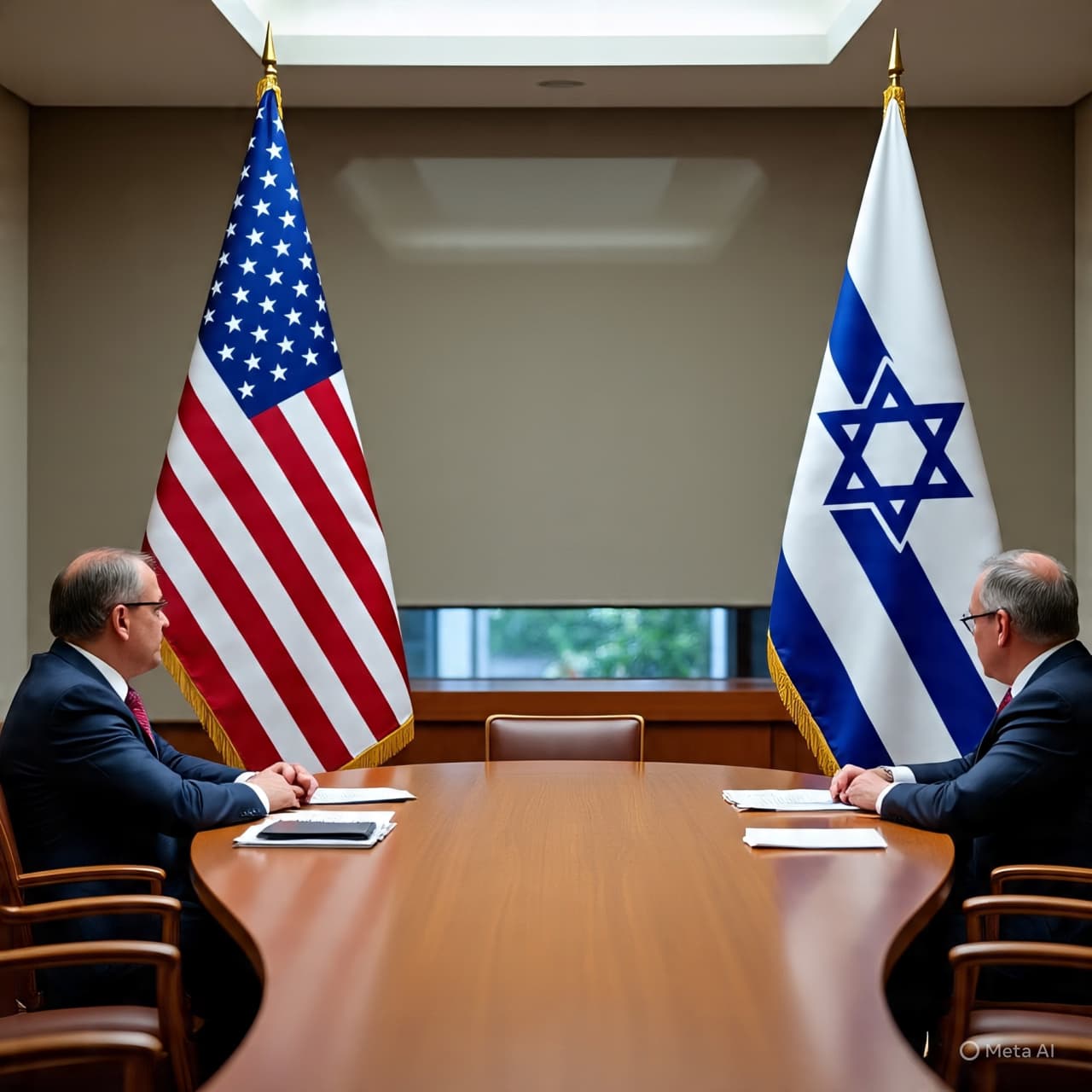
There are moments in conflict when the end is spoken of before it arrives—when its shape is imagined, its timing suggested, as though the conclusion might be guided not only by events on the ground, but by the alignment of those who stand alongside one another.
In recent remarks, former U.S. President Donald Trump suggested that Israel’s course in its war with Iran may, in some measure, reflect that of the United States. “I think Israel will be ready to end the Iran war when the U.S. wants to end,” he said, adding that both countries “want more or less similar things.” The phrasing carries a sense of parallel movement—two actors, distinct yet connected, navigating the same unfolding moment.
The comment emerges within a conflict that has already drawn multiple layers of involvement. The United States and Israel have operated in close coordination, with overlapping strategic objectives that include limiting Iran’s military capabilities and addressing its nuclear ambitions. Yet even within alignment, there are differences of pace and perspective—variations that shape how each nation approaches both escalation and resolution.
Reports in recent days have suggested that while the United States has at times considered ways to reduce its level of engagement, Israel has signaled a willingness to continue operations without a fixed timeline. This contrast introduces a question that lingers beneath the surface: whether shared goals necessarily lead to shared timing.
Trump’s remarks, in this context, present one interpretation—that the endpoint may ultimately be coordinated, or at least mutually understood. It is a view that emphasizes partnership, suggesting that decisions of such scale are not made in isolation, but in conversation, shaped by a broader strategic alignment.
At the same time, the realities of conflict rarely conform entirely to expectation. Military campaigns evolve, influenced by developments on the ground, by responses from adversaries, and by the pressures of international reaction. The idea of a synchronized conclusion, while conceivable, remains subject to these shifting conditions.
There is also a deeper layer to the statement, one that speaks to the nature of alliances themselves. To act in concert is to share not only objectives, but also the burden of timing—of deciding when enough has been achieved, when further action risks diminishing returns, and when the transition from conflict to conclusion becomes possible.
Yet such decisions are rarely singular. They are shaped by multiple actors, each with their own considerations, even within a shared framework. What appears aligned at one moment may diverge at another, reflecting the complexity of both strategy and circumstance.
And so the remark settles into the broader narrative of the conflict—not as a declaration of outcome, but as a reflection of how one perspective envisions the path toward it.
President Donald Trump said he believes Israel would be ready to end its war with Iran when the United States decides to conclude its involvement, adding that both countries share broadly similar objectives. The comments come amid ongoing coordination between the U.S. and Israel, though officials have indicated that timelines for ending the conflict remain uncertain.
AI Image Disclaimer
Visuals are AI-generated and serve as conceptual representations.
Source Check Reuters Associated Press The Guardian Bloomberg CNBC
Published by Banx Network. This article is part of the Banx decentralized media programme, powered by the BXE token on the XRP Ledger.