
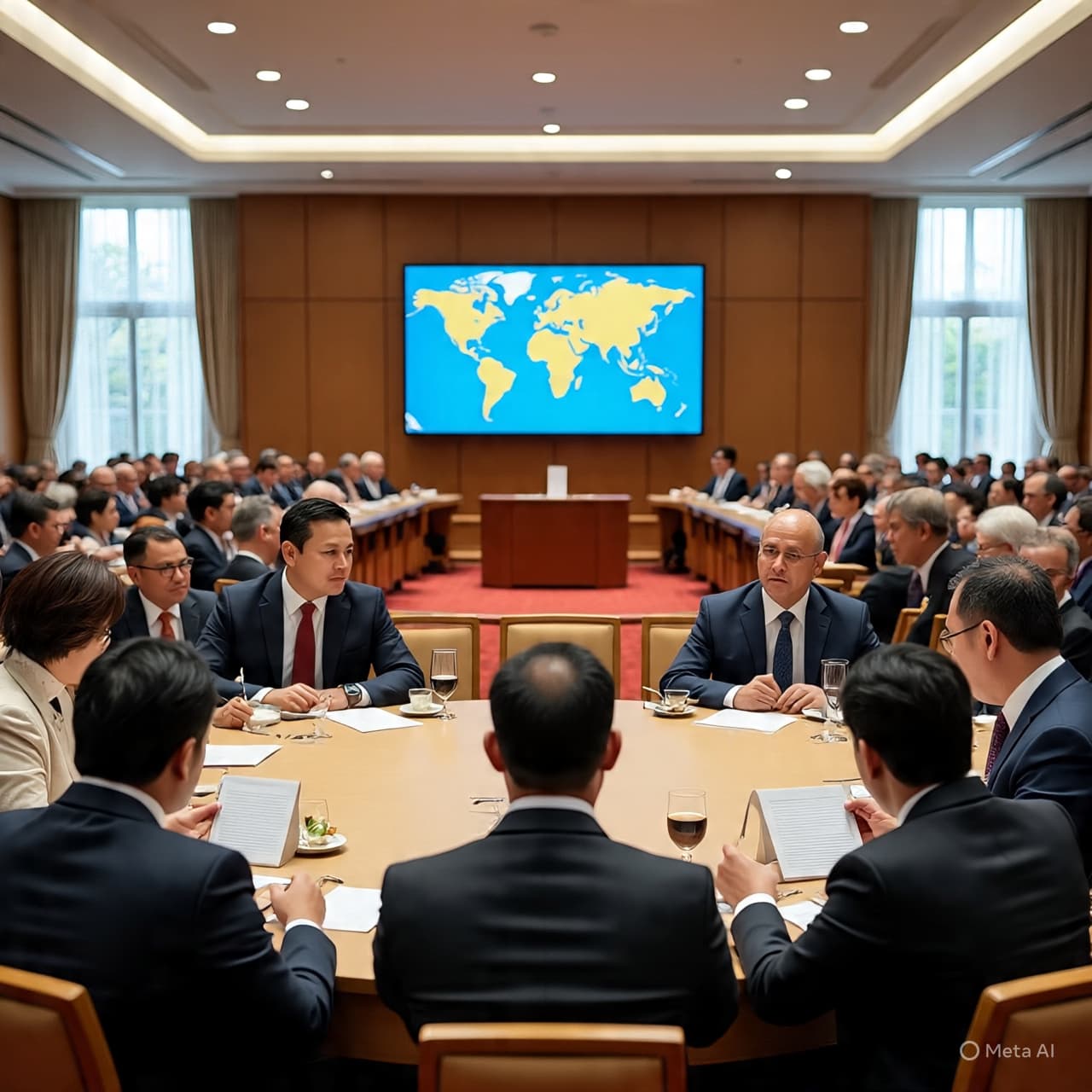
In the cool wash of a late winter morning in Washington, an unusual gathering unfolded — not in the grand halls of traditional diplomacy, but in a forum shaped by aspiration, controversy, and the resolute voice of its architect. Like a new branch sprouting from an old tree, President Donald Trump’s inaugural meeting of the “Board of Peace” brought representatives from dozens of nations to the U.S. capital, each bearing hopes, doubts, and questions about what this newly formed body might achieve.
The Board of Peace, unveiled late last year and formally constituted after a U.N. Security Council resolution, is envisioned as an international body focused on fostering stability and coordinating reconstruction efforts in war-torn regions, beginning with Gaza. But as representatives converged on Washington for the first official session, the event carried a broader metaphor — a reflection of a world searching for peace, yet grappling with deep divisions over how, and by whom, it should be pursued.
In remarks opening the meeting, President Trump struck a confident tone, highlighting the $5 billion in pledges that member states have committed toward the arduous task of rebuilding Gaza — a sum that, while substantial, falls far short of the estimated $70 billion needed for comprehensive reconstruction. The initiative’s agenda also includes efforts to form an international stabilization force aimed at sustaining a fragile ceasefire and disarming militant actors.
Yet the gathering was more than a tally of pledges and plans; it was, in itself, a kind of mirror reflecting the complex geography of global diplomacy. While representatives from more than two dozen countries actively participated, a number of major Western democracies declined full membership and many sent observers instead, expressing reservations about the board’s mandate and its relationship with established institutions like the United Nations.
Across the room, the voices gathered spanned regions and perspectives. Some delegates spoke of unity and shared responsibility in addressing human suffering, while others voiced hesitancy about the board’s long-term direction, its mechanisms for accountability, and the concentration of influence in the hands of its chairman. The absence of Palestinian representation on the board was noted by observers, adding another layer of complexity to discussions about Gaza’s future.
Outside, street-level conversations echoed these differing tones: optimism tempered by realism, and eagerness intertwined with caution. For many, the event marked a sincere attempt to channel collective energy toward peace and reconstruction. For others, it raised questions about legitimacy, inclusivity, and the role of traditional multilateral structures in shaping international action.
Yet in its inaugural moments, the Board of Peace embodied a simple idea — that amid the ruins of conflict, there is space for nations to come together and carve out new pathways forward. Whether this gathering will prove an enduring source of constructive cooperation or a fleeting page in diplomatic history remains to be seen.
For now, in the halls of Washington and beyond, the meeting stands as both an opening chapter and a quiet reminder of how elusive peace can be — and how persistent the search for it remains.
AI Image Disclaimer Visuals are created with AI tools and are not real photographs; they serve as conceptual representations only.
Sources Reuters AP News Al Jazeera WDSU News The Guardian
Published by Banx Network. This article is part of the Banx decentralized media programme, powered by the BXE token on the XRP Ledger.
.jpg&w=3840&q=75 "Estonian Intelligence Chief Says Russia Could Collapse Rapidly")
.jpg&w=3840&q=75 "Ukraine’s Ambassador Summoned Over Attacks on Turkish-Operated Civilian Vessels")