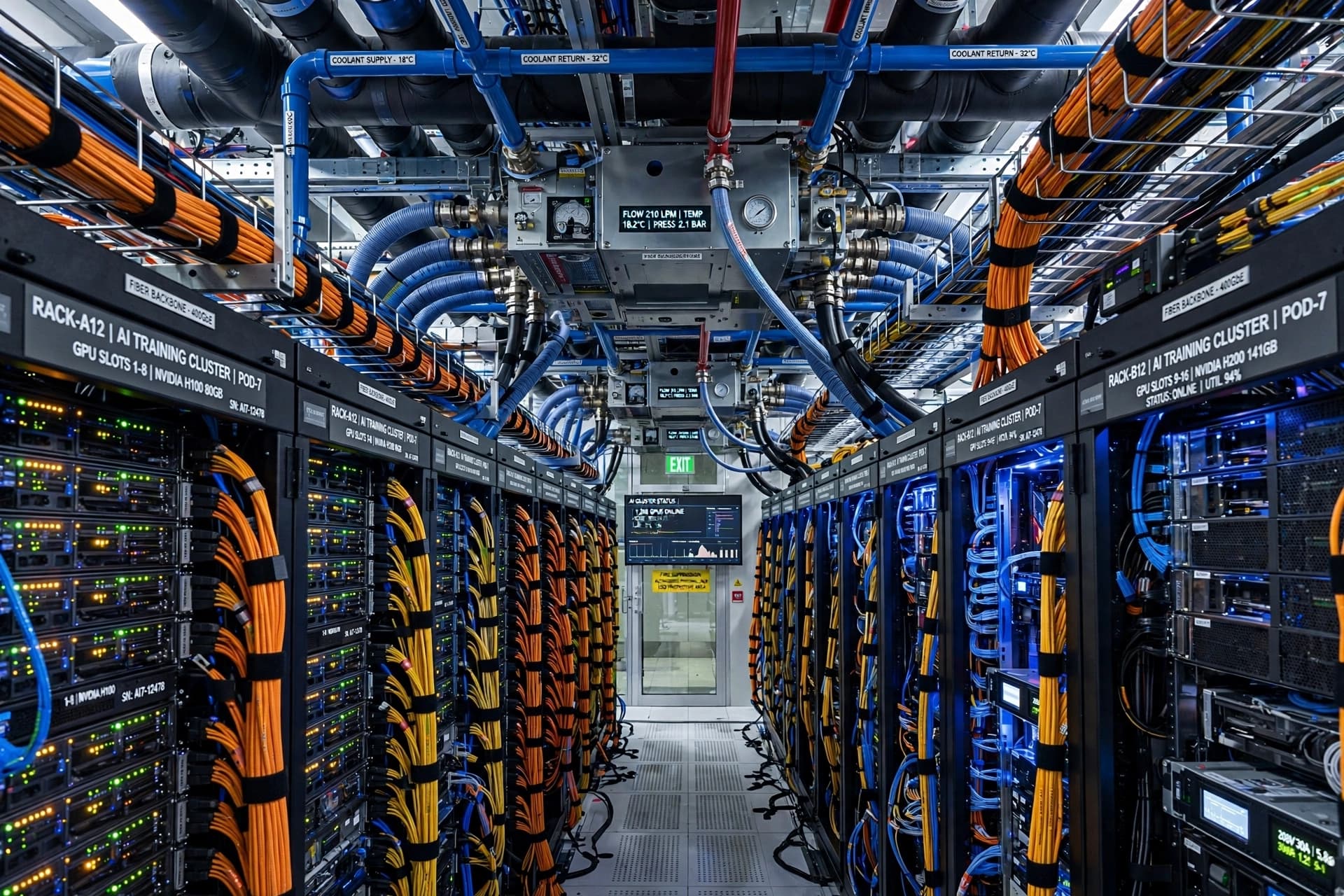
The modern data center is easy to overlook from the outside. Behind concrete walls and carefully controlled doors, thousands of machines work continuously, turning electricity into computing power that supports digital services used around the world.
Across the United States, those facilities are expanding as artificial intelligence creates new demand for computing capacity. Large technology companies are investing heavily in infrastructure capable of training and operating increasingly complex AI systems.
The expansion is closely connected to the rapid growth of artificial intelligence. Training large models requires enormous computing resources, while operating those systems for millions of users creates another layer of continuous demand.
That demand has created a new economic chain. Data centers require processors, memory chips, networking equipment, electrical systems and cooling technology. The growth of AI infrastructure therefore reaches far beyond the companies that develop AI models themselves.
The physical requirements are substantial. Large facilities can consume significant amounts of electricity, while their cooling systems require additional infrastructure to keep servers operating within precise temperature ranges.
The expansion is also changing relationships between technology companies and local communities. A data center can bring construction activity, employment and investment, while simultaneously increasing demands on electricity networks, roads, water systems and land.
Energy has become one of the central questions surrounding the next phase of AI infrastructure. As facilities become larger and computing workloads increase, companies and utilities must consider how additional electricity demand can be supplied reliably.
The semiconductor industry is also being reshaped by this expansion. More data centers require more advanced processors, memory and networking components, creating additional pressure on manufacturers to increase production capacity.
This illustrates how one technological shift can create pressure across several industries at once. More AI applications require more computing, more computing requires more data centers, and more data centers require more chips, electricity and network capacity.
The expansion is therefore not simply a story about buildings filled with servers. It is becoming a story about the physical foundation of the digital economy. As artificial intelligence continues to develop, the United States is building an infrastructure network designed to keep pace with machines that increasingly depend on enormous amounts of computing power.
IMAGE DISCLAIMER
The accompanying visuals were generated using AI and are conceptual illustrations of American data-center infrastructure.
SOURCES
Reuters The Wall Street Journal Virginia State Government
Published by Banx Network. This article is part of the Banx decentralized media programme, powered by the BXE token on the XRP Ledger.