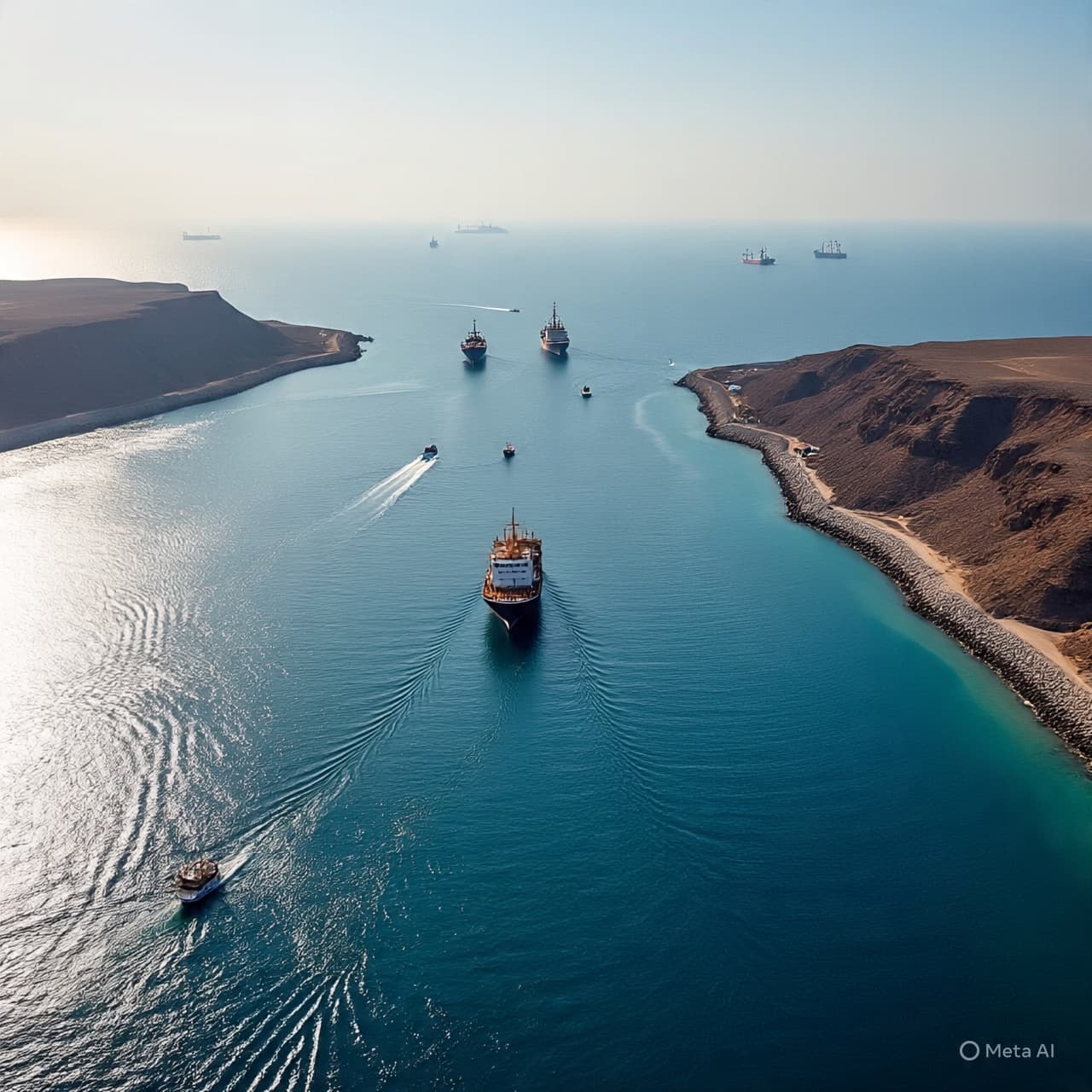
At sea, distance has a way of softening intent. Ships appear first as silhouettes, then as purpose, then as presence—slow-moving declarations of direction. In the narrow passage of the Strait of Hormuz, where the horizon is never quite empty, each vessel carries more than cargo. It carries permission, passage, and the fragile understanding that the route ahead remains open.
Recently, that understanding faltered, if only briefly.
Authorities in Iran reportedly turned back a vessel bound for Pakistan as it moved through or near the Strait of Hormuz, signaling a tightening of control in one of the world’s most closely watched maritime corridors. The decision, described without elaborate explanation, comes at a time when the region is already marked by heightened vigilance, where the movement of ships is observed not only for trade, but for meaning.
The Strait itself remains a constant—a narrow channel linking the Persian Gulf to the wider ocean, through which a significant share of global energy supplies continues its passage. Its geography has long invited attention, but in moments of tension, that attention sharpens. The presence of naval patrols, the monitoring of routes, and the enforcement of maritime boundaries all become more pronounced, turning routine navigation into something more deliberate.
For vessels passing through, the rules are both formal and fluid. International maritime law provides a framework, but enforcement often reflects the realities of the moment—security concerns, political signals, and regional dynamics that shift with time. The reported turning back of a Pakistan-bound ship suggests an instance where these layers intersect, where authority is exercised not just in accordance with regulation, but in response to a broader climate.
Pakistan, whose ports receive energy shipments and goods that traverse these waters, finds itself connected to the Strait not only by geography but by dependency. Any disruption—whether temporary or symbolic—touches on supply lines that extend into daily life, shaping markets and expectations in ways that are not immediately visible from the deck of a single ship.
For Iran, control over its coastal waters and influence within the Strait has long been framed as a matter of sovereignty and security. Actions such as redirecting vessels, even when limited in scope, can serve multiple purposes: enforcing compliance, signaling resolve, or simply reinforcing presence in a region where visibility often equates to authority.
The sea, however, remains indifferent. Waves continue their quiet repetition, and ships adjust their courses, sometimes by miles, sometimes by meaning. What changes is not the water itself, but the context through which it is crossed.
In the unfolding of events, the facts remain measured and clear: Iran has turned back a ship reportedly bound for Pakistan in or near the Strait of Hormuz; the move reflects heightened scrutiny over maritime movement amid regional tensions; and the incident underscores the continued sensitivity of one of the world’s most vital shipping routes. In the steady rhythm of passage and pause, the Strait holds its place—narrow, watchful, and always carrying more than it seems.
AI Image Disclaimer These visuals are AI-generated and intended as illustrative interpretations, not real scenes.
Sources Reuters Al Jazeera BBC News Associated Press Bloomberg
Published by Banx Network. This article is part of the Banx decentralized media programme, powered by the BXE token on the XRP Ledger.