There has always been a sense that the sky holds what we cannot carry—weather, light, distance, the slow turning of time itself. Now, increasingly, it is asked to hold something else: memory. Not the quiet, human kind, but the vast and growing accumulation of data, layered and expanding, pressing outward from the earth that produced it.
In recent months, attention has gathered around the ambitions of Elon Musk and his aerospace company, SpaceX, where discussions of orbital data centers have begun to move from speculative edges toward conceptual reality. The idea, at once simple and immense, proposes relocating large-scale computing infrastructure—servers, storage, and processing systems—into orbit, where energy, cooling, and proximity to satellite networks might reshape how information is handled.
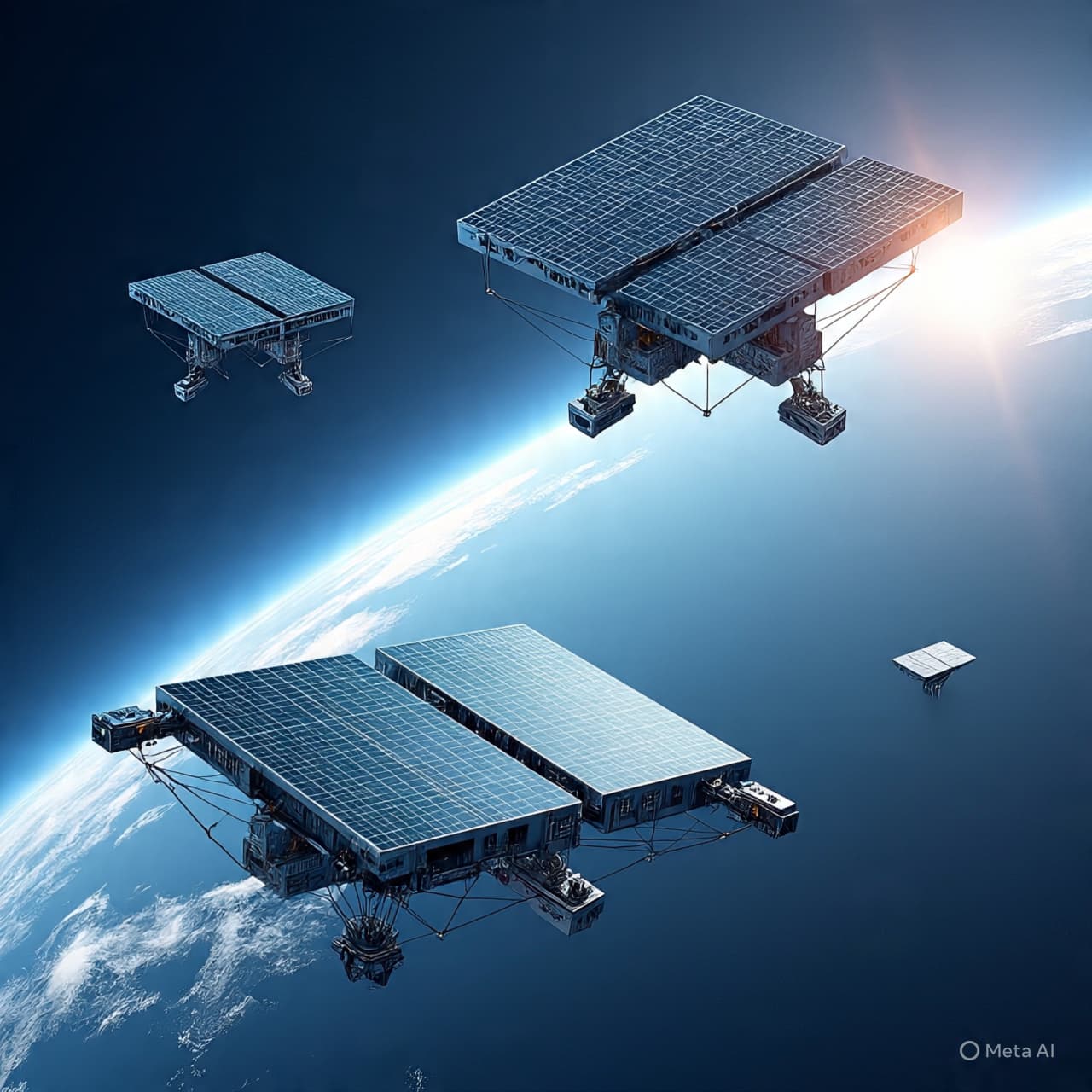
The scale implied is difficult to picture in familiar terms. On Earth, data centers already stretch across landscapes, drawing power, requiring cooling, anchoring themselves in geography. In orbit, that geography dissolves. Instead, there would be modular platforms, potentially assembled in stages, circling the planet as part of a broader constellation. Their size would not be defined by land but by launch capacity, by engineering limits, by the cadence of rockets rising and returning.
Part of the vision intersects naturally with Starlink, SpaceX’s existing network of thousands of satellites that already form a lattice of connectivity around the globe. An orbital data center, positioned within or alongside such a network, could shorten the distance between data transmission and processing. Information that now travels down to Earth and back again might instead remain above, moving through a system designed to exist entirely in the near vacuum of space.
There are practical reasons behind the appeal. Space offers a kind of ambient cold, a natural environment for dissipating heat—one of the central challenges of terrestrial data centers. Solar energy, abundant and continuous in orbit, suggests another advantage, though it brings with it the need for storage and distribution systems capable of managing cycles of light and shadow. These factors combine into a vision where efficiency is not bound by ground-based constraints, but reshaped by orbital physics.
Yet the idea carries its own weight of uncertainty. Launching and maintaining such infrastructure would require not only repeated missions but sustained reliability in an environment where repair is complex and costly. The economics remain fluid, tied to the evolving cost of access to space—a domain where SpaceX, through its reusable rocket systems, has already begun to alter expectations.
There is also the quieter question of accumulation. As more objects enter orbit—satellites, stations, fragments—the space surrounding Earth becomes more crowded, more intricate. Orbital data centers would add another layer to this expanding presence, contributing to a system that is no longer empty, but increasingly structured by human intention.
For now, much of this remains at the level of proposal and early-stage exploration. Public details are limited, and timelines uncertain. But the direction is suggestive. Data, once tethered to rooms and racks and cables beneath fluorescent light, is gradually being imagined elsewhere—lifted, quite literally, into a different kind of environment.
Elon Musk and SpaceX are exploring the concept of orbital data centers—massive computing infrastructures placed in space to leverage solar power, natural cooling, and proximity to satellite networks like Starlink. While still largely conceptual, the idea reflects broader efforts to expand digital infrastructure beyond Earth, with significant technical and economic challenges yet to be addressed.
AI Image Disclaimer
Visuals are AI-generated and serve as conceptual representations.
Sources
SpaceNews Ars Technica CNBC Reuters TechCrunch
Published by Banx Network. This article is part of the Banx decentralized media programme, powered by the BXE token on the XRP Ledger.