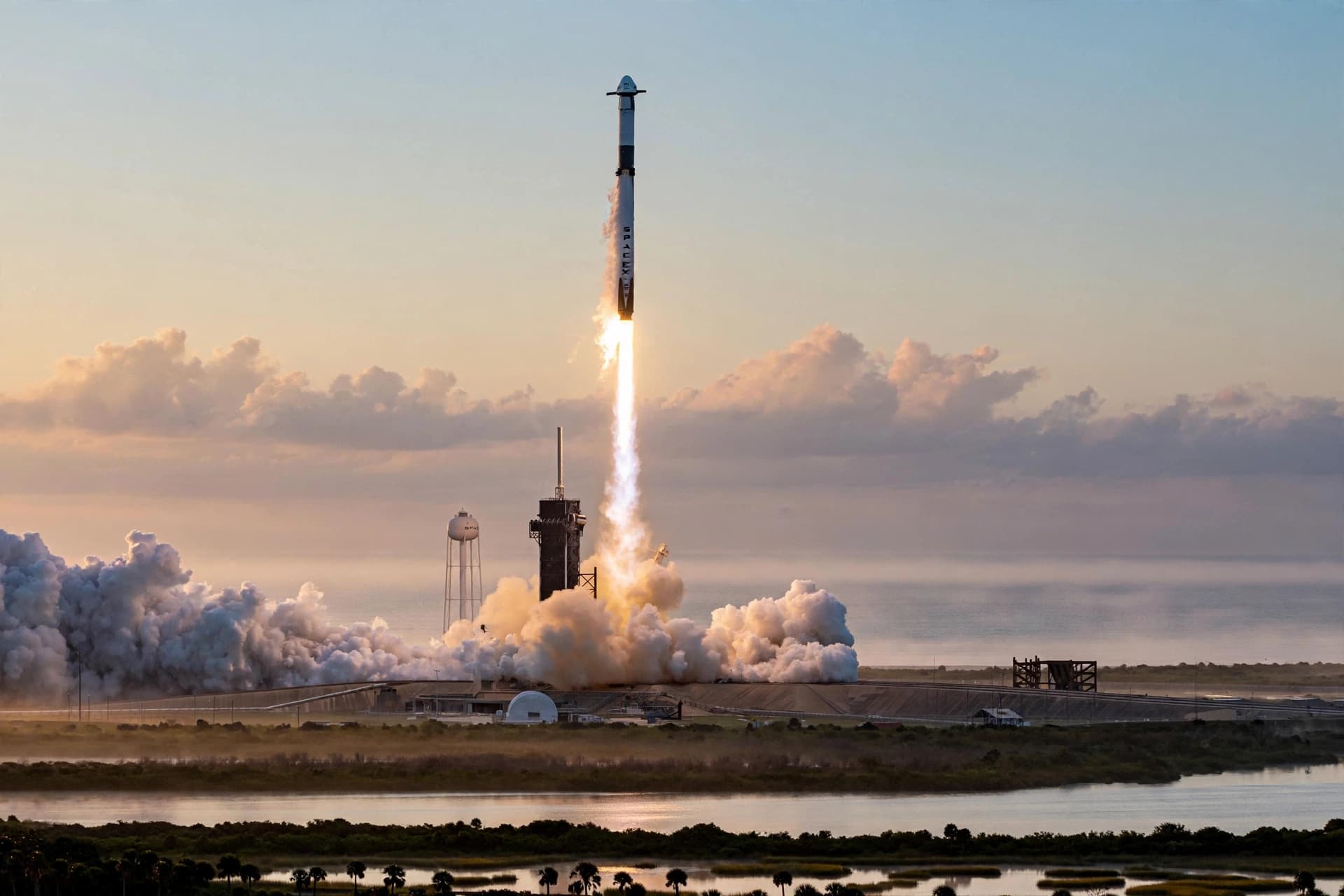
At night, the sky has always felt like a shared inheritance—dark, distant, and largely untouched. But in recent years, it has grown busier, threaded with moving points of light that drift silently across the horizon. Now, SpaceX is asking permission to add something far more ambitious to that quiet traffic: up to one million solar-powered satellite data centers, orbiting above the planet like a dispersed, mechanical constellation.
The proposal, now seeking federal approval, imagines data centers not rooted in land or cooled by rivers, but suspended in space, powered by sunlight and freed from the physical limits that bind servers on Earth. Each satellite would function as a small node of computation, collectively forming an orbital network designed to process and relay information beyond the atmosphere.
The idea arrives at a moment when demand for data storage and computing power is expanding rapidly, driven by artificial intelligence, cloud services, and global connectivity. On the ground, data centers have become increasingly controversial—consuming vast amounts of energy, water, and land. By shifting part of that burden into orbit, SpaceX suggests a future where computation follows the sun, drawing energy continuously as satellites circle the globe.
Yet scale changes meaning. One million satellites would represent an unprecedented expansion of human infrastructure in space, far exceeding anything previously launched. Regulators are now tasked with considering not just technical feasibility, but cumulative impact: orbital congestion, collision risk, space debris, and the long-term sustainability of near-Earth space.
Astronomers have already voiced concerns about the growing brightness and density of satellite constellations, which can interfere with ground-based observations. Environmental researchers warn that what seems weightless in orbit can still leave traces—through rocket launches, atmospheric reentry, and the gradual cluttering of orbital paths.
SpaceX frames the proposal as part of a broader shift toward efficiency and innovation, pairing solar power with the near-infinite cooling capacity of space. The company argues that orbital data centers could reduce pressure on terrestrial grids while supporting global communications and future space-based services.
For regulators, the question is less about possibility than precedence. Approving such a system would quietly redefine how humanity uses near-Earth space—not only as a corridor for travel and communication, but as an extension of industrial infrastructure itself.
As the application moves through federal review, the sky remains unchanged to the casual observer. Stars still hold their places. Satellites still pass in silence. But above that calm surface, decisions are forming that may determine whether space remains a sparse commons—or becomes the next crowded layer of the digital world.
AI Image Disclaimer
Visuals are AI-generated and serve as conceptual representations.
Sources
Federal Communications Commission SpaceX NASA U.S. National Oceanic and Atmospheric Administration International Astronomical Union
Published by Banx Network. This article is part of the Banx decentralized media programme, powered by the BXE token on the XRP Ledger.