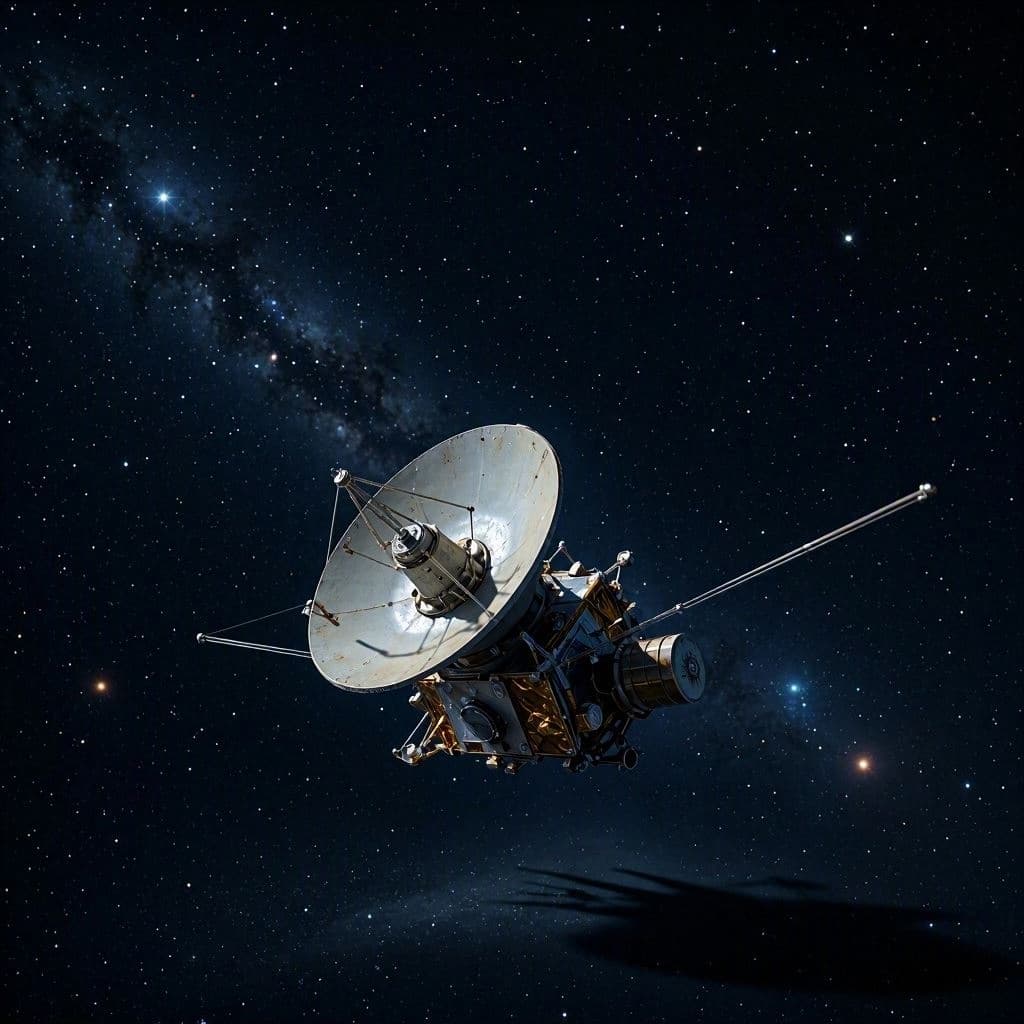
More than four decades after its launch, Voyager 2 continues to drift through the interstellar medium, a silent ambassador of humanity. Powered by decaying radioactive isotopes, its energy supply dwindles with each passing year. Yet, in a remarkable feat of engineering ingenuity, NASA engineers have managed to extend the spacecraft’s operational life by carefully managing its power budget. This latest adjustment ensures that Voyager 2 will continue to send back precious data for at least another year, defying the odds of time and distance.
The spacecraft’s radioisotope thermoelectric generators (RTGs) produce less heat and electricity as the plutonium-238 fuel decays. To compensate, engineers have been systematically shutting down non-essential systems and heaters. Recently, they implemented a new strategy involving the redistribution of power among the remaining instruments. By tweaking voltage levels and optimizing software efficiency, they squeezed out extra watts from the aging system, a digital sleight of hand that keeps the science flowing.
This process is delicate and risky. Every watt saved is a watt that can be used to keep the communication antenna pointed toward Earth. If the power drops too low, the spacecraft could lose its ability to transmit data, ending the mission prematurely. The team at NASA’s Jet Propulsion Laboratory works with extreme precision, modeling every possible scenario to ensure stability. It is a high-stakes balancing act performed from billions of miles away.
Voyager 2 is currently the only human-made object exploring the southern region of interstellar space. Its measurements of plasma density, magnetic fields, and cosmic rays provide unique insights into the environment beyond our solar system. Losing this data stream would leave a gap in our understanding of the heliosphere’s boundary. Thus, every extended day of operation is scientifically valuable.
The success of these power-saving measures highlights the resilience of vintage technology. Built in the 1970s, Voyager’s computers have less processing power than a modern calculator. Yet, their robust design and the creativity of their operators have allowed them to outlast many newer missions. It is a tribute to the foresight of the original engineers and the dedication of the current team.
As power continues to decline, further sacrifices will be necessary. Instruments may need to be turned off permanently, reducing the scope of science but preserving the link to Earth. The goal is to keep the heartbeat of Voyager 2 ticking for as long as physically possible, maximizing the return on one of history’s most ambitious explorations.
Voyager 2’s extended lease on life is a victory for human ingenuity. As it travels deeper into the unknown, it carries with it the hopes and curiosity of our species. For another year, at least, it will continue to whisper secrets from the edge of the solar system.
AI Image Disclaimer: Visuals associated with this article are AI-generated to illustrate the themes of space exploration and engineering resilience.
Sources: NASA JPL The New York Times Scientific American
Published by Banx Network. This article is part of the Banx decentralized media programme, powered by the BXE token on the XRP Ledger.