There are moments in astronomy when the universe seems to speak in unexpected ways. Not through sound, of course, but through faint threads of light that have traveled unimaginable distances. These signals arrive quietly, crossing billions of years before finally touching the sensitive instruments pointed toward the night sky.
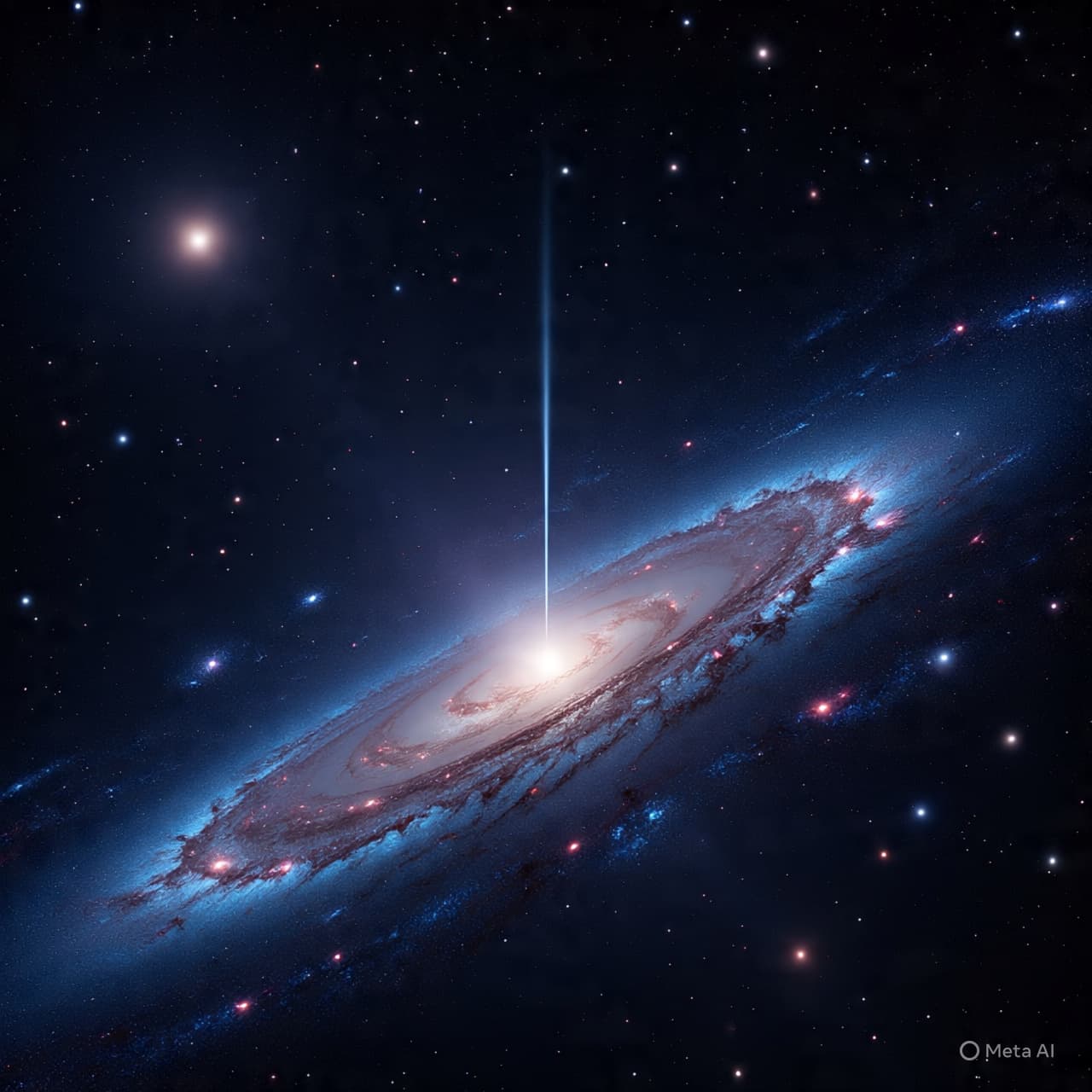
Recently, astronomers detected one such signal—a remarkable beam of energy that has traveled nearly eight billion light-years to reach Earth. Known as a cosmic “space laser,” the discovery has drawn attention across the astronomical community for both its distance and its intensity.
Despite the dramatic name, a space laser is not quite the same as the lasers used on Earth. The phenomenon is known scientifically as a maser, which stands for “microwave amplification by stimulated emission of radiation.” Instead of visible laser light, masers emit powerful radio waves, produced naturally in certain regions of space under very specific conditions.
These cosmic masers often appear in environments where vast clouds of gas swirl around energetic objects such as supermassive black holes or regions of intense star formation. In those turbulent places, molecules—commonly water molecules—can amplify radio emissions, creating beams that behave somewhat like lasers in the microwave portion of the electromagnetic spectrum.
The newly observed signal stands out because of its extraordinary distance. Astronomers estimate that the maser originates from a galaxy roughly eight billion light-years away, meaning the light detected today began its journey when the universe was significantly younger than it is now.
To put that in perspective, the signal started traveling toward Earth long before the formation of our solar system had fully settled into its current structure. During those eight billion years, galaxies have shifted, stars have been born and died, and cosmic expansion has steadily stretched the fabric of space itself.
Yet the signal endured.
The discovery was made using highly sensitive radio telescopes capable of detecting faint emissions across enormous cosmic distances. By analyzing the signal’s characteristics, researchers believe the maser is produced by water molecules orbiting close to a supermassive black hole at the center of a distant galaxy.
Such “megamasers,” as they are often called, are vastly more powerful than typical masers observed closer to Earth. Their immense brightness allows them to be detected even from across the observable universe.
Scientists value these rare signals not only because they are unusual, but because they provide a unique tool for studying the universe. Maser emissions can help astronomers measure the motion of gas around black holes, determine the structure of distant galaxies, and refine estimates of cosmic distances.
In some cases, megamasers have even contributed to improved measurements of the universe’s expansion rate—a key question in modern cosmology.
The newly discovered signal is believed to be the most distant water megamaser ever detected. Its presence suggests that the extreme environments needed to produce such powerful emissions existed billions of years earlier than scientists once thought.
For researchers studying galaxy evolution, that realization offers another small piece in the vast puzzle of how the cosmos has changed over time.
Across the enormous expanse of space, light continues to travel patiently. Sometimes it arrives as the faint glow of distant galaxies, sometimes as the brilliant flash of a supernova. And occasionally, it arrives as something stranger—a focused beam of microwaves, amplified by nature itself.
For now, astronomers will continue examining this ancient signal, tracing its origins and measuring its properties. The universe, after all, rarely reveals its secrets all at once.
But with every new observation, another quiet message from the distant past becomes just a little clearer.
AI Image Disclaimer Images in this article are AI-generated illustrations, meant for concept only.
Source Check Credible mainstream / niche media covering this issue:
NASA Space.com Live Science New Scientist Sky & Telescope
Published by Banx Network. This article is part of the Banx decentralized media programme, powered by the BXE token on the XRP Ledger.