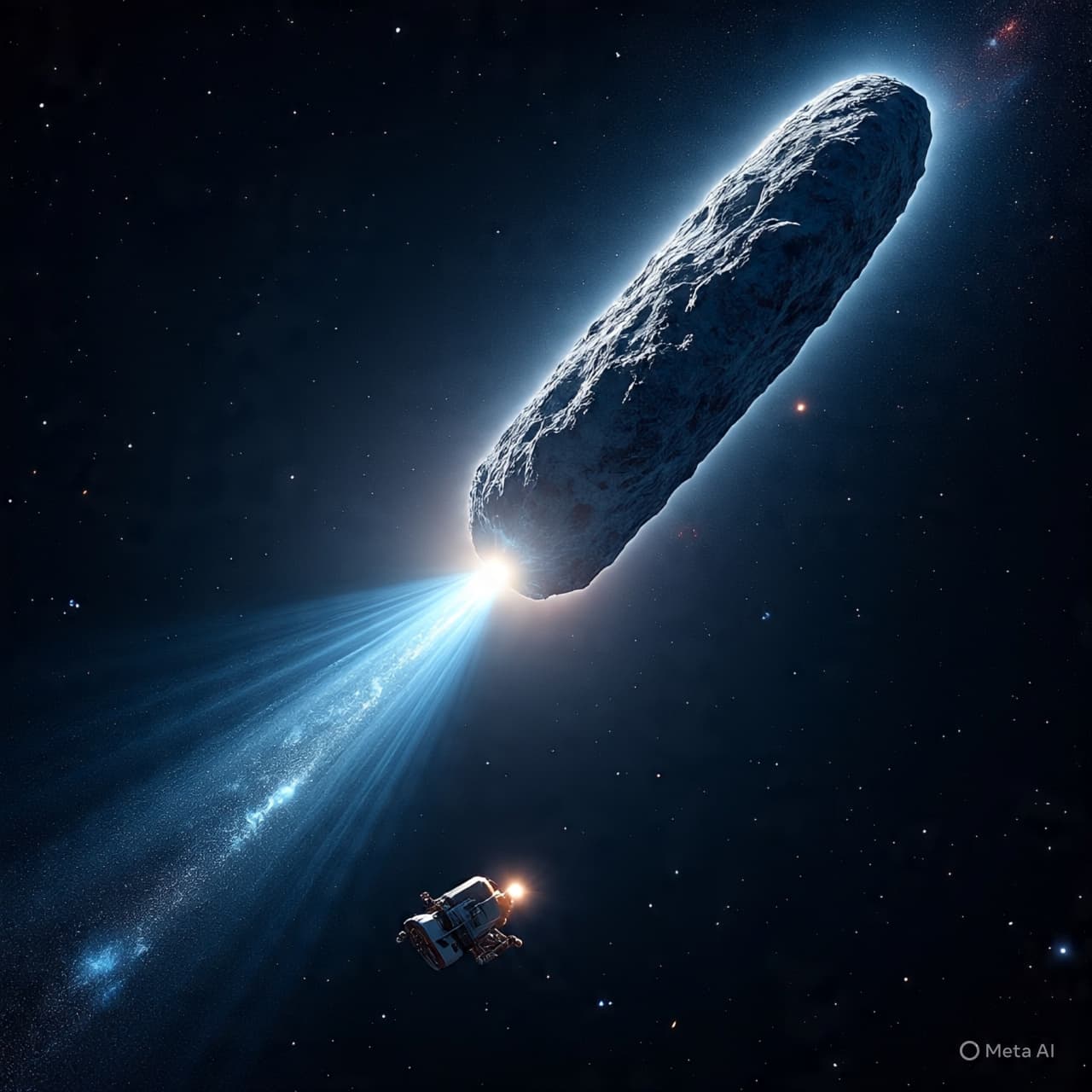
There are moments in science when ambition feels like standing at the edge of a vast ocean, watching a distant ripple and wondering if it came from another world. The discovery of interstellar visitors—cosmic wanderers that do not belong to our Sun—has quietly stirred that feeling again. Now, with the appearance of comet 3I/ATLAS, the question is no longer just about observing from afar, but whether humanity might dare to reach out and touch something that was born beyond our solar neighborhood.
The proposal being discussed is not a gentle one. It is, in essence, a calculated gamble—a maneuver that trades caution for possibility. To intercept an interstellar comet like 3I/ATLAS, a spacecraft would need to perform an intricate sequence of gravitational assists, likely borrowing speed from planets such as Jupiter, bending its path like a slingshot pulled to its limits. Timing becomes everything. Launch windows narrow into fleeting opportunities, and a delay of even months could mean missing the visitor entirely as it continues its silent journey through the cosmos.
What makes this plan particularly delicate is the velocity involved. Interstellar objects do not linger; they arrive fast and leave faster. Unlike typical comets bound to the Sun, 3I/ATLAS carries with it a momentum shaped by another star system. A spacecraft attempting to intercept it must match not only its direction but also a portion of its extraordinary speed. Engineers describe trajectories that feel less like paths and more like threads being carefully woven through moving celestial bodies, each adjustment tightening the margin for error.
Yet, within this risk lies a rare scientific promise. Previous interstellar visitors, such as 1I/‘Oumuamua and 2I/Borisov, were observed only from a distance, leaving behind questions that telescopes alone could not fully answer. What is their true composition? How do they form in other star systems? Are they fundamentally different from the icy relics orbiting our own Sun? A close encounter with 3I/ATLAS could transform speculation into direct measurement, offering insights that bridge not just space, but origin.
The mission concept, still evolving, suggests rapid-response spacecraft—vehicles designed to wait in readiness, capable of launching quickly when such rare objects are detected. It is a shift in philosophy: from long-planned missions to agile, opportunistic exploration. In this sense, the spacecraft becomes less like a scheduled traveler and more like a hunter of fleeting moments, ready to pursue whatever the universe briefly reveals.
Still, the risks remain undeniable. High-speed encounters reduce observation time to mere hours or days. Navigation uncertainties grow as distance increases. And the cost of failure—missing the comet entirely—would echo as a reminder of how unforgiving deep space can be. But perhaps that is also the quiet allure of the endeavor. Not every journey promises certainty; some offer only the chance to try.
In the end, the plan to reach 3I/ATLAS sits at a crossroads between patience and boldness. It does not guarantee success, nor does it demand it. Instead, it invites a question that has followed exploration for centuries: when something rare passes within reach, do we simply watch it fade, or do we attempt, however carefully, to follow?
AI Image Disclaimer Visuals are created with AI tools and are not real photographs.
Source Check NASA ESA (European Space Agency) Nature Space.com Scientific American
Published by Banx Network. This article is part of the Banx decentralized media programme, powered by the BXE token on the XRP Ledger.