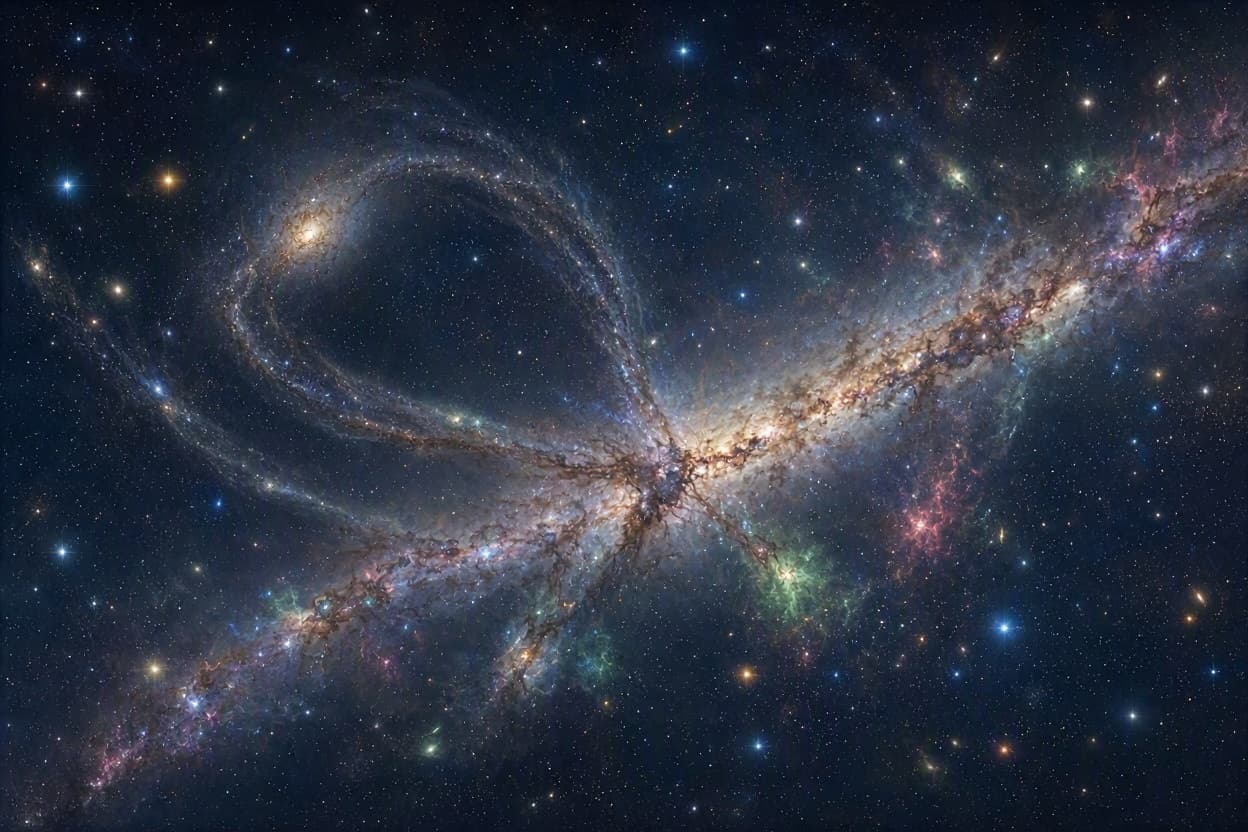
Our Milky Way galaxy is not a solitary entity but a cosmic cannibal, having grown over billions of years by consuming smaller neighboring galaxies. Recent astronomical evidence points to one of the earliest and most significant of these mergers, leaving a distinct "scar" in the heart of our galaxy. This ancient collision, involving a dwarf galaxy dubbed Gaia-Enceladus or similar early progenitors, has shaped the structure and composition of the Milky Way, offering clues to its formative years.
Astronomers used data from the European Space Agency’s Gaia mission to trace the movements and chemical compositions of millions of stars in the Milky Way’s halo and bulge. They identified a group of stars with unique orbital patterns and lower metallicity, indicating they originated from a different galaxy. These stars appear to have been stripped from their home during a violent merger event that occurred roughly 10 billion years ago.
The "scar" refers to the disruption in the distribution of stars and dark matter caused by the impact. This event likely triggered a burst of star formation and reshaped the Milky Way’s central bulge. The remnants of the swallowed galaxy are now integrated into the Milky Way’s structure, but their distinct signature remains visible to sensitive instruments. Understanding this merger helps explain why the Milky Way looks the way it does today.
The merged galaxy, often referred to in recent literature as part of the Gaia-Enceladus-Sausage complex or an even earlier precursor, was likely comparable in mass to the Small Magellanic Cloud. Its consumption was a pivotal moment in the Milky Way’s history, contributing significantly to its mass and angular momentum. This process of hierarchical assembly is a cornerstone of modern cosmological models.
Chemical analysis of the stars reveals differences in elements like iron and magnesium, serving as fingerprints of their origin. These "chemical tags" allow astronomers to distinguish between native Milky Way stars and those acquired through mergers. This technique, known as galactic archaeology, is revolutionizing our understanding of galaxy evolution.
The discovery also has implications for the search for dark matter. Mergers can disturb the dark matter halo, creating substructures that might be detectable through gravitational effects. By mapping the scars of past collisions, scientists hope to infer the distribution and nature of dark matter in our galaxy.
As telescopes become more powerful, we expect to uncover more details about these ancient events. Future missions will provide higher resolution data, allowing for a more precise reconstruction of the Milky Way’s merger history. Each discovery adds a chapter to the biography of our home galaxy.
The scar left by the earliest galaxy swallowed by the Milky Way is a testament to the dynamic and violent history of our cosmic neighborhood. It reminds us that even the most stable structures are born from chaos and change.
AI Image Disclaimer: Any images used in conjunction with this article are AI-generated conceptualizations meant to illustrate the themes of media and justice.
Sources: European Space Agency (ESA), Nature Astronomy, Astrophysical Journal, BBC Science
Published by Banx Network. This article is part of the Banx decentralized media programme, powered by the BXE token on the XRP Ledger.