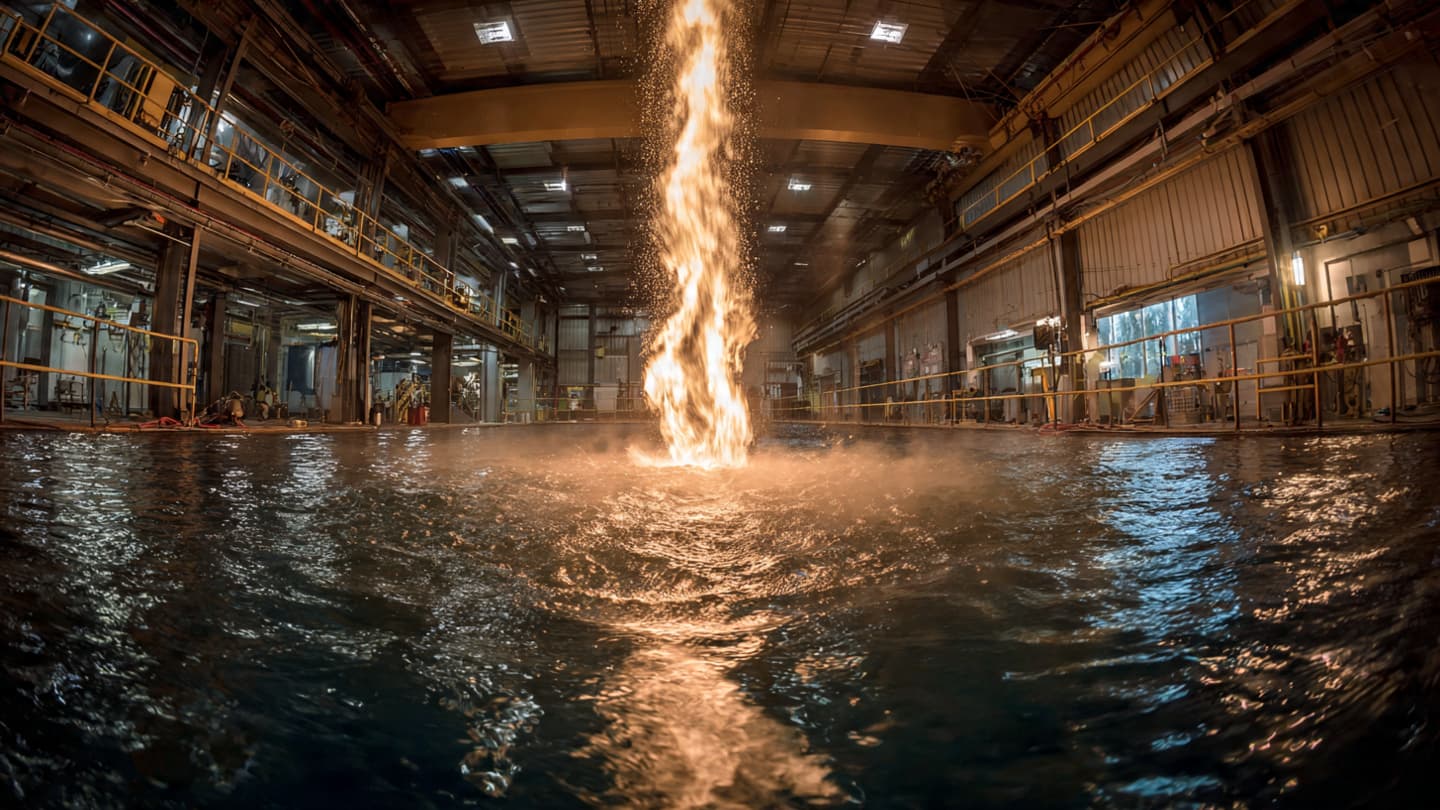
Innovation often emerges from unexpected places. Sometimes, solutions to long-standing environmental challenges arrive not through entirely new inventions but through a deeper understanding of forces that already exist in nature. Researchers studying a phenomenon known as a fire tornado are now exploring whether this dramatic swirling column of flame could become a cleaner and more efficient tool for responding to oil spills.
Scientists have reported progress in understanding how controlled fire whirlwinds, sometimes called fire tornadoes, can be used to burn oil floating on water more efficiently than traditional methods. The research builds on earlier observations that rotating flames concentrate heat and improve combustion performance.
Oil spills remain among the most difficult environmental emergencies to manage. Cleanup efforts often involve a combination of mechanical recovery, chemical dispersants, and controlled burning. Each approach carries benefits and limitations, particularly when large volumes of oil spread across extensive areas of water.
Researchers found that fire whirl technology may consume oil more completely than conventional surface burning. By creating a rotating column of fire, the system increases airflow and combustion efficiency, reducing the amount of soot and residue released into the environment.
The science behind the process resembles the behavior of naturally occurring fire whirls sometimes observed during wildfires. In controlled conditions, however, engineers can harness similar principles to generate stable rotating flames designed for specific industrial or environmental purposes.
Laboratory experiments have demonstrated promising results, showing that oil can burn more rapidly while producing fewer airborne pollutants. Scientists emphasize that the goal is not to create larger fires, but rather to improve the efficiency of cleanup operations in carefully managed environments.
Environmental experts note that reducing soot emissions is particularly important because soot particles can contribute to air pollution and climate-related effects. Cleaner combustion could help address some concerns associated with traditional in-situ burning techniques used during major spill responses.
Despite the encouraging findings, researchers acknowledge that further testing will be necessary before large-scale deployment becomes possible. Questions regarding safety, operational logistics, and environmental impacts under real-world conditions remain areas of active study.
For now, the research represents another example of how scientific inquiry can transform a striking natural phenomenon into a practical tool. If future studies confirm its effectiveness, controlled fire tornadoes may one day become part of the environmental response toolkit used to protect oceans and coastlines from pollution.
AI Image Disclaimer: The illustrations accompanying this article are AI-generated visual representations created to explain scientific concepts.
Published by Banx Network. This article is part of the Banx decentralized media programme, powered by the BXE token on the XRP Ledger.