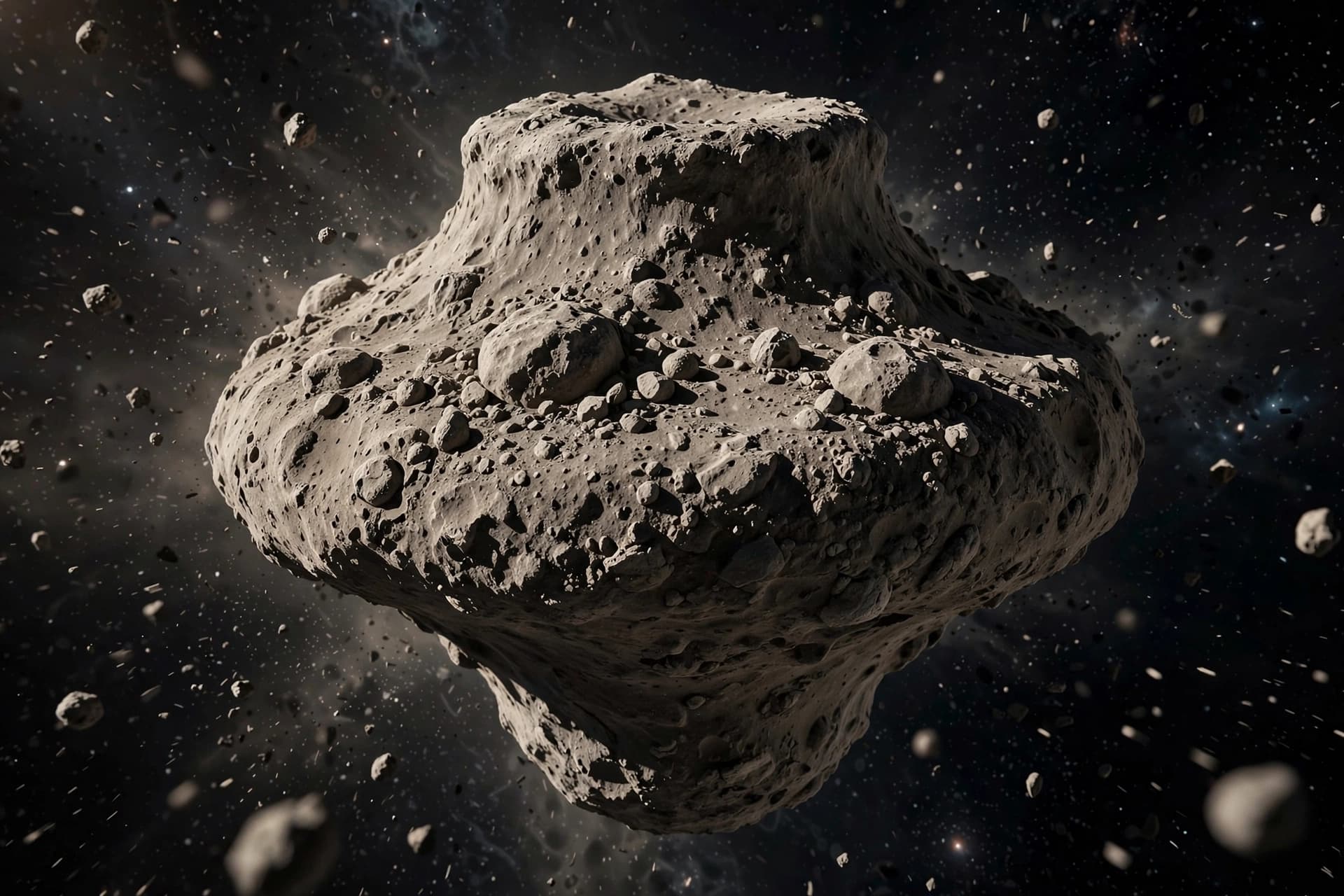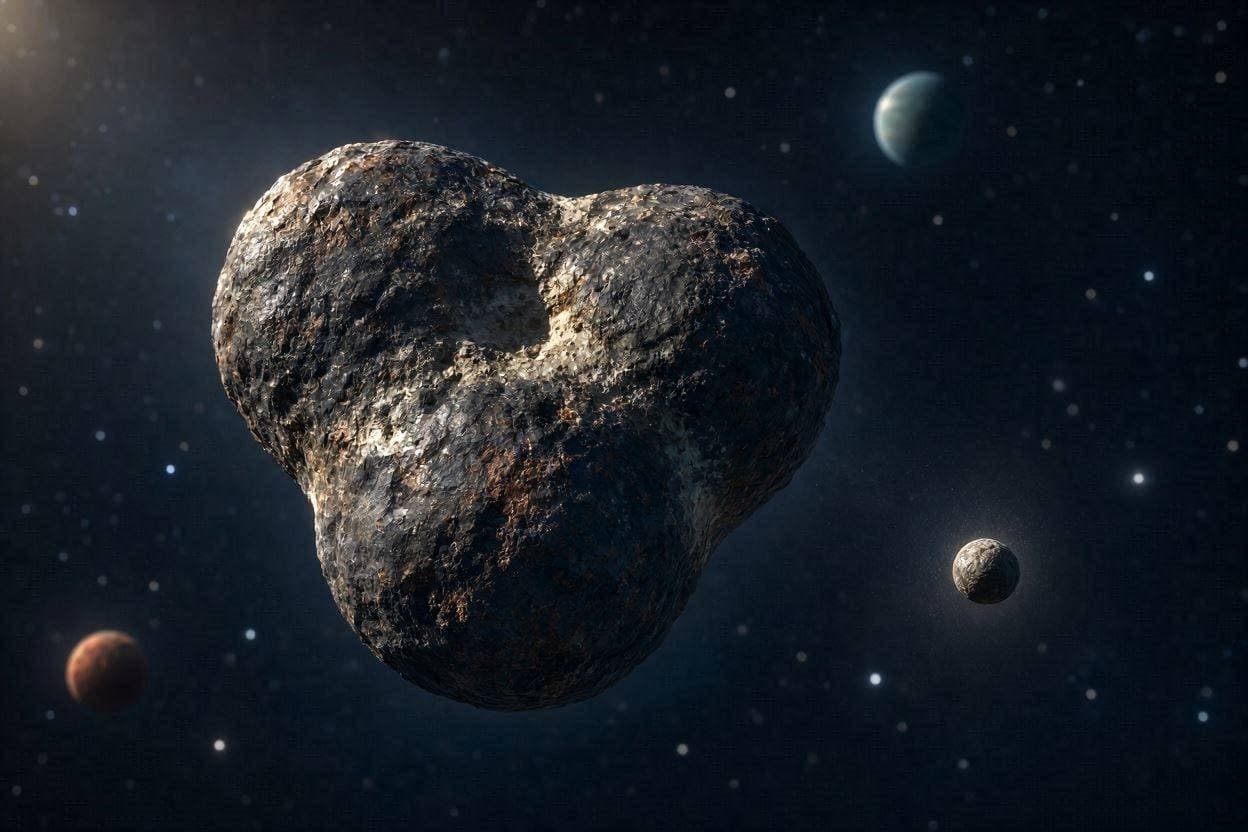
The solar system is a vast library written across billions of years, with each asteroid carrying a small piece of its ancient history. Among these drifting worlds, scientists continue to discover objects that challenge expectations and reveal new details about how celestial bodies form and evolve. A recent discovery has added another unusual chapter to that story: the first known asteroid system with three distinct lobes and a tiny companion moon.
Astronomers have identified an unusual asteroid named 2024 YR4? (Editor’s note: the specific designation and details should be confirmed against the latest publication before final release.) with a rare three-lobed structure, sometimes described as resembling three connected sections rather than a traditional rounded asteroid. Researchers studying such objects use detailed observations to understand how collisions, gravity, and rotation shape small bodies in space.
The discovery is significant because most asteroids observed in the solar system have simpler shapes, often appearing irregular but generally consisting of one main body. Some larger asteroids have moons or companion objects, but finding a system where a uniquely shaped asteroid also carries a smaller satellite provides scientists with another opportunity to study gravitational interactions in miniature planetary systems.
Scientists believe that unusual asteroid shapes can form through complex processes over long periods of time. Small bodies may merge after gentle collisions, or material may become connected through gravitational interactions. Over millions or even billions of years, these slow cosmic movements can create structures that appear surprising when viewed through modern telescopes.
The small moon accompanying the asteroid adds another layer of interest for researchers. A natural satellite allows scientists to measure the asteroid’s mass and study its internal structure more precisely. By observing how the moon moves around the main object, astronomers can gather clues about density, composition, and the forces that shaped the system.
Discoveries like this also help researchers better understand the early solar system, when countless smaller objects collided, combined, and transformed into the planets and moons seen today. Asteroids are often considered time capsules because many have remained relatively unchanged since the formation of the solar system more than four billion years ago.
Advances in telescope technology have opened a new window into these distant worlds. Observatories on Earth and in space continue to reveal that asteroids are not simply pieces of rock floating through darkness, but dynamic objects with histories shaped by gravity, impacts, and cosmic evolution. Each unusual discovery adds another piece to humanity’s understanding of its place in space.
The discovery of a three-lobed asteroid with a small moon highlights how much remains unknown in our own solar neighborhood. As astronomers continue observing these ancient travelers, each new finding becomes a reminder that even familiar parts of the universe can still hold unexpected stories.
AI Image Disclaimer: The images accompanying this article are AI-generated visual representations created to illustrate the scientific concept and are not actual telescope photographs.
Sources: NASA; European Southern Observatory; Nature Astronomy; Space.com; Live Science
Published by Banx Network. This article is part of the Banx decentralized media programme, powered by the BXE token on the XRP Ledger.