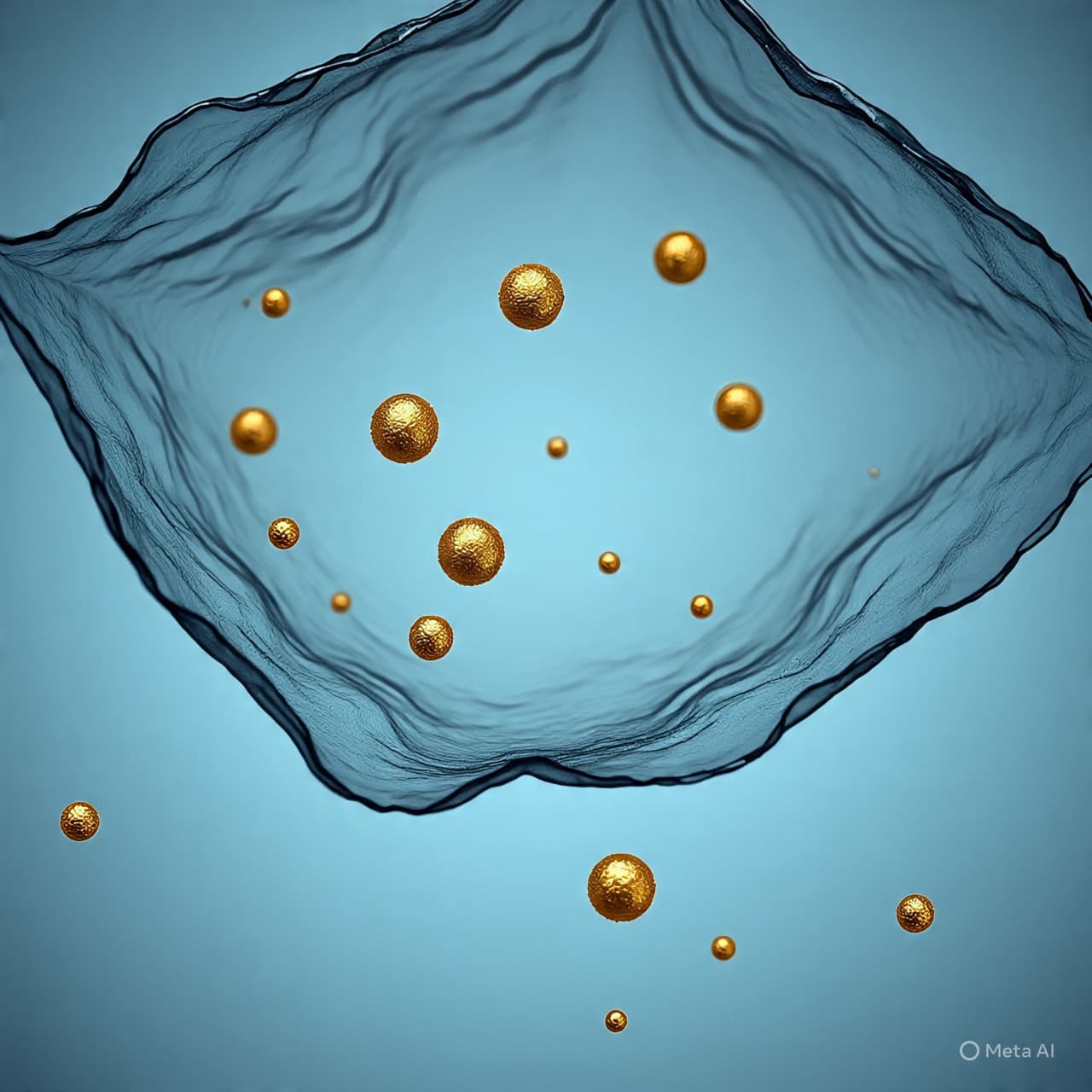
In the world of materials science, some of the most transformative changes occur at scales invisible to the eye. A single atomic layer, rearranged or subtly altered, can shift how a material conducts electricity or responds to light. Such is the case with graphene oxide — a derivative of graphene whose oxygen-bearing groups soften its conductivity but open pathways for chemical modification. When exposed to controlled heat or adorned with gold nanoparticles, this seemingly simple sheet of carbon begins to display a new vocabulary of optoelectronic behavior.
Graphene oxide is prized for its solution processability and tunable electronic structure. Unlike pristine graphene, which conducts electricity with remarkable efficiency, graphene oxide contains oxygen functional groups that disrupt its sp² carbon lattice. These disruptions reduce electrical conductivity but create opportunities: they allow researchers to engineer its properties through chemical reduction, doping, and nanoparticle decoration.
Thermal treatment plays a foundational role in this transformation. When graphene oxide is subjected to elevated temperatures, oxygen groups are partially removed in a process often referred to as thermal reduction. This restores segments of the conjugated carbon network, improving charge mobility and narrowing the material’s band gap. As conductivity rises, so too does its responsiveness to light-induced charge separation — a critical parameter in photodetectors and solar devices. Yet the process must be carefully calibrated: excessive heating can introduce structural defects, while insufficient reduction leaves electronic pathways fragmented.
The introduction of gold nanoparticles adds another dimension. At the nanoscale, gold behaves differently from its bulk counterpart. Gold nanoparticles exhibit localized surface plasmon resonance — collective oscillations of electrons that enhance local electromagnetic fields when illuminated by specific wavelengths of light. When dispersed across or embedded within graphene oxide, these nanoparticles can amplify light absorption and facilitate faster charge transfer between material interfaces.
The interaction is not merely additive; it is synergistic. Gold nanoparticles can serve as electron sinks, reducing recombination rates of photo-generated carriers within graphene oxide. This enhances photoconductivity and improves device efficiency in optoelectronic systems. In some experimental configurations, researchers have observed improved responsivity in photodetectors and greater stability in thin-film solar architectures when graphene oxide composites include gold nanostructures.
Thermal treatment and gold nanoparticle integration also influence structural morphology. Heat can increase surface roughness and restore conductive domains, while gold nanoparticles can create percolation networks that assist in electron transport. Together, these modifications tune optical absorption spectra, electrical conductivity, and charge mobility — properties essential for flexible electronics, biosensors, and next-generation transparent electrodes.
Importantly, the scale and distribution of gold nanoparticles matter. Uniform dispersion enhances optical coupling and electronic coherence, while aggregation can hinder performance. Advances in deposition techniques — including chemical reduction methods and sputtering — allow researchers to better control nanoparticle size and placement, refining optoelectronic outcomes.
Beyond performance metrics, these composite systems raise broader questions about material design. Graphene oxide, once seen as a compromised form of graphene, has emerged as a versatile platform precisely because of its modifiability. Heat acts as a sculptor, removing unwanted oxygen and restoring conductivity. Gold nanoparticles act as amplifiers, interacting with light and charge in ways that expand functionality.
Applications remain under active development. Flexible photodetectors, wearable sensors, and transparent conductive films stand among the most promising uses. Yet challenges persist, including long-term stability under repeated illumination and scalability for industrial production. As with many nanomaterials, laboratory promise must meet manufacturing reality.
Still, the narrative unfolding in research laboratories suggests something quietly profound: that a two-dimensional carbon sheet, altered by temperature and touched by nanoscale gold, can become more than the sum of its parts. In the interplay between heat, metal, and carbon, graphene oxide finds renewed electronic clarity — and in doing so, offers new possibilities for devices that respond to light with greater precision and efficiency.
AI Image Disclaimer Images in this article are AI-generated illustrations, meant for concept only.
Sources Nature Advanced Materials ACS Nano ScienceDirect IEEE Xplore
Published by Banx Network. This article is part of the Banx decentralized media programme, powered by the BXE token on the XRP Ledger.