For centuries, lightning has been a terrestrial drama — a sudden fracture of light, a crack of thunder rolling across valleys and oceans. On Earth, we know its signature well: the flash, the boom, the electrical discharge tearing through dense, moisture-laden air.
But on Mars, where the atmosphere is thin and dry, lightning has long remained uncertain — theorized, debated, searched for in radio silence.
Now, scientists report that a faint, high-frequency “whistling” signal consistent with electrical discharge has been detected on Mars for the first time.
Unlike Earth’s thunderclaps, this Martian lightning does not echo across thick clouds. Mars’ atmosphere is composed mostly of carbon dioxide and is less than one percent as dense as Earth’s. Traditional lightning bolts — the kind that illuminate towering storm clouds — would struggle to form in such sparse conditions. Yet Mars is no stranger to turbulence. Its vast dust storms can envelop the entire planet, lofting fine particles high into the sky.
Researchers have long suspected that within these swirling dust columns, static electricity could build up as grains collide and separate, much like rubbing a balloon against fabric. The friction can generate electrical fields strong enough to produce small discharges — not necessarily brilliant flashes visible from orbit, but subtle bursts of electromagnetic energy.
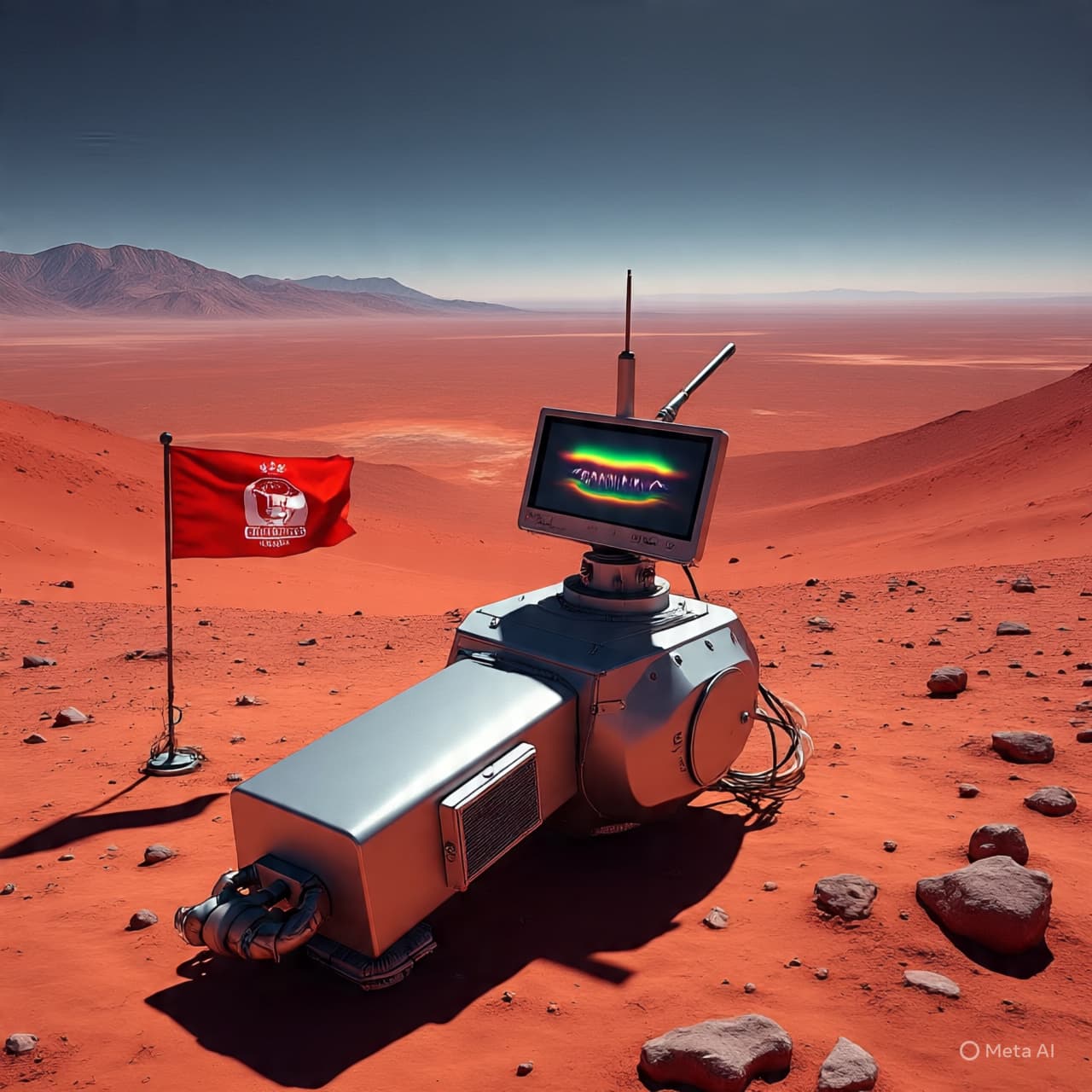
The newly reported “whistling” signal was captured by instruments designed to monitor atmospheric and magnetic activity. Rather than a visual flash, scientists observed a radio-frequency signature — a descending tone resembling a whistle when converted into audible sound. On Earth, similar radio signatures are associated with lightning-generated electromagnetic waves that travel along magnetic field lines.
Mars does not possess a global magnetic field like Earth’s. Instead, it has patchy, localized magnetic regions embedded in its crust — remnants of an ancient planetary dynamo that faded billions of years ago. These localized magnetic pockets may guide electromagnetic waves in distinctive ways, producing the whistling pattern detected by researchers.
The signal’s structure matches theoretical predictions for electrical discharge in Mars’ dusty environment. While the discharge likely occurred within a dust storm rather than a water-ice cloud, its detection marks the strongest evidence yet that lightning — or lightning-like electrostatic activity — does occur on the Red Planet.
This finding matters beyond novelty. Electrical discharges can influence atmospheric chemistry, breaking apart molecules and potentially contributing to the formation of reactive compounds. On early Earth, lightning is thought to have played a role in synthesizing complex organic molecules. While Mars today is cold and arid, understanding its electrical environment offers clues about both its present dynamics and its distant past.
The discovery was reported by planetary scientists analyzing atmospheric data from Mars missions equipped with sensitive electromagnetic instruments. Their findings add a new sensory dimension to our understanding of the planet: Mars is not only shaped by dust and wind, but also by electricity whispering through its thin sky.
There is something intimate in the idea. For decades, Mars has been photographed, mapped, drilled, and sampled. We have seen its canyons and polar caps, traced the dry beds of ancient rivers. Now, for the first time, we have effectively heard it — not in thunder, but in a faint electronic whistle carried across millions of kilometers.
In the vast quiet between worlds, even a small signal can feel profound. It suggests that Mars is not a static relic but a planet still alive with physical processes — dust rising, particles colliding, charge building invisibly until, briefly, it sings.
Visuals are AI-generated and serve as conceptual representations.
Sources (Media Names Only)
Nature Astronomy NASA European Space Agency Live Science New Scientist
Published by Banx Network. This article is part of the Banx decentralized media programme, powered by the BXE token on the XRP Ledger.