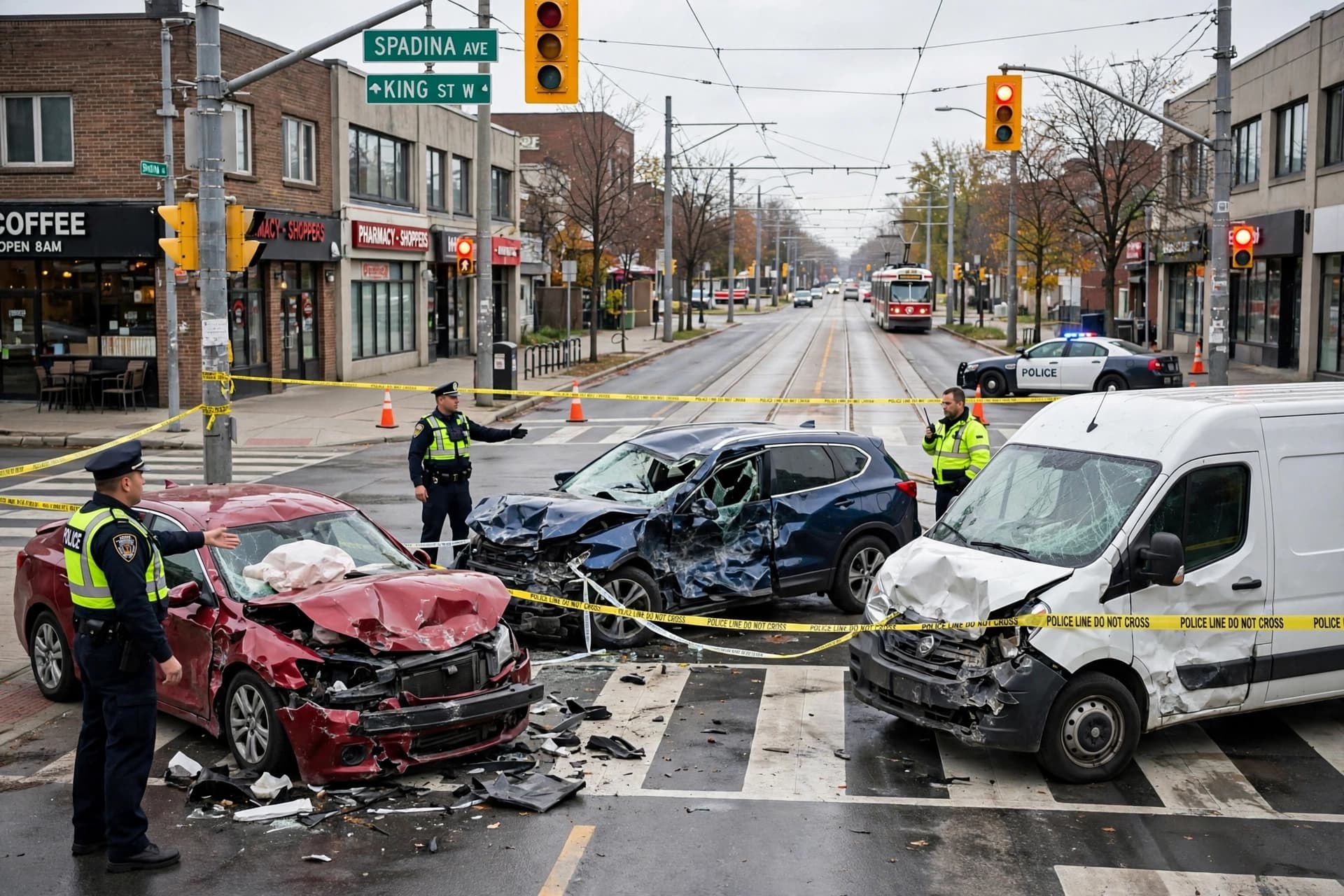
There is a particular weight that attaches to a charge when it is not the first. On Sunday morning, just before 10 a.m., Toronto police were called to the intersection of Windermere Avenue and The Queensway in the city's Swansea neighborhood, where three vehicles had collided. All drivers remained at the scene. One of them, a forty-year-old woman, was arrested for suspected impaired driving. She was taken to the hospital with non-life-threatening injuries. No one else was seriously hurt . It was, in the language of police reports, a straightforward case. But the details that emerged made it something more.
When the woman was taken into custody, her blood alcohol level was allegedly three times the legal limit. Police also said she has two previous impaired driving charges currently before the courts . The charges in this case have not been formally detailed by police, and the woman's name has not been released. The allegations have not been proven. But the fact of the prior charges, if confirmed, suggests a pattern that is difficult to ignore—a pattern that raises questions not only about the individual but about the systems meant to prevent repeat offenses.
The collision occurred at an intersection that is busy on a Sunday morning, a place where people are moving between home and errands, between the lake and the city. The road closures that followed were extensive: Windermere Avenue between Lake Shore Boulevard West and Windermere Place, and The Queensway between Southport Street and Coe Hill Drive . The closures lasted for hours, a disruption that rippled outward from the crash site, affecting people who had nothing to do with the collision and would never know its details.
There is a quiet irony in the fact that the driver was taken to the hospital. She was injured, though not seriously, and she received care. The other drivers remained at the scene, their Sunday morning interrupted by an event they did not cause. The police investigation continues, and the charges will proceed through the courts, where the presumption of innocence applies and the facts will be tested.
The prior charges, if they exist as police described, add a layer of complexity that the legal system will have to address. Impaired driving is a recurring offense, and the question of how to prevent repetition is one that courts, legislators, and communities have struggled with for decades. The answer is not simple, and this case does not offer one. It offers only a fact pattern: a woman, a crash, a blood alcohol level, and a history that police say includes two other pending cases.
The intersection of Windermere and The Queensway has reopened. The vehicles have been towed. The hospital has discharged its patient, or will soon. The ordinary life of the neighborhood has resumed, as it always does. But the case remains, a small entry in the record of a city that sees too many of these entries. The court date will come. The facts will be examined. And the question of what happens next—to the woman, to the other drivers, to the systems that are meant to catch such cases before they become crashes—will be answered in the slow, deliberate way that the law requires.
Image Disclaimer: This article's illustration was produced using AI generation tools and does not represent the actual crash or individuals involved.
Sources: CityNews Toronto, CP24, TorontoToday
Published by Banx Network. This article is part of the Banx decentralized media programme, powered by the BXE token on the XRP Ledger.