
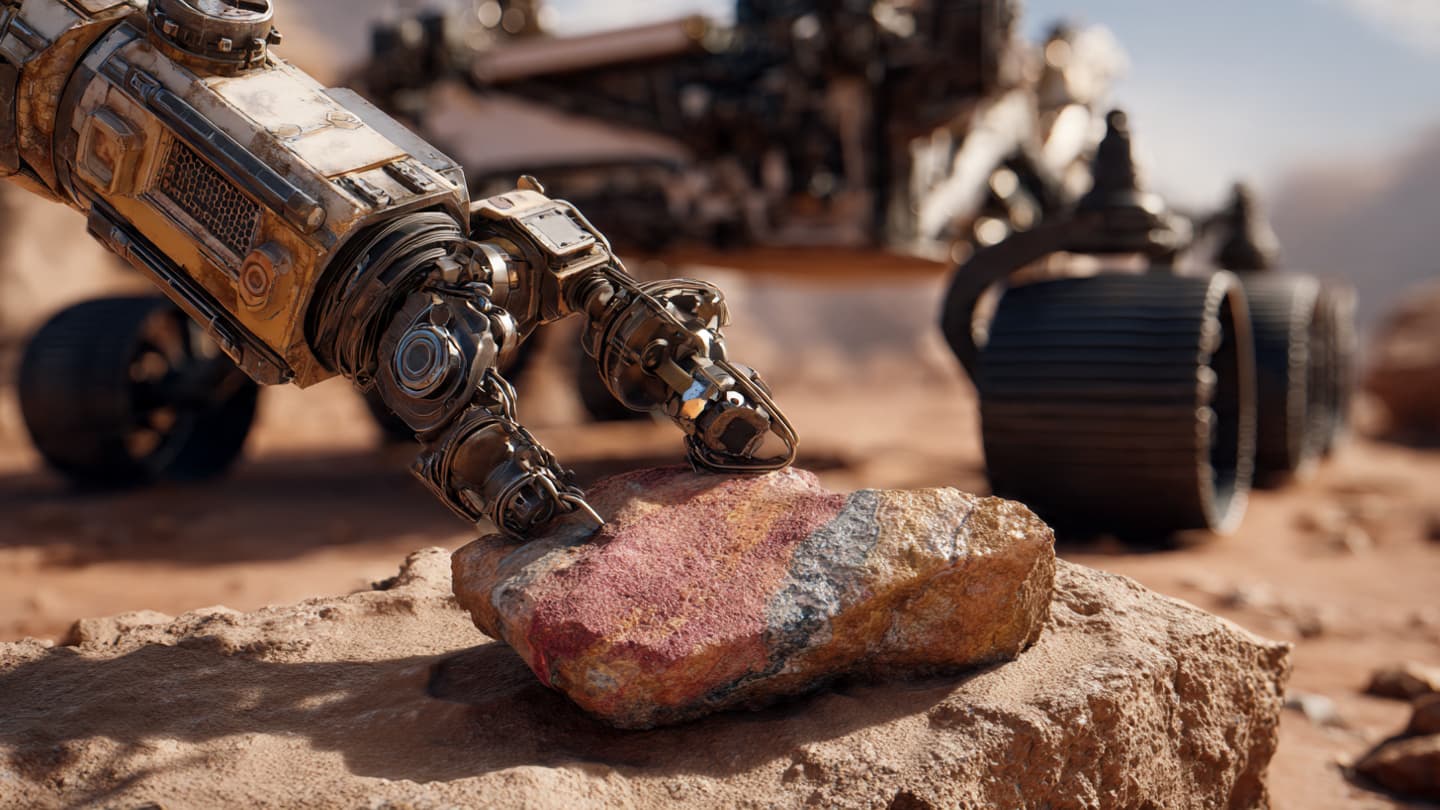
Mars continues to resemble a vast archive scattered beneath red dust and ancient winds. With every rover journey, another page appears to turn, revealing details about a world that once looked very different from the cold desert seen today. A newly identified rock type is now adding another chapter to that unfolding story.
Scientists studying Martian geology have reported evidence of an unusual rock formation that differs from previously documented materials on the planet. The discovery highlights the growing diversity of geological features being identified through rover exploration and orbital observations.
Mars rovers have spent years examining sedimentary, volcanic, and mineral-rich formations across different regions. Each new sample helps researchers reconstruct environmental conditions that existed billions of years ago when water played a more significant role on the planet's surface.
The newly identified rock type appears to possess characteristics that distinguish it from surrounding formations. Scientists are using spectroscopic analysis, imaging, and mineralogical studies to understand how it formed and what it reveals about Martian geological history.
Unexpected geological discoveries are not uncommon on Mars. Previous missions have identified minerals and rock compositions that challenged existing assumptions about the planet's volcanic and environmental past. Such findings often lead researchers to revise models of planetary evolution.
The significance of a new rock type extends beyond classification. Different rocks preserve records of temperature, water activity, chemical interactions, and environmental change. By examining their structure and composition, scientists can better understand processes that shaped the Martian landscape.
Researchers are also interested in whether unusual geological environments could have created conditions favorable to complex chemistry in Mars' distant past. While discoveries of new rocks do not indicate life, they often provide important context for broader astrobiological investigations.
Further analysis and future sample-return efforts may provide a more complete understanding of the newly identified material. Until then, the discovery stands as another reminder that Mars remains a dynamic scientific frontier with many unanswered questions.
AI Image Disclaimer: Visual elements accompanying this report were generated with AI for illustrative purposes and do not depict actual rover imagery.
Sources (verification check):
NASA Jet Propulsion Laboratory NASA Mars Mission Updates Live Science ScienceDaily
Published by Banx Network. This article is part of the Banx decentralized media programme, powered by the BXE token on the XRP Ledger.



