In the deep quiet between galaxies, light travels for unimaginable distances before it reaches a telescope on Earth. By the time that faint signal arrives, the event that produced it may have happened millions or even billions of years earlier. Astronomy often unfolds like this—an investigation carried out across time itself, where each flash of light becomes a clue about how the universe works.
Recently, astronomers studying a distant stellar explosion encountered a signal that did not behave as expected. The event appeared to be a supernova, the brilliant end-of-life explosion of a star. But its brightness and evolution did not match the familiar patterns that astronomers rely on to measure cosmic distances. Instead, the explosion showed unusual characteristics that suggest something more complex may be unfolding within the dying star.
The discovery has drawn attention because supernovae play a quiet but essential role in one of the biggest mysteries in modern cosmology: the expansion of the universe.
For decades, astronomers have used a particular type of stellar explosion—known as Type Ia supernovae—as cosmic measuring tools. These explosions typically reach nearly the same intrinsic brightness, allowing scientists to estimate how far away they are by comparing their true luminosity with how bright they appear from Earth. In the late 1990s, observations of these supernovae revealed that distant galaxies were moving away from us faster than expected, a discovery that led researchers to conclude that an unknown force, now called dark energy, is accelerating the expansion of the universe.
The relationship between cosmic distance and expansion can be expressed through a fundamental cosmological relation:
v = H_0 d
In this equation, the recession velocity of a galaxy grows in proportion to its distance, a principle that forms the foundation of modern cosmology. Observations of supernovae help refine this relationship by providing accurate measurements of those distances across vast regions of space.
The newly observed supernova, however, appears to challenge the tidy assumptions behind these measurements. Its brightness pattern evolved differently from standard Type Ia explosions, suggesting that the internal physics of the event may be more complicated than previously thought. Some astronomers suspect that the explosion may involve an unusual stellar system—perhaps two white dwarf stars merging in an uncommon configuration, or a thermonuclear reaction unfolding in stages rather than all at once.
If confirmed, such variations could help explain subtle inconsistencies that have appeared in recent measurements of cosmic expansion. Different techniques used to estimate the universe’s expansion rate—one based on nearby supernovae and another derived from observations of the early universe—have produced slightly conflicting results, a puzzle sometimes referred to as the “Hubble tension.”
Unusual supernovae like this one may help researchers understand whether hidden variations in stellar explosions are affecting the cosmic distance scale. By studying how these rare events differ from the standard models, astronomers can refine the tools used to map the universe.
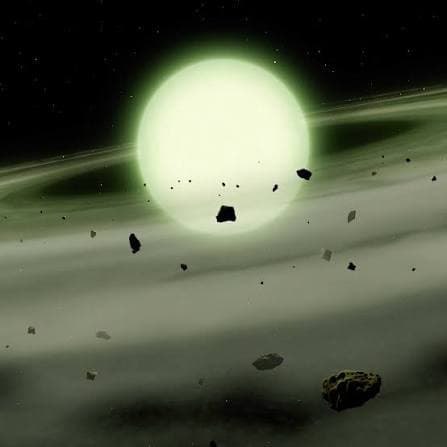
The discovery also highlights how much remains unknown about the stars themselves. White dwarfs, the dense remnants left behind after Sun-like stars exhaust their fuel, are typically stable for billions of years. Yet when they interact with nearby stars or merge with another white dwarf, the resulting instability can trigger explosions powerful enough to outshine entire galaxies for a brief moment.
Each such explosion leaves behind more than expanding clouds of gas. It leaves a record—light curves, spectral fingerprints, and patterns of brightness that astronomers analyze carefully to reconstruct the event.
In this case, the record appears unusual enough to attract continued attention from observatories around the world. Follow-up observations are now underway to determine exactly what mechanism produced the explosion and whether it represents a new class of supernova.
The implications extend beyond the death of a single star. If the physics of these explosions proves more diverse than previously assumed, astronomers may gain new insight into the cosmic measurements that underpin modern cosmology.
For now, the strange supernova remains a distant flash in the darkness—one more signal arriving after a long journey across space. Yet within that brief burst of light may lie a deeper understanding of the force that shapes the universe itself.
Published by Banx Network. This article is part of the Banx decentralized media programme, powered by the BXE token on the XRP Ledger.