There is a moment in every friendship when the question arises: what do we owe each other? In the human world, this question is answered through a thousand small courtesies, a thousand unspoken expectations. In the world of chimpanzees, it appears, the question is answered through pineapple. A new study from UC Berkeley has found that chimpanzees steal less from their friends than from non-friends, and that the emotional responses of both thief and victim vary depending on the depth of their bond.
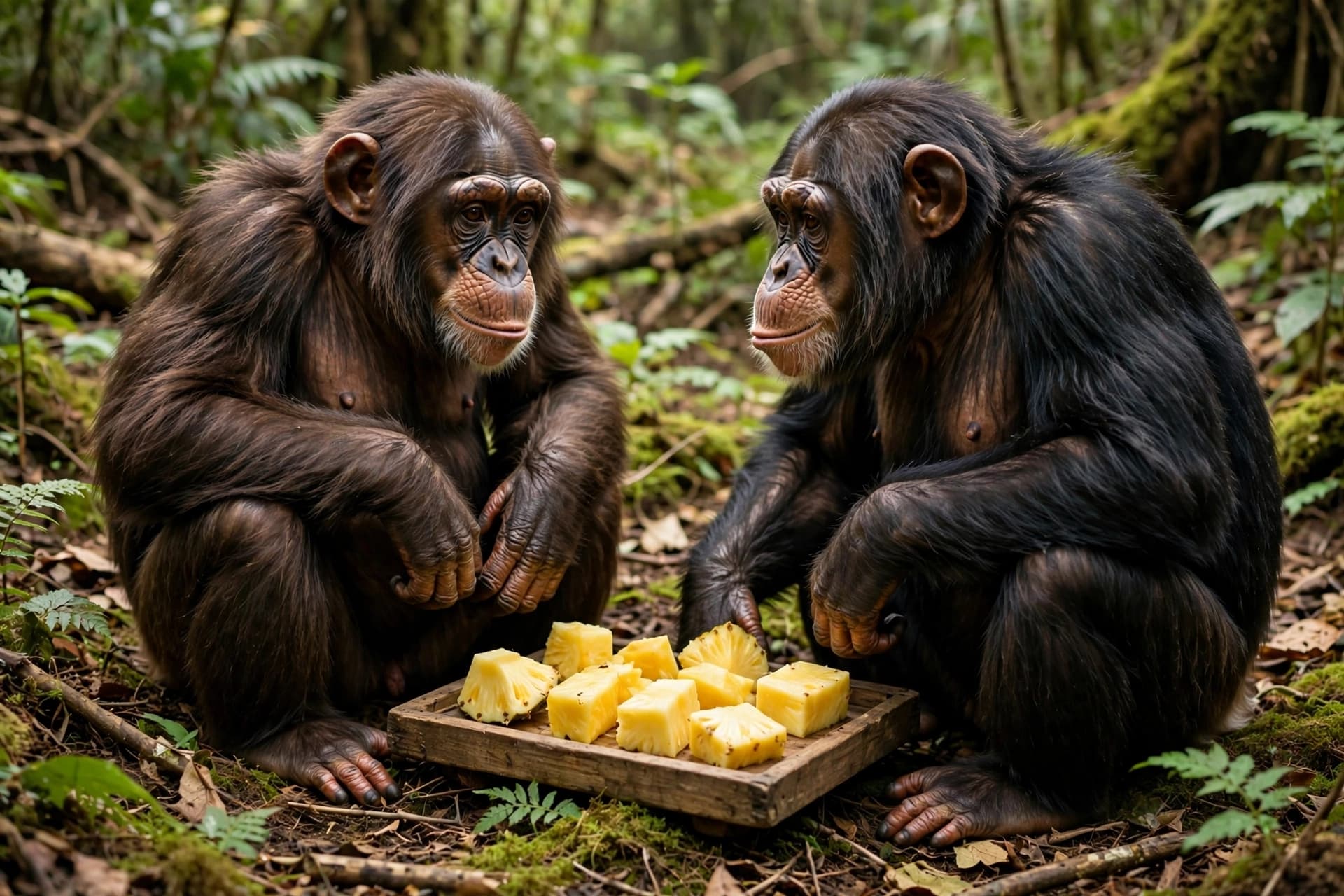
The research, published in the November issue of Evolution and Human Behavior, observed 26 chimpanzees over more than 800 hours at the Ngamba Island Chimpanzee Sanctuary in Uganda . Researchers documented grooming patterns, daily interactions, and physical proximity to identify which chimpanzees were closely bonded—like friends—and which were not. They then designed an experiment in which one chimpanzee, the thief, could pull a rope to steal a tray of pineapple pieces from another chimpanzee, the victim.
The results were subtle but revealing. Chimpanzees stole in 70 percent of trials when the victim was a non-friend, compared with 61 percent of trials when the victim was a friend . The difference of nine percentage points may seem modest, but because each chimpanzee experienced both conditions, the researchers could be confident the difference was meaningful rather than random. As lead author Oded Ritov noted, this is the first study to show that chimpanzees are able to hold back antisocial behavior with their friends .
The emotional responses told an even richer story. When friends stole from them, victims initially expressed more anger than when non-friends stole from them—but they calmed down more quickly . The thieves themselves showed less hostility when stealing from a friend, suggesting they viewed the interaction as less confrontational. The pattern points to something deeper than simple tolerance. It suggests that chimpanzees hold expectations about how friends should behave, and that violations of those expectations carry emotional weight.
Jan Engelmann, a senior author of the paper, explained that while previous research has shown that nonhuman primates act differently toward specific partners, human friendships involve stronger expectations. We expect more of our friends, he said, and these findings deepen understanding of the evolutionary roots of friendship . The study offers the first evidence that chimpanzees also expect and perhaps demand special treatment from their friends—social expectations that might form the basis of human moral principles.
Ritov, a Berkeley psychology Ph.D. student, framed the work in broader terms. Collaborative relationships are important for well-being, health, and survival, he said, and increasingly researchers understand that this is not unique to humans . The expectations chimpanzees have from their friends or close partners might have scaled up, over evolutionary time, to the generalized expectations humans hold for how we should treat each other.
The study adds to a growing body of research suggesting that the emotional architecture of friendship—the trust, the restraint, the quiet accounting of mutual obligation—has deep roots in the primate lineage. The pineapple, in this case, was merely the medium. What was being measured was something older and more familiar: the expectation that those we care about will treat us differently than strangers would.
---
AI Image Disclaimer: All images accompanying this report are AI-generated and do not depict actual animals or events.
Sources: UC Berkeley, Evolution and Human Behavior, ScienceDirect, University of Portsmouth
Published by Banx Network. This article is part of the Banx decentralized media programme, powered by the BXE token on the XRP Ledger.