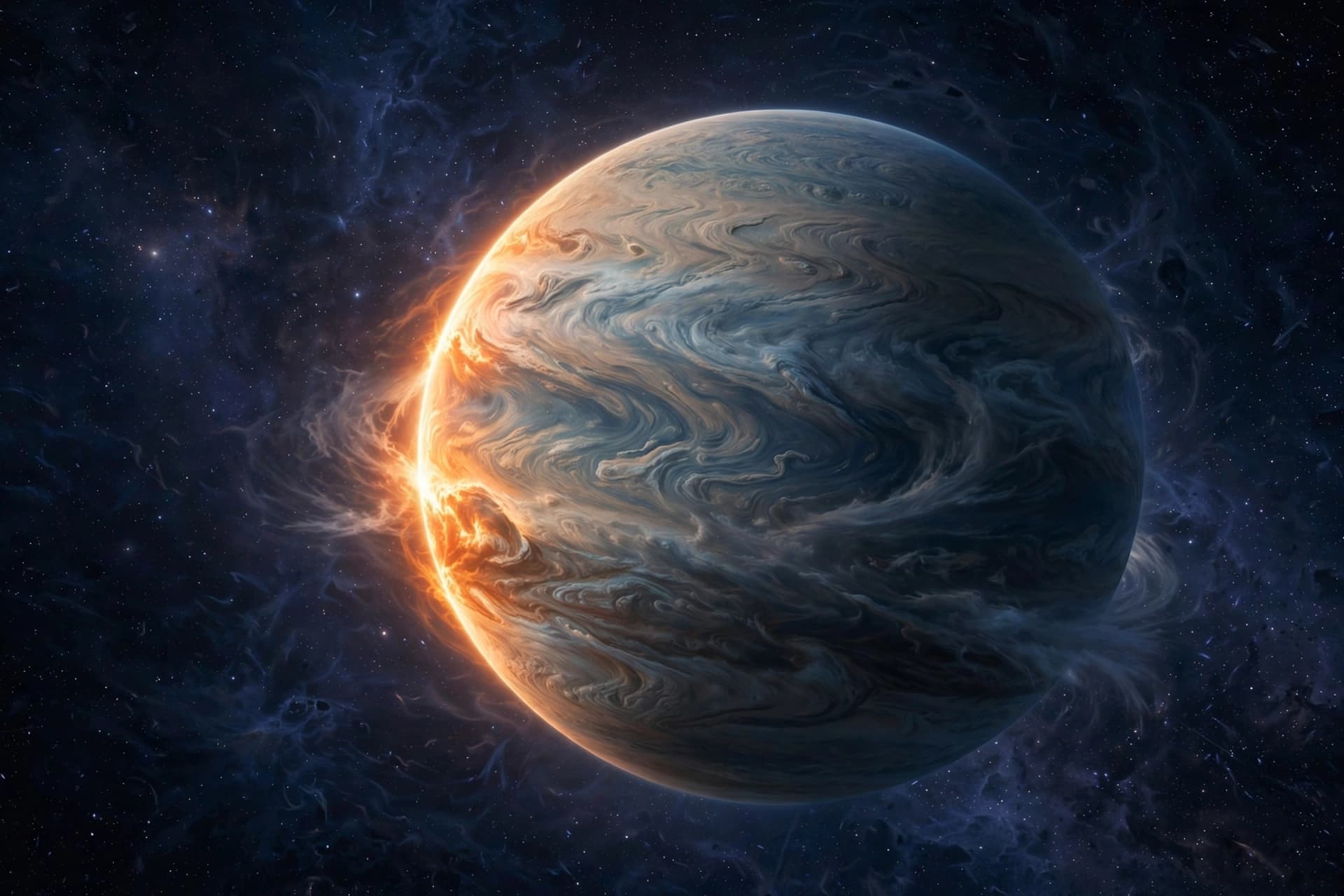
For generations, astronomy has offered a reassuring narrative about how worlds are born. In vast disks of gas and dust circling young stars, heavier elements drift inward, lighter materials remain farther out, and over time planets assemble in a pattern that feels almost orderly. Rocky worlds close to their suns. Gas giants beyond. Ice farther still. A cosmic architecture repeated often enough to feel like a rule.
Yet space, as ever, keeps its right to surprise.
A satellite operated by the has identified what researchers describe as an “inside-out” planetary system — one in which the expected order appears reversed. In this distant system, giant planets orbit remarkably close to their host star, while smaller, denser worlds lie farther away, defying conventional formation models.
The discovery was made using precision observational data gathered by ESA’s exoplanet-hunting mission, designed to track the subtle dimming of starlight as planets pass in front of their stars. By carefully analyzing orbital periods, planetary sizes, and mass estimates, astronomers concluded that the system’s layout does not align neatly with established theories of planetary formation.
Under prevailing models, gas giants typically form in colder outer regions of a protoplanetary disk, where abundant icy material helps them accumulate massive atmospheres. Rocky planets, meanwhile, tend to emerge closer to the star, where temperatures are higher and lighter gases dissipate. While migration over time can shuffle planets inward or outward, the newly observed configuration suggests a more complex and perhaps less predictable evolutionary path.
Researchers caution that the term “inside-out” does not imply chaos, but rather an alternative history. It may indicate that the giant planets formed farther out before migrating dramatically inward, reshaping the system’s structure as they moved. Alternatively, variations in disk chemistry, temperature gradients, or early gravitational interactions may have produced conditions unlike those seen in our own solar system.
The finding contributes to a growing body of evidence that planetary systems are more diverse than once assumed. Since the first confirmed exoplanet discoveries in the 1990s, astronomers have catalogued thousands of distant worlds — hot Jupiters skimming their stars, super-Earths in tight orbits, and multi-planet systems arranged in surprising resonances. Each discovery gently erodes the idea that our solar system is the standard template.
For theorists, such anomalies are not setbacks but invitations. Models must now account for a broader spectrum of outcomes, incorporating dynamic migration scenarios and more nuanced interactions within early stellar disks. In this sense, the “inside-out” system becomes less an exception and more a reminder of nature’s flexibility.
The ESA mission responsible for the discovery continues to scan distant stars, searching for further patterns — or further departures from them. As data accumulates, astronomers refine simulations and reconsider long-held assumptions about how dust becomes planet and orbit becomes order.
In the grand chronology of the universe, planetary systems are still revealing their secrets. This latest discovery does not overturn the foundations of astrophysics, but it does widen the lens. It suggests that formation is not a single script, but a collection of possibilities — some orderly, some surprising, all written in the language of gravity and time.
For now, the newly identified system stands as a quiet testament to cosmic diversity. In the darkness beyond our own orbit, worlds continue to assemble in ways that challenge expectation, inviting science to look again — and think again — about how planets come to be.
AI Image Disclaimer Images in this article are AI-generated illustrations, meant for concept only.
Sources European Space Agency (ESA) BBC Science Reuters Space.com Nature Astronomy
Published by Banx Network. This article is part of the Banx decentralized media programme, powered by the BXE token on the XRP Ledger.