There is a particular wonder in discovering that the universe repeats its patterns across scales so vast they defy intuition—that the same physics that drives a storm on the surface of our sun might also drive an eruption near a black hole millions of times more massive. For the first time, researchers have seen that repetition, and it suggests that the machinery of magnetic energy is more universal than we knew.
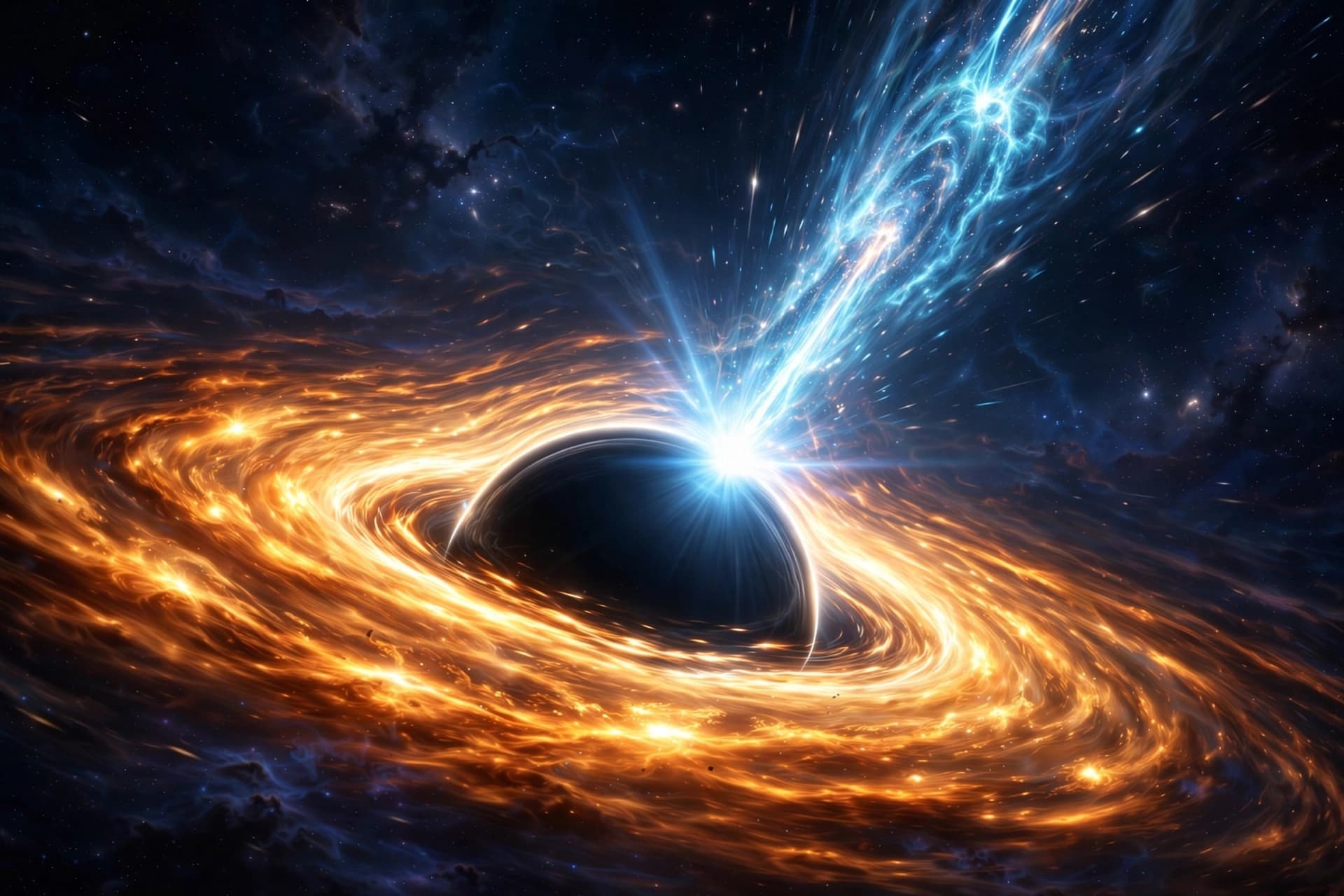
An international team of researchers has discovered eruptions similar to solar storms near a giant black hole in the galaxy NGC 3783, according to a study published in the Astrophysical Journal Letters . The Israel Institute of Technology (Technion) announced the finding Sunday, describing it as the first evidence that the physical processes driving solar storms can also occur near supermassive black holes . The black hole in question has a mass roughly 30 million times that of the sun .
Solar storms occur when energy stored in magnetic fields is suddenly released, producing bursts of radiation and streams of charged particles. The researchers analyzed X-ray emissions from the region around the black hole using the XRISM and XMM-Newton space telescopes, tracking changes in radiation over a ten-day observation . They identified a pattern known as the "Neupert effect," first discovered on the sun in 1968 but never previously observed near a black hole .
The sequence was striking. The black hole first emitted a bright X-ray flare, which rose and faded quickly. Shortly after the flare weakened, instruments captured an extremely fast outflow of gas—material accelerated to speeds reaching 60,000 kilometers per second, or about 20 percent of the speed of light . This is the first time astronomers have clearly linked a short X-ray flare to a subsequent ultrafast wind, according to SRON, the Dutch space research institute that led the study .
The mechanism appears to be magnetic reconnection—a sudden reconfiguration of magnetic fields that releases enormous energy. This is the same process that triggers coronal mass ejections on the sun, when large blobs of hot plasma are hurled into space . The black hole's version is billions of times more powerful, dwarfing anything the sun can produce. "The data suggest that the acceleration of the outflow is driven by magnetic forces, similar to coronal mass ejections from the Sun," said Liyi Gu, lead author of the study .
The finding carries implications beyond the exotic. Such high-speed winds from active galactic nuclei may play a key role in how galaxies grow and change, influencing the stars and gas around the black hole and helping shape the universe we see today . The winds can blow cold gas away from galactic centers, suppressing new star formation and redistributing material on vast scales.
What makes this discovery particularly satisfying is its resolution of a long-standing question. Black holes are known to flicker in X-rays, and theorists have predicted that magnetic processes should operate in their accretion disks. But until now, no one had observed the full chain—flare, then wind—in a single event. The ten-day continuous observation with XRISM, supported by XMM-Newton and a fleet of other space missions, provided that window .
The universe, it seems, has a limited repertoire of tricks. It uses them at every scale, from the star we can see with our eyes to the gravitational monsters at the hearts of galaxies. The discovery is not merely that black holes can mimic the sun, but that the sun's physics is not uniquely solar—it is cosmic, written into the fabric of magnetic fields wherever they exist.
AI Image Disclaimer: The visuals in this report were produced using artificial intelligence and serve an illustrative purpose only.
Sources: Xinhua, Technion (Israel Institute of Technology), SRON, The Astrophysical Journal Letters
Published by Banx Network. This article is part of the Banx decentralized media programme, powered by the BXE token on the XRP Ledger.